The Grainstacks in Haystacks Series by Claude Monet | Light, Time & Atmosphere
A closer look at this element in Claude Monet's masterpiece
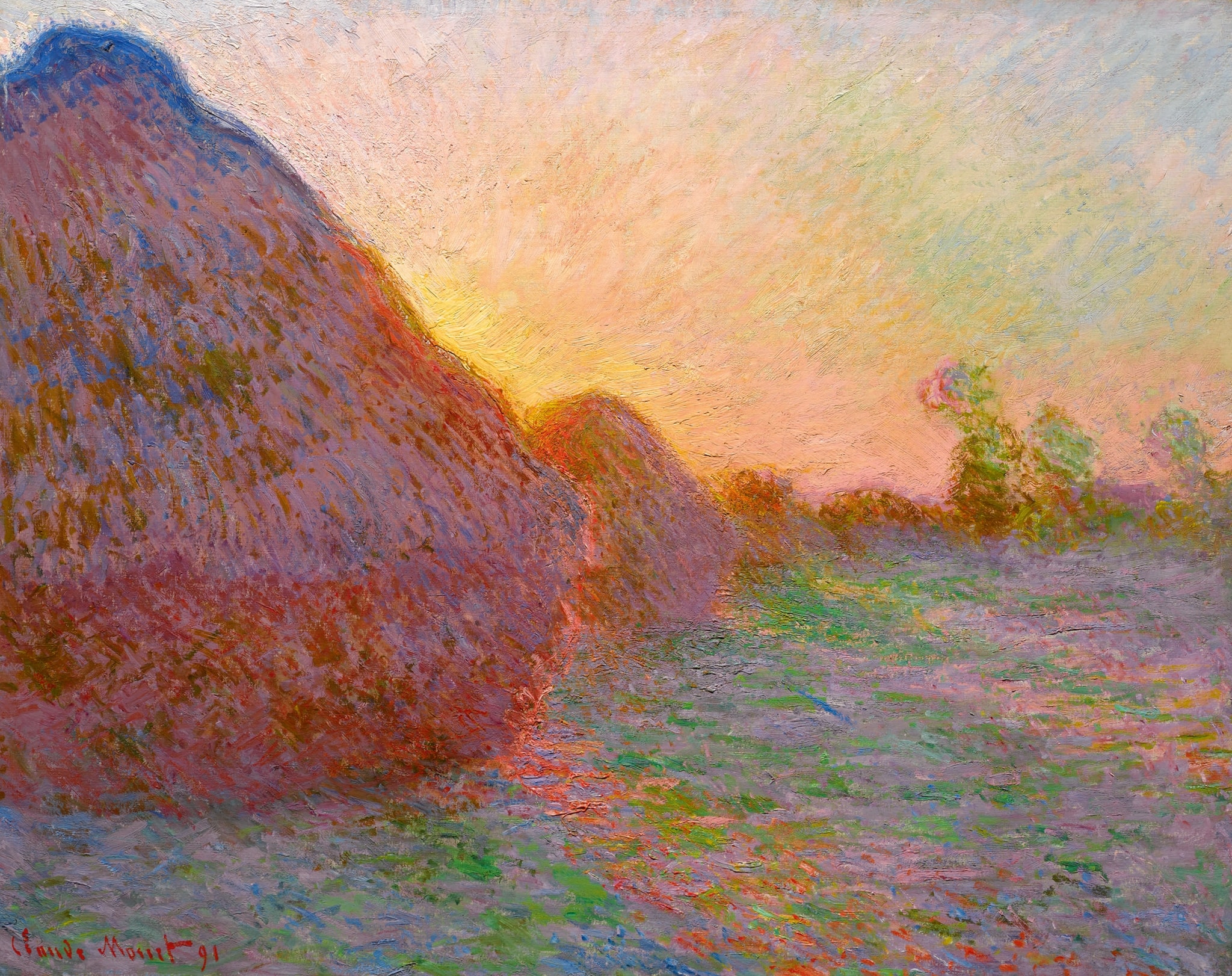
Monet’s grainstacks—the monumental, conical piles of unthreshed grain—anchor the Haystacks/Grainstacks (Meules) series. Placed left and center, they become fixed beacons against which sunrise, snow, mist, and twilight unfold, turning ordinary rural structures into a laboratory for seeing light, time, and atmosphere.
Historical Context
After moving to Giverny in 1883, Monet sought motifs he could revisit daily to pursue a rigorous study of changing light and weather. In 1890–91 he produced roughly twenty‑five canvases of grainstacks viewed from late summer through winter, often working outdoors on several pictures at once and refining them in the studio 12. These conical stacks stood in fields immediately west of his house, allowing him to return at precise hours and under specific conditions to register chromatic shifts as the sun rose, set, or vanished behind cloud and frost 12.
In May 1891, fifteen Grainstacks were exhibited together at Durand‑Ruel in Paris—the first time Monet publicly presented a series as an integrated set. Viewers encountered variations orchestrated by season, hour, and viewing angle rather than narrative incident, a curatorial and artistic strategy that made the recurring left‑and‑center stacks the series’ steadfast protagonists 12.
Symbolic Meaning
For contemporary audiences, the grainstack was more than a convenient rural form. It signified agricultural fertility, prosperity, and the cyclical health of the land—associations deeply rooted in French landscape culture and readily legible to Monet’s 1890s viewers 4. By choosing grainstacks rather than picturesque ruins or grand monuments, Monet fused avant‑garde optical inquiry with a motif embedded in communal life, linking formal experiment to shared agrarian meaning 24.
Critics and later scholars have also read the stacks as emblems of endurance. Richard Brettell argued that, when seen across seasons from harvest warmth to “the most difficult and frigid weather,” the sequence becomes an apotheosis of steadfastness—forms that persist while everything around them changes 3. Monet himself described racing the setting sun and “struggling with a series of different effects,” framing the grainstack as a constant against which time is measured 1. Thus the motif operates on two symbolic registers at once: material abundance and temporal resilience. In Monet’s hands, the humble stack becomes a metric of duration and a vessel for light, where national rural identity, seasonal labor, and modern perception converge 134.
Artistic Technique
Monet pursued a serial method—rotating among canvases as light shifted, then making calculated studio revisions. Technical studies document compositional adjustments (including moving a stack within the field), pentimenti, and layered repainting that fine‑tune each effect 2. Surface handling varies dramatically: some versions set thick impasto against thin, fluid passages; others keep a flatter, brush‑marked skin to let color vibration carry form 2.
Color structure pivots on complementary contrasts—especially orange and blue—used to turn the stacks’ volumes and cast long shadows in snow, sunset, or mist. The dominant left and center stacks often silhouette against cool grounds, their warm raking light intensified by adjacent cools, while blue‑violet contours lock forms to the sky and field 56.
Connection to the Whole
Within the Haystacks/Grainstacks series, the stacks at left and center function as the anchor of perception: a fixed motif around which Monet orchestrates hour, season, and weather. The 1891 Durand‑Ruel display—fifteen canvases seen together—invited viewers to “read” time chromatically, moving from late summer to deep winter as the same forms absorb changing atmosphere 13.
Brettell’s reconstruction shows how Monet balanced canvases by shifting the stack’s placement (left, center, right) and keying light from mist to blazing sun, creating a theme‑and‑variations structure across the room 3. Seen this way, each painting is complete, but the meaning flowers in sequence: constancy of form, mutability of seeing. The left‑and‑center stacks hold the ensemble steady so that color, not narrative, becomes the series’ engine of meaning 123.
Explore More from This Painting
This detail is one part of Haystacks Series by Claude Monet | Light, Time & Atmosphere. Use the links below to return to the full interpretation, browse the full set of details, or view the painting's valuation if available.
Sources
- The Met, Haystacks (Effect of Snow and Sun), 1891 – object page and exhibition notes
- Art Institute of Chicago, Online Scholarly Catalogue: Cats. 27–33. Stacks of Wheat, 1890/91 – series overview and technique
- Richard R. Brettell, “Monet’s Haystacks Reconsidered,” Art Institute of Chicago Museum Studies 11, no. 1 (1984)
- MFA Boston, Grainstack (Sunset) – symbolism and object history
- National Galleries of Scotland, Grainstacks: Snow Effect – color contrasts, site, and practice
- Art Institute of Chicago, Stack of Wheat – scale (15–20 ft) and symbolic resonance