The Setting Sun in Haystacks Series by Claude Monet | Light, Time & Atmosphere
A closer look at this element in Claude Monet's masterpiece
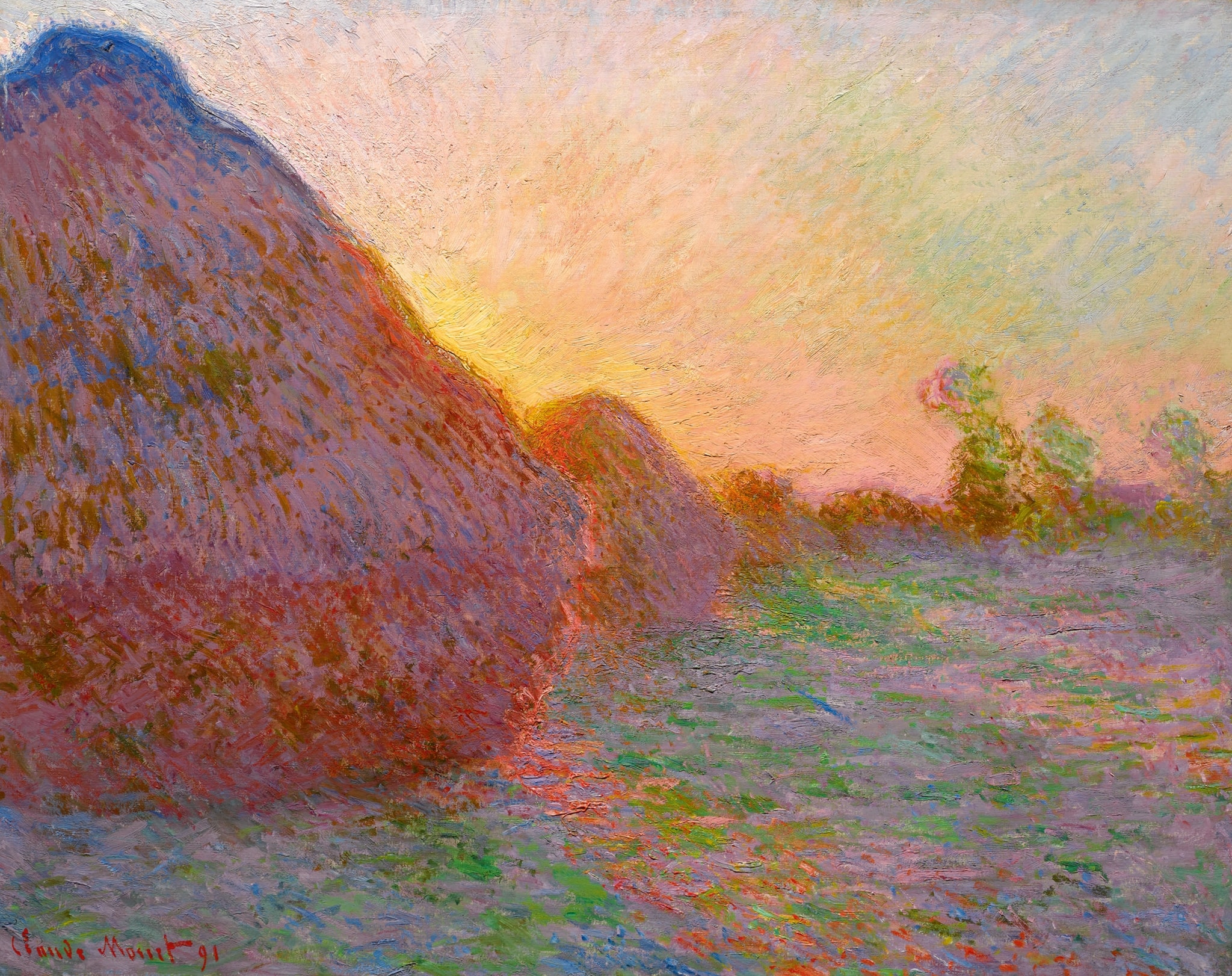
In Monet’s Haystacks, the setting sun is both the light source and the subject: a brief, blazing descent that floods field and snow with volatile color. By pinning a low, glowing disk to the horizon, Monet turns rural stacks into instruments for measuring how time and atmosphere remake the visible world.
Historical Context
Monet developed his Haystacks at Giverny in the winter of 1890–91, painting the same rural motif under changing conditions to test how light, season, and hour alter perception. Sunset became a crucial "effect" precisely because of its speed; writing on October 7, 1890, Monet confessed that "the sun sets so fast I cannot follow it," a remark museums have used to anchor the chronology and intent of the series 1. The setting sun thus functioned as both motif and method—forcing rapid on-site notations that he later refined in the studio.
In May 1891, Monet exhibited fifteen Haystacks together at Durand‑Ruel, the first time he framed a body of work explicitly as a series. Viewers encountered canvases keyed to specific effects—frost, thaw, morning, and sunset—inviting comparison across time. The Art Institute’s scholarly catalog groups the variant with the sun low between two stacks as “Sunset, Snow Effect,” and documents how Monet reworked contours and harmonies across multiple sessions to calibrate that fleeting light rather than to record a single instant 2. The Met’s entry likewise links the sunset theme to the show’s critical success and Monet’s stated pursuit of rapidly changing light 1.
Symbolic Meaning
Within nineteenth‑century landscape painting, sunset traditionally signals transition and closure—the world visibly moving toward an end. That cultural code heightens the drama of Monet’s evening Haystacks: the sun slips behind the fields even as the stacks hold their form, staging a dialogue between permanence and flux. Museum writing on twilight underscores this symbolism of endings and ephemerality, which Monet converts into a visual premise for the series itself 7.
The agrarian motif adds another layer. Grainstacks near Giverny embodied local prosperity and the fertility of the land; setting the sun over these mounded reserves can be read as the day’s—and season’s—close within a productive rural cycle, aligning natural rhythms with human labor and stored bounty 3. At the same time, scholars connect Impressionist “instants” to a modern, industrialized sense of measured time. In Haystacks the setting sun sharpens that modern time-consciousness: its rapid change exposes the limits of direct notation and the necessity of constructed effects. Contemporary criticism even praised the series as a “synthetic summary” of the elements—an artful distillation of weather and light—placing the sunset variants at the heart of Monet’s inquiry into how time structures seeing 65.
Artistic Technique
In the “Sunset, Snow Effect” variant, Monet positions the low solar disk between adjacent stacks, concentrating the canvas’s highest chroma at the horizon and letting warmth radiate across chilled snow. He exploits complementary contrasts—orange and rose afterglow against blue‑violet shadows—to make the light feel incandescent while the ground remains cool, a twilight pairing noted in museum discussions of the series 24. Broken, layered strokes knit these complements into a vibrating envelope of color; technical study shows he adjusted stack silhouettes and horizon lines over multiple sessions to tune the harmony, not to record a single instant 2. The volatile edge where sun meets stack becomes the fulcrum of the composition, translating the physical glare of dusk into pulses of paint that the eye reassembles as atmosphere 1.
Connection to the Whole
Sunset serves as a keystone effect within Haystacks’ comparative logic. Placed alongside canvases of morning frost, thaw, or bright noon, the evening versions clarify Monet’s claim that time and atmosphere—not the stacks themselves—are the true subject. The Art Institute argues that, despite titles inviting a clock‑like reading, these works are carefully constructed harmonies rather than minute‑by‑minute records; sunset functions less as timestamp than as a calibrated sensation within the set 2. The Durand‑Ruel display of 1891 made that structure legible: fifteen canvases orchestrated around changing light, with the setting sun marking one extreme of appearance and mood. Seen this way, the glowing horizon is the series’ comparative anchor—an ending that illuminates everything that precedes it 12.
Explore More from This Painting
This detail is one part of Haystacks Series by Claude Monet | Light, Time & Atmosphere. Use the links below to return to the full interpretation, browse the full set of details, or view the painting's valuation if available.
Sources
- The Metropolitan Museum of Art, Haystacks (Effect of Snow and Sun), object entry quoting Monet’s 1890 letter and discussing the 1891 exhibition
- Art Institute of Chicago, Online Scholarly Catalogues: Stacks of Wheat, 1890/91 (including “Sunset, Snow Effect,” technical and interpretive essays)
- Museum of Fine Arts, Boston, Grainstack (Sunset), object page on symbolism and series context
- National Galleries of Scotland, Haystacks: Snow Effect, note on complementary orange/blue in snow and shadows
- Richard R. Brettell, "Monet’s Haystacks Reconsidered," Art Institute of Chicago Museum Studies 11, no. 1 (1984)
- Institute for Advanced Study, "Painting Time: Impressionism and the Modern Temporal Order"
- Cleveland Museum of Art, "Twilight in the Wilderness" essay on sunset as a transitional ending in 19th‑century landscape