The Violet Shadows in Haystacks Series by Claude Monet | Light, Time & Atmosphere
A closer look at this element in Claude Monet's masterpiece
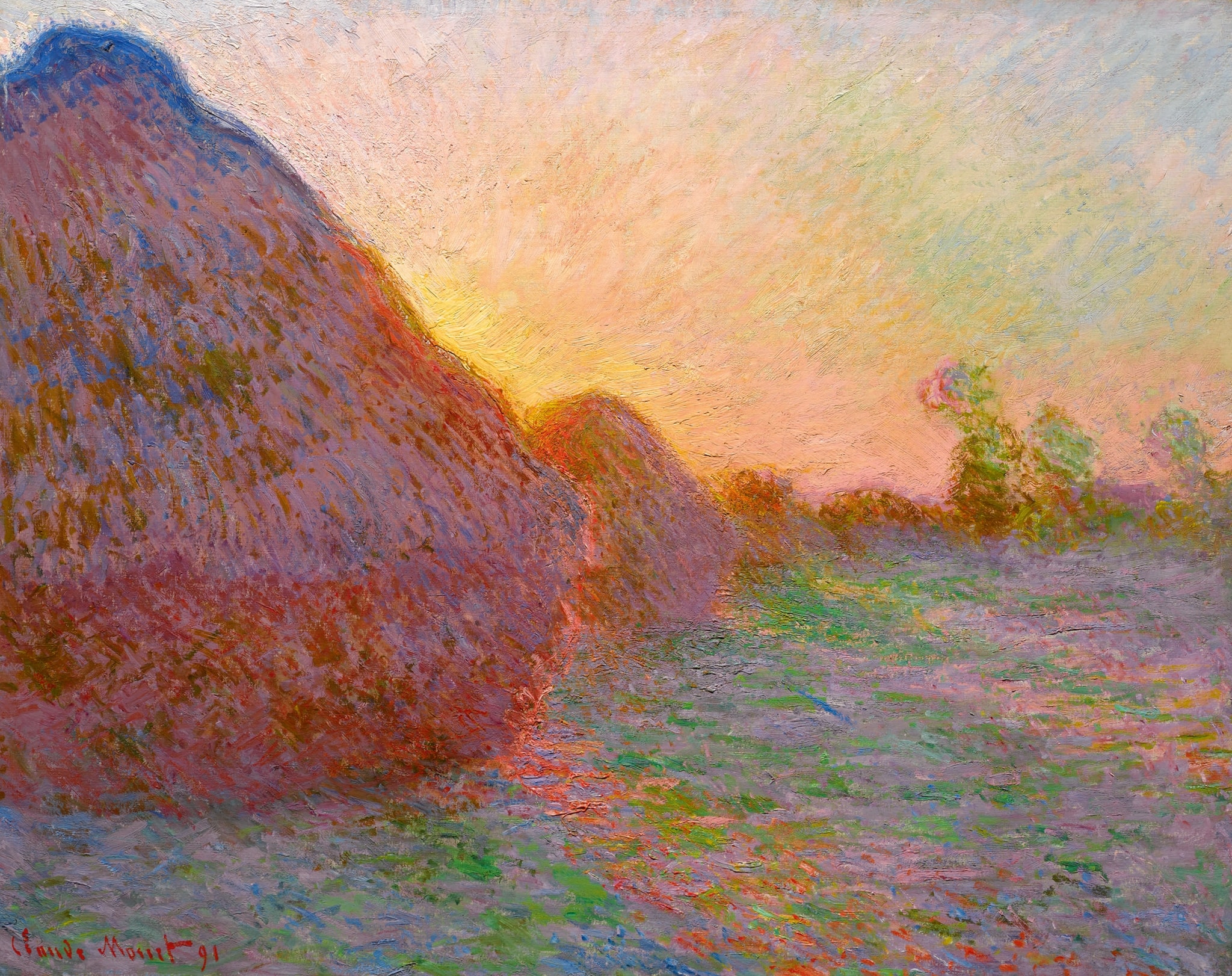
Monet’s violet shadows—cool blue‑purple passages along the haystacks and across the ground—are not mood coloring but observed effects of skylight and reflection. In the Haystacks series (1890–91), these hues turn shadow into a carrier of time and weather, binding forms into a shared atmosphere and intensifying the warm glow of sunlit straw.
Historical Context
In 1890–91, Monet embarked on his first sustained series, painting the same wheatstacks near Giverny under shifting times of day, seasons, and weather, then exhibiting fifteen canvases together at Durand‑Ruel in 1891. Holding the motif constant forced him to track how light transforms shadow, which in winter mornings and sunsets reads as blue to blue‑violet rather than gray. Technical analysis of Stacks of Wheat (Sunset, Snow Effect) confirms his strategy: he reserves a more intense blue for the shaded flanks and foreground, and compresses values so field, stacks, and sky nearly fuse in a single atmospheric envelope 12.
The violet passages arise from the physics of the scene—cool skylight and colored reflections bathing snow, stubble, and thatch—translated through Monet’s serial labor on multiple canvases. The grouped display made those chromatic shifts legible from picture to picture, turning shadow color into a precise index of time’s passage across the rural landscape 21.
Symbolic Meaning
For Monet and his Impressionist peers, colored shadows signaled fidelity to vision over anecdote: shadows are luminous and chromatic because light is. Museum overviews stress that Impressionists rendered both lights and darks in color, rejecting the academic convention of black shadows; Monet’s violet shadows publicly align the series with this modern optics 58.
The chromatic daring drew notice—sometimes mockery—as critics fixated on the movement’s “violettomanie.” That debate, reconstructed by historians, shows how blue‑violet shadows became a lightning rod in the 1890s reception of Impressionism, precisely because they exemplified a new way of seeing 6. Period writing around the series even praised the enchantment of “pure blue shadows,” acknowledging their experiential power 7.
Within the motif, haystacks carried associations of rural labor, sustenance, and survival. Set against wintry light, the cool violet shadows can suggest dormancy and endurance between harvests, lending quiet gravity to Monet’s optical studies 9. Getty scholarship further reads the series as a meditation on national time and seasonality after the 1870s—where shifting shadow color evokes continuity, memory, and the weathering of the French countryside 4.
Artistic Technique
Monet built the violet shadows through calibrated mixtures of lead white, cadmium yellow, vermilion, red lake, emerald green, viridian, cobalt blue, and ultramarine. Thin veils and thicker accents yield mauves and blue‑violets tuned to specific light states 3. He alternates wet‑in‑wet blends with wet‑over‑dry scumbling; in snow effects he intermixes pinks and blues, reserving slightly stronger blue for the darkest shadow notes 1.
Conservation imaging pinpoints an added band of pinkish‑purple along the lower edge in Stacks of Wheat (End of Summer), a late, wet‑over‑dry adjustment that clarifies the cool foreground shadow plane 3. Across versions he contrasts breathy, thin passages with raised impasto so the cool shadowed areas “breathe” against sunlit warms, enhancing atmospheric depth without breaking the narrow tonal range 41.
Connection to the Whole
The violet shadows provide the series’ chromatic counterpoint: cool complements to the stacks’ oranges and russets, which intensify each other through simultaneous contrast grounded in 19th‑century color science 8. Because Monet keeps values close and lets color carry form, these shadows knit ground, stack, and air into a continuous envelope—one reason the compositions feel suffused rather than outlined 1.
Shadow color is also the clearest register of time: slight shifts in sun angle, cloud cover, or snow reflectance swing the violets toward blue or mauve, making temporality visible from canvas to canvas 41. The device extends Monet’s long-standing pursuit of luminous shadow from earlier works like The Magpie, now radicalized through serial comparison across the Haystacks 10.
Explore More from This Painting
This detail is one part of Haystacks Series by Claude Monet | Light, Time & Atmosphere. Use the links below to return to the full interpretation, browse the full set of details, or view the painting's valuation if available.
Sources
- Art Institute of Chicago, Stacks of Wheat (Sunset, Snow Effect) — technical entry (blue shadows; narrow tonal range; scumbling)
- Art Institute of Chicago, Haystacks (Cats. 27–33) — series overview and 1891 Durand‑Ruel display
- Art Institute of Chicago, Stacks of Wheat (End of Summer) — pigments; pinkish‑purple foreground band; techniques
- Smarthistory/Getty, Wheatstacks (Snow Effect, Morning) — palette of icy pinks/blues; layered working; historical framing
- The Met, Impressionism: Art and Modernity — Impressionists render shadows in color
- Persée, Violettomanie — historiography of violet in Impressionist reception
- Getty Museum publication (French ed.) — period praise of “ombres bleues et pures”
- OpenEdition (MNHN), Chevreul and the phenomenon of coloured shadows — color theory context
- Art Institute of Chicago object page — stacks as symbols of sustenance and survival
- Musée d’Orsay, La Pie (The Magpie) — early Monet and luminous shadow precedent