The Foggy Silhouette in Houses of Parliament
A closer look at this element in Claude Monet's 1903 masterpiece
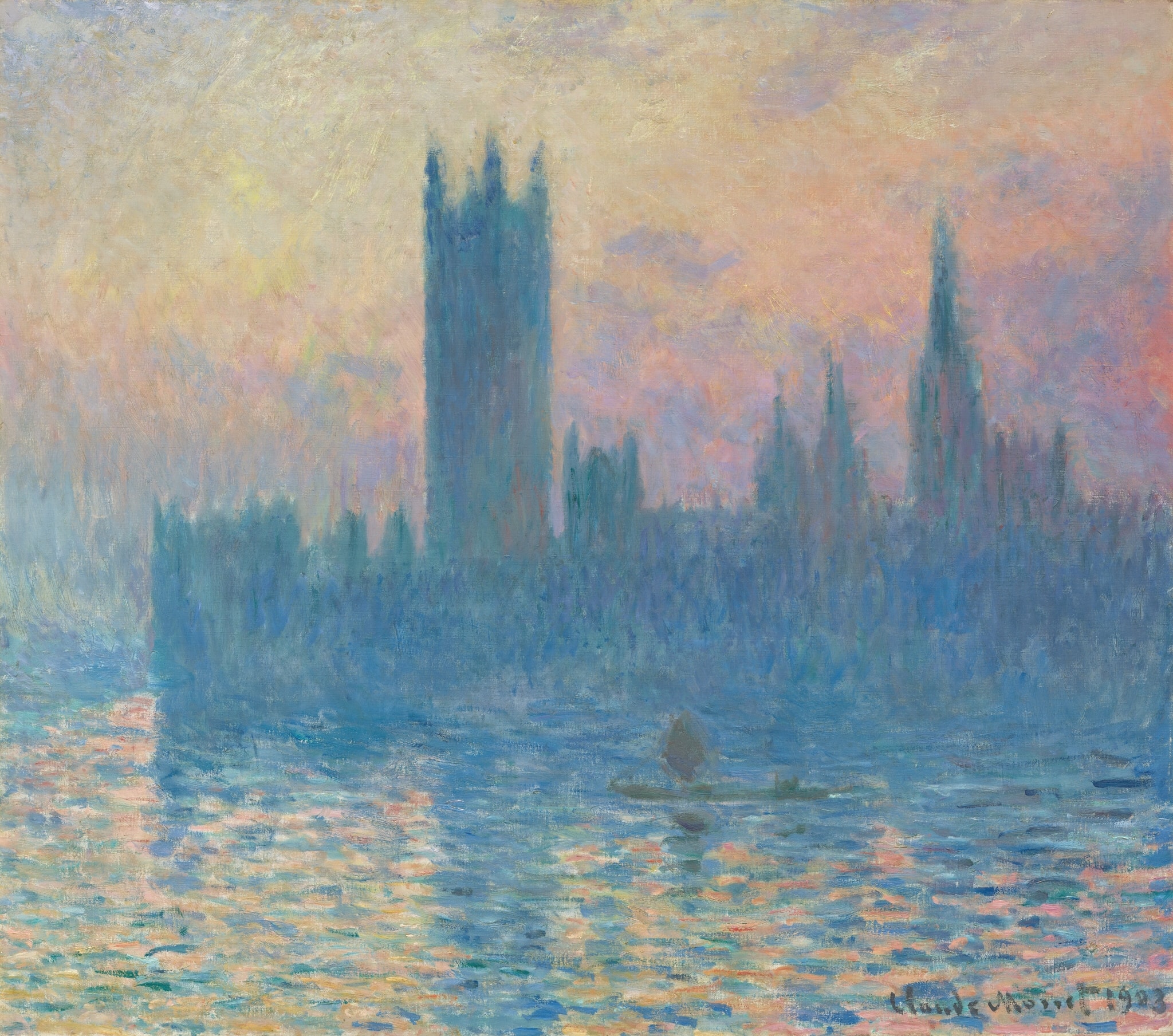
Monet’s “foggy silhouette” reduces the Palace of Westminster to a dark, shimmering mass glimpsed across the Thames at sunset. From his St Thomas’s Hospital vantage, the artist turns the monument into a register of London’s light and haze, letting atmosphere—not architecture—carry the drama.
Historical Context
Claude Monet pursued the Parliament motif during three London campaigns between 1899 and 1901, painting from the terraces of St Thomas’s Hospital across the Thames. Back in Giverny he reworked the canvases together and only considered them finished in 1903, preparing a unified 1904 Durand‑Ruel exhibition. The silhouetted mass of Westminster supplied a fixed profile that he could calibrate against shifting fog, color, and the low winter sun—hence its central, simplified presence in versions signed 1903 1.
The city’s famous fogs were not merely picturesque. Contemporary observers and later curators link their density to industrial pollution that softened edges and cooled tonal contrasts. Monet embraced this condition, seeking sunsets that set the azure silhouette against warm haze and fusing building, sky, and river into one atmospheric field. His oft‑recounted remark that London owes its beauty to fog captures the aim: to paint optical effects rather than masonry. The resulting “foggy silhouette” embodies the modern metropolis as seen through its own climate of smoke and mist 2.
Symbolic Meaning
The dissolving profile of Westminster recasts state power as something perceived through air and light. Instead of descriptive Gothic detail, Monet presents a silhouette that hovers between presence and disappearance, converting the monument into a stage for color phenomena. Curators at the Fondation Beyeler describe the contours as barely discernible beneath a veil of superposed strokes—an image of transience that places perception at the center of meaning 4. In this sense, the building becomes a modern emblem: authority glimpsed through weather, its edges negotiated by atmosphere rather than stone.
Art historians often align this effect with the Impressionist idea of the colored atmospheric “envelope,” where forms fuse within a shared optical climate. Princeton highlights how, on a foggy day, boundaries between sky, buildings, and water dissolve—precisely the threshold the silhouette occupies 7. Environmental studies add a further layer: the hazier contours and paler palettes seen in Monet’s London work correlate with rising aerosol pollution in the nineteenth century. While interpretation is aesthetic, the physics of smog helps explain the picture’s mute, vaporous contours. The silhouette thus functions doubly—as a poetic sign of impermanence and as a modern, environmentally inflected view of the city 82.
Artistic Technique
Monet builds the silhouette with cool blues and violets set against a sky of peaches, pinks, and yellows, creating a high‑value haze that presses the building into a unified tonal mass. Vertical and slightly diagonal strokes articulate towers, while rippled, broken strokes knit reflections to the base, binding monument, river, and sky into one field 3.
Across the series he layered and reworked dense paint, leaving soft impasto in towers and sky; technical study documents this accretion and revision, which helps the mass read as solid yet vibrating within fog 6. Beyeler’s description of a veil of small, superposed touches explains the softened, near‑abstract edges that give the silhouette its hovering presence 4.
Connection to the Whole
The foggy silhouette is the structural anchor of the composition: it fixes place and scale while yielding its edges to light. Warm haze halos the cool mass, and its broken mirror in the Thames links sky to water, organizing the canvas through a counterpoint of dark form and luminous atmosphere 3.
Within the broader series Monet developed together, Westminster’s profile is the constant against which changing weather and hour could be measured. By centering a simplified, readable outline, he invites viewers to register the true subject—time, light, and air—across multiple canvases. The silhouette thus secures recognition even as it dissolves, articulating the work’s modern balance of stability and flux 14.
Explore More from This Painting
This detail is one part of Houses of Parliament. Use the links below to return to the full interpretation, browse the full set of details, or view the painting's valuation if available.
Sources
- The Metropolitan Museum of Art – The Houses of Parliament (Effect of Fog), 1903–4
- National Gallery, London – London fog context and St Thomas’s vantage
- National Gallery of Art, Washington – The Houses of Parliament, Sunset, 1903
- Fondation Beyeler – Monet room‑guide (Parliament at sunset; mist as veil of strokes)
- High Museum of Art – Houses of Parliament in the Fog, 1903
- Art Institute of Chicago – Technical study of Houses of Parliament (1900–01)
- Princeton University Art Museum – The Houses of Parliament, Seagulls, 1903
- PNAS 2023 – Polluted realism in the art of Turner and Monet
- Proceedings of the Royal Society A (Baker & Thornes, 2006) – Solar position within Monet’s Houses of Parliament
- MuMa Le Havre – Monet, London Parliament, 1903 (fog/light as true subject; 1904 show)