The Reflected Light on the Thames in Houses of Parliament
A closer look at this element in Claude Monet's 1903 masterpiece
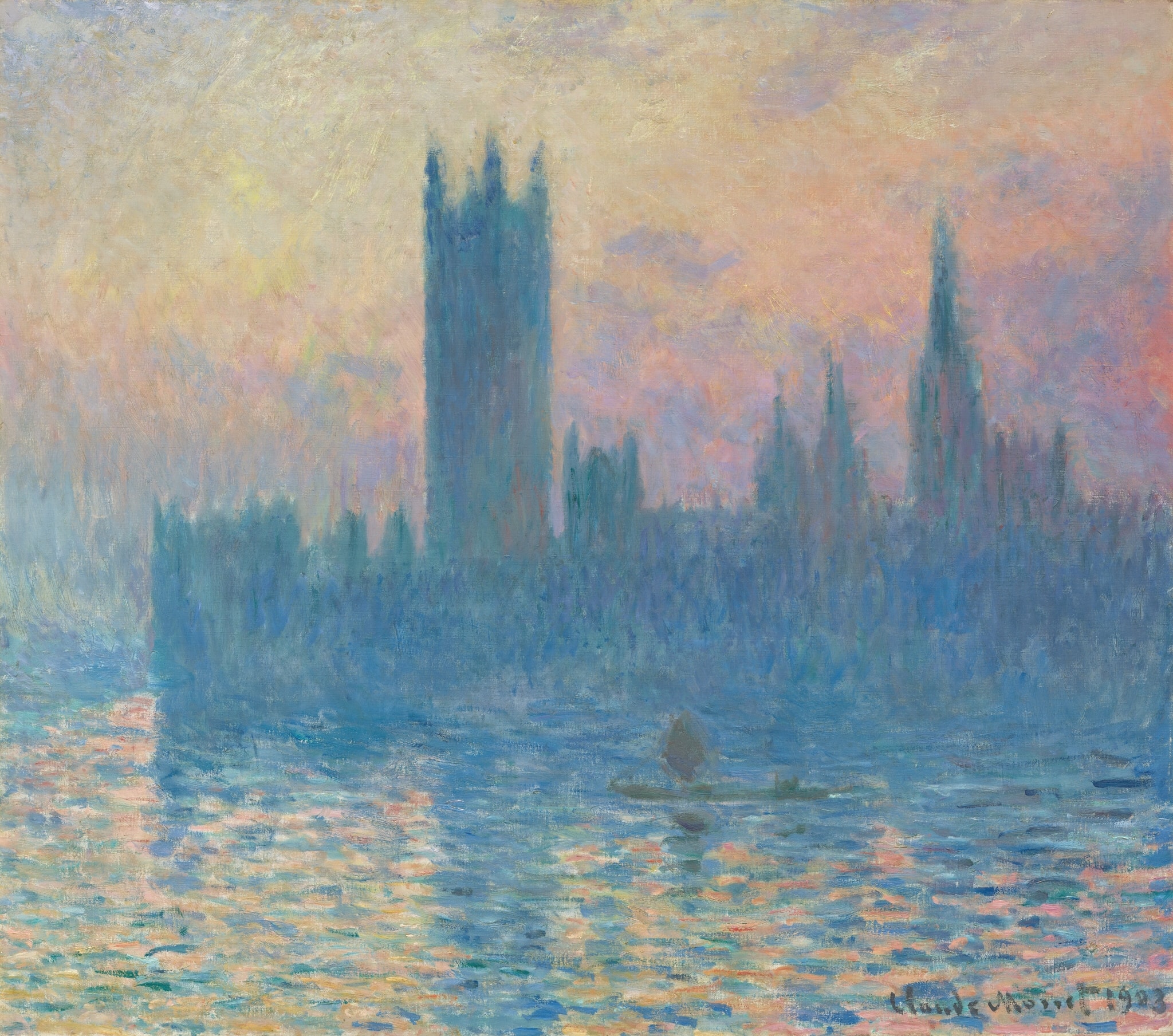
Monet turns the Thames into a luminous mirror, letting ripples of mauve and apricot carry the drama of sunset and fog. In Houses of Parliament (1903), the river’s reflected light becomes the work’s chromatic hinge, dissolving stone into shifting bands of color and binding sky to water.
Historical Context
Claude Monet pursued his London campaigns between late 1899 and early 1901, then reworked the canvases in Giverny, completing many in 1903 and presenting the ensemble at Durand‑Ruel in 1904. He insisted on developing the pictures together so their effects harmonized across the series—an approach that calibrated the river’s reflective color to the skies he observed and later orchestrated in the studio 1.
Monet chose a cross‑river vantage near St Thomas’s Hospital, directly facing the Palace of Westminster. From this position he could make the Thames dominate the lower register, a constantly changing reflector of fog, sunlight, and silhouette. He rotated canvases as the light shifted, returning to the motif over successive afternoons so that the water’s reflections would register precise atmospheric states rather than a generic river scene 2.
Symbolic Meaning
The reflected light transforms the Thames into a mutable mirror that challenges architectural permanence. By painting sky and water in the same tonal family—mauves warmed by oranges—Monet allows the Parliament’s mass to lose substance, yielding to a field of light where the building’s authority is visually dissolved and doubled below. The Musée d’Orsay notes this attenuation of stone and the chromatic echo that fuses upper and lower halves of the composition 3.
As a sign of modernity, the reflection also registers London’s distinctive atmosphere. Contemporary fogs—industrial smog laden with color—produced greens, yellows, and purples that artists could observe directly; the Courtauld highlights research confirming these chromatic fogs, which Monet translates into a river-surface palette that is both beautiful and pointedly urban 4. Finally, the reflective band pushes the series toward abstraction: Princeton observes that boundaries between sky, buildings, and water are softened, making the shimmer itself the subject. The Thames thus becomes a poetic instrument of flux, turning a symbol of state power into fugitive light and motion 7.
Artistic Technique
Monet renders the reflection with short, horizontal strokes that fracture the Parliament’s silhouette into cool blues and violets, interleaved with apricot, rose, and orange notes that mirror the sky. These lateral marks play against more vertical touches in the architecture, stabilizing the composition while keeping the water optically alive 5.
A restrained but resonant palette—mauves paired with oranges—creates tonal unity between sky and river 3. Layered, overlapping strokes produce a surface of scintillating light, so the water reads as an active screen rather than a passive mirror, a quality museum texts describe as “shimmering” 6.
Connection to the Whole
The reflective band is the painting’s structural and chromatic fulcrum. It repeats and modulates the sky’s color below, counterbalancing the dark vertical mass of Parliament and knitting the composition into a single atmospheric system 53.
Monet’s cross‑river vantage ensures this lower-zone mirror drives the image, shifting emphasis from emblem (monument) to experience (light-in-air). Within the series logic—conceived and finished as an ensemble—the river’s reflections synchronize with varied skies, turning each canvas into a precise register of time and weather observed from the same position 21.
Explore More from This Painting
This detail is one part of Houses of Parliament. Use the links below to return to the full interpretation, browse the full set of details, or view the painting's valuation if available.
Sources
- The Metropolitan Museum of Art. The Houses of Parliament (Effect of Fog) (1903–4)
- High Museum of Art. Houses of Parliament in the Fog (1903)
- Musée d’Orsay. Londres, le Parlement. Trouée de soleil dans le brouillard (1904)
- Courtauld Gallery. Monet and the Changing City (Learning Resource PDF)
- National Gallery of Art, Washington. The Houses of Parliament, Sunset (1903)
- Brooklyn Museum. Houses of Parliament, Sunlight Effect (1903)
- Princeton University Art Museum. The Houses of Parliament, Seagulls (1903)
- University of Birmingham (on Royal Society A study). Monet’s Scientific Skies