The Japanese Footbridge Auction History
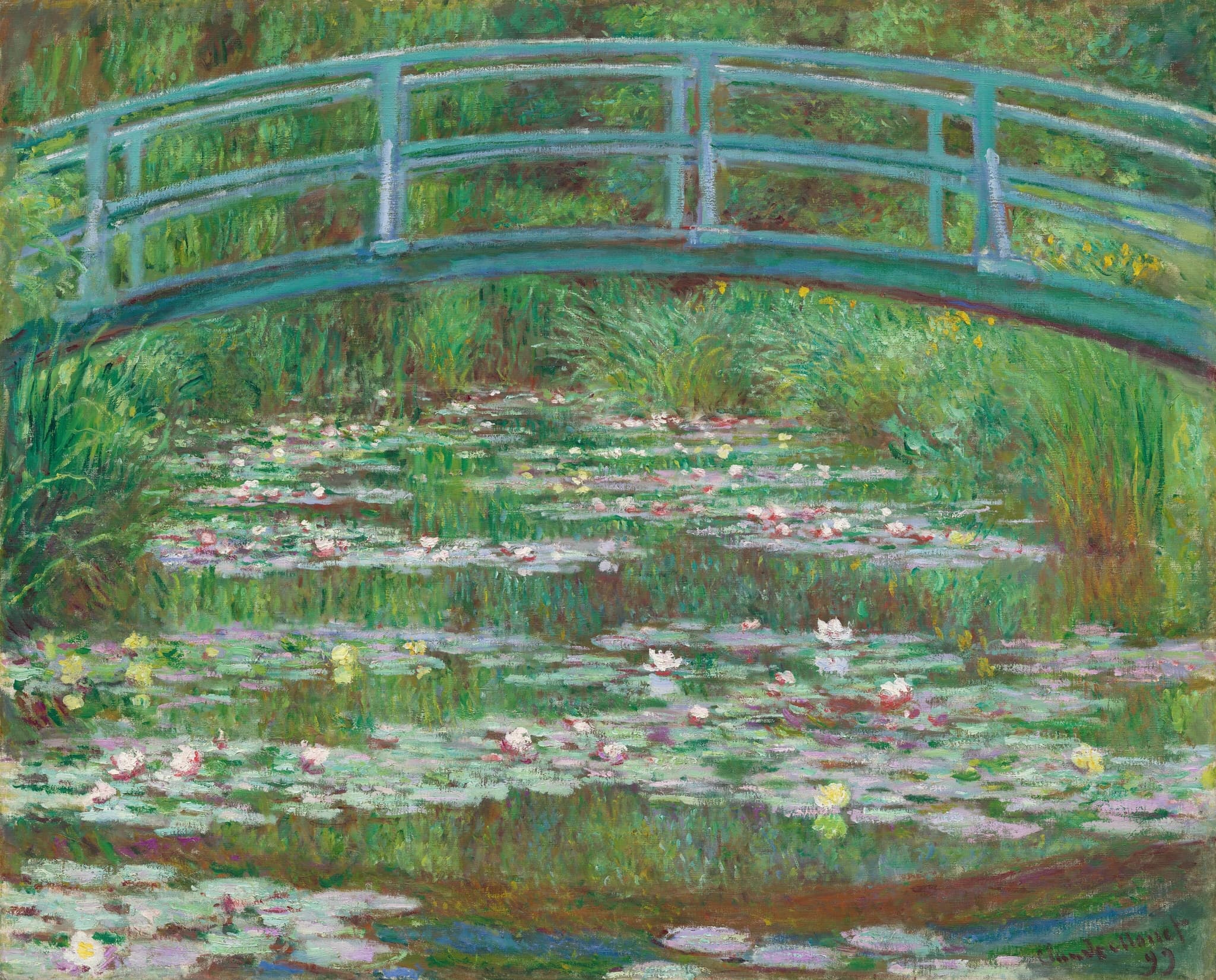
No public auction is recorded for Monet’s The Japanese Footbridge. Provenance shows private and institutional transfers: artist to Durand‑Ruel (1900), to the Carnegie Institute (1920), then a 1953 deaccession to Sam Salz and later to Henry T. Mudd, before a 1992 gift to the National Gallery of Art. Prices for these transactions have not been published. The motif is highly prized, with related Monets achieving major auction results, but this canvas is museum‑held and off‑market.
- Artwork
- The Japanese Footbridge
- Artist
- Claude Monet
- Sale type
- No known public sale
- Current location / owner
- National Gallery of Art, Washington, DC
Auction and Ownership Timeline
Monet paints The Japanese Footbridge
Painted in 1899, one of about twelve views of the Japanese bridge at Giverny; signed and dated "Claude Monet 99" [1].
Durand‑Ruel buys from the artist
Galerie Durand‑Ruel, Paris
Purchased from Monet by Galerie Durand‑Ruel, Paris, in January 1900 [1].
Exhibited at Durand‑Ruel, Paris
Paris
Shown shortly after completion at Galerie Durand‑Ruel, Paris [1].
Exhibited at Grafton Galleries, London
Grafton Galleries, London
Shown at the Grafton Galleries in London in 1905 under the title "The Water Lily Pond" [1].
Carnegie Institute acquires the painting
Carnegie Institute, Pittsburgh
Sold by Durand‑Ruel to the Carnegie Institute, Pittsburgh (now Carnegie Museum of Art) in 1920 [1].
Carnegie deaccessions via private sale
Sam Salz, New York
Deaccessioned by the Carnegie Institute and sold privately to dealer Sam Salz, New York; no auction is cited [1].
Provenance and Ownership
Provenance: Purchased from Monet by Galerie Durand‑Ruel, Paris, in January 1900; sold by Durand‑Ruel to the Carnegie Institute, Pittsburgh, in 1920; deaccessioned by the Carnegie Institute and sold privately to Sam Salz, New York, in 1953; subsequently sold to Henry T. Mudd, Los Angeles; by inheritance to Victoria Nebeker Coberly; in 1992 given (with Walter H. and Leonore Annenberg) to the National Gallery of Art, Washington, DC [1][2].
Quick Facts
- Last known sale
- 1953
- Known sale price
- Not publicly reported
- Sale type
- Private sale
- Venue / institution
- Carnegie Institute (deaccession) to Sam Salz, New York
- Current owner or location
- National Gallery of Art, Washington, DC
- Publicly viewable?
- Yes
Why This Sale Matters
This 1899 canvas belongs to Monet’s celebrated Japanese bridge series, painted from a single vantage point over his water garden. Its ownership history is fully documented from the artist’s studio to leading dealers and institutions: Durand‑Ruel acquired it in 1900; the Carnegie Institute purchased it in 1920; it was deaccessioned in 1953 in a private sale to New York dealer Sam Salz; it later entered the Mudd collection and, ultimately, the National Gallery of Art as a 1992 gift [1][2]. No public auction has been recorded for this specific work, and sale prices for its private transfers have not been published [1].
While this picture has no auction record, the motif’s market strength is well established. A related Japanese Bridge painting achieved $33 million at Sotheby’s London in 1998, a landmark price at the time (a different canvas) [3]. Monet’s wider market has since reached much higher peaks, including the $110.7 million record for Meules in 2019 [4]. Late Giverny masterworks continue to anchor the top tier of Impressionist demand: recent benchmarks include Le bassin aux nymphéas at $74.01 million in 2023 and another Water-Lilies scene at $65.5 million in 2024 (both different works) [5][6].
Given this context, The Japanese Footbridge aligns with a blue-chip subset of Monet’s oeuvre that remains coveted. However, as a museum-held painting with an unbroken, well-documented provenance and no public auction history, it is effectively off-market. Its significance lies not only in the 1899 bridge series’ art-historical status but also in the caliber of its ownership and exhibition history, culminating in its placement at the National Gallery of Art—factors that reinforce institutional importance rather than setting a tradable price benchmark [1][2].
Related Pages
Other auction histories by Claude Monet
Sources
- National Gallery of Art – Object Entry: The Japanese Footbridge — National Gallery of Art
- NGA Press Release (June 11, 1992): National Gallery of Art Receives Monet’s Japanese Footbridge — National Gallery of Art
- Monet’s Bridge Fetches $33 Million — The Washington Post
- Monet’s Meules Sells for $110.7 Million — A New Artist Record — Sotheby’s
- 20/21 Marquee Week: Sale Results (Nov 9, 2023) — Christie’s
- A Claude Monet ‘Water Lilies’ Scene Sold for $65.5 Million — Wall Street Journal