How Much Is Equestrian Portrait of Philip IV (Philip IV on Horseback) Worth?
Last updated: April 27, 2026
Quick Facts
- Methodology
- extrapolation
A hypothetical, free‑market sale of an accepted autograph Equestrian Portrait of Philip IV by Diego Velázquez is estimated at USD 100–300 million. This band reflects extreme rarity, museum‑grade importance and likely institutional competition; the low end assumes attribution/condition/legal constraints, the high end assumes undisputed autograph status and full marketability [1][2].
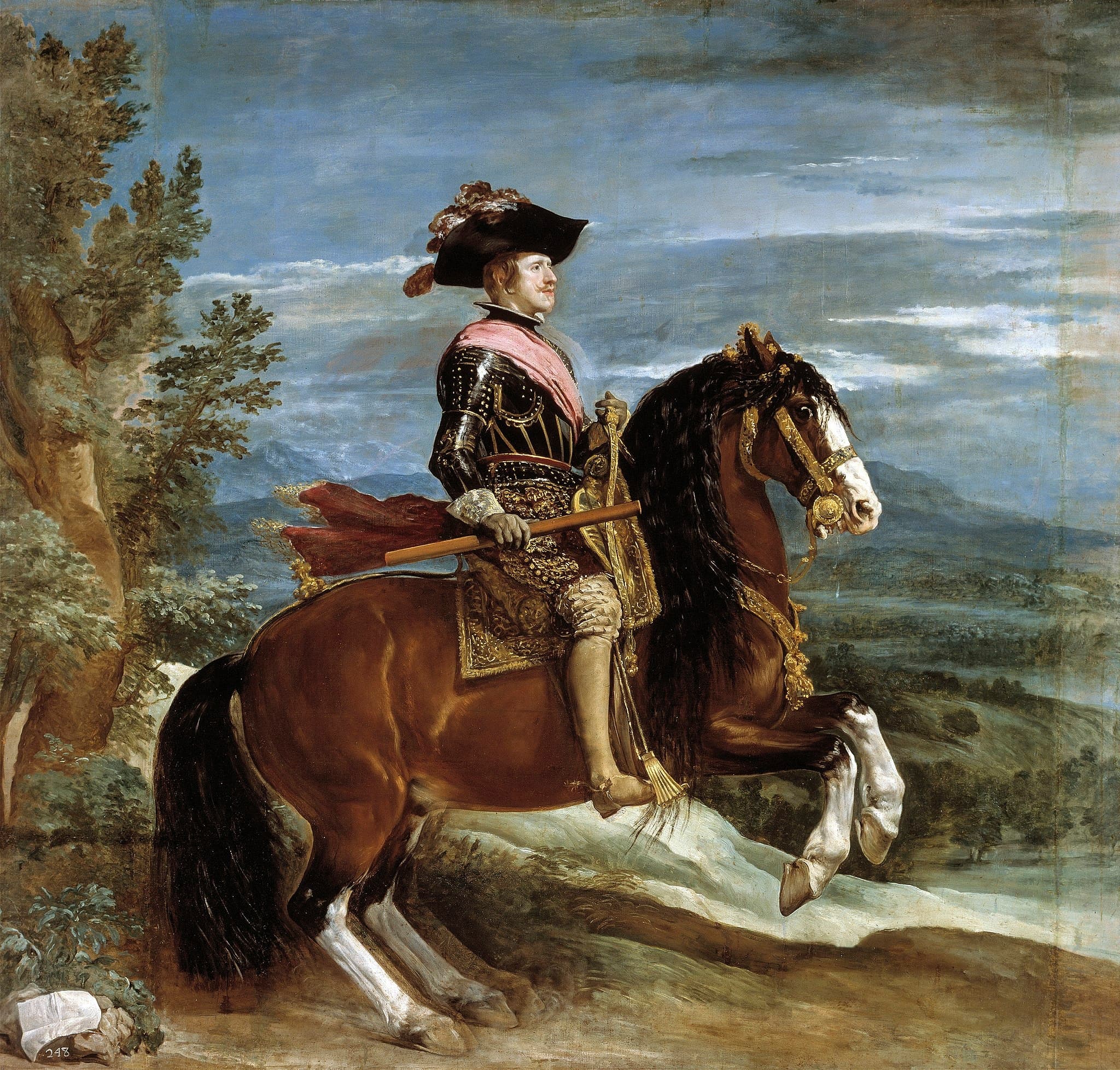
Equestrian Portrait of Philip IV (Philip IV on Horseback)
Diego Velazquez, 1635 • Oil on canvas
View more by Diego Velazquez →Valuation Analysis
Valuation context: The canonical Equestrian Portrait of Philip IV is a museum‑held, royal, full‑scale Velázquez (Prado inv. P001178) and has no record of modern public sale; the estimate below is therefore hypothetical and premised on a scenario in which an undisputed autograph, saleable version appeared on the open market [1].
Market evidence and comparables: Public auction data for undisputed Velázquez masterpieces is extremely limited. Historical auction realizations for accepted Velázquez paintings have been mid‑single to low‑double millions in nominal terms, and high‑quality royal portraits prepared for sale have been estimated in the tens of millions but are often withdrawn or pre‑empted by institutions (a recent Sotheby’s estimate for a royal Velázquez exemplifies this dynamic) [2][3]. Because direct comparables are scarce, the valuation below extrapolates from the available auction record, institutional acquisition behavior and precedent for trophy Old Master purchases.
Why the range is wide: The lower bound (USD 100M) reflects a best‑case saleable autograph that nonetheless faces market frictions — provenance gaps, condition issues, or national patrimony/export constraints that reduce the pool of bidders and the willingness of institutions to bid competitively. The upper bound (USD 300M) represents an undisputed, museum‑quality autograph in excellent condition with clear provenance and legal ability to cross borders; in that event institutional and private rivalry for a unique Velázquez could drive price substantially above historical public‑auction ceilings.
Key contingent variables: Attribution certainty, conservation state, completeness of provenance, and legal transferability (Spanish patrimony/ export restrictions and inalienability rules) are determinative. A work that fails on one or more of these fronts could collapse to a fraction of the top estimate; conversely, new technical evidence or an extraordinary competitive bidding environment (rare but possible) could push realization toward or above the upper bound. The Prado’s custodial status for the canonical equestrian underscores how rare a market appearance would be and how much premium scarcity imparts [1][2].
Conclusion: This USD 100–300 million band is a reasoned hypothetical for a saleable, autograph Equestrian Portrait of Philip IV by Velázquez. Final valuation would require confirmed attribution and authorship, detailed conservation and technical reports, full provenance documentation and legal clarity on export/alienation; absent those, the painting is effectively priceless as a cultural asset but only conditionally actionable in market terms [1][2][3].
Key Valuation Factors
Art Historical Significance
High ImpactThe Equestrian Portrait of Philip IV is a major genre within Velázquez’s royal portraiture and a canonical example of 17th‑century Spanish court imagery. As a full‑scale royal equestrian, it functions both as dynastic propaganda and as a technical showcase—compositionally complex and requiring exceptional handling of figure, horse and setting. That combination makes the painting a trophy for national collections and major museums: its cultural and scholarly value is maximal and translates into exceptional market interest when saleable. In practice, significance drives both demand and willingness to pay premiums, particularly from institutional buyers seeking to complete or enhance national narratives and exhibition programs.
Rarity / Supply
High ImpactAutograph Velázquez masterpieces of this scale almost never appear on the secondary market; they are overwhelmingly in national or museum collections. This extreme scarcity materially elevates hypothetical value: the first authentic, market‑accessible equestrian would attract intense competition from institutions and deep private buyers. The rarity effect is compounded by the fact that auction house estimates for comparable royal Velázquez portraits are often conservative because consignments are frequently withdrawn or subject to institutional pre‑emption, thereby compressing observable public sale prices despite high latent demand.
Provenance & Legal Restrictions
High ImpactClear Royal Collection provenance increases confidence and value, but Spanish cultural patrimony laws and export controls can materially reduce or eliminate cross‑border marketability. A painting with uninterrupted, documented provenance that can be legally exported will command a premium; conversely, if the work is legally inalienable or export‑blocked, it may have negligible practical market value to foreign buyers despite enormous cultural worth. Provenance also affects institutional appetite: well‑documented royal lineage encourages competitive museum interest and possible state involvement.
Condition & Technical Authentication
High ImpactCondition and technical attribution work (paint layer analysis, X‑radiography, dendrochronology where relevant, pigment analysis) are determinative. An autograph canvas in excellent, stable condition with corroborating technical evidence will justify the high end of the estimate; significant overpainting, structural damage, or substantial studio participation will reduce marketability and price sharply. Detailed conservation reports and cataloguing by leading Velázquez scholars are prerequisites for institutional acquisition and for commanding top prices at auction or private treaty.
Market Demand & Buyer Base
Medium ImpactDemand is concentrated among national museums, major international institutions and a handful of ultra‑high‑net‑worth private collectors able to underwrite reputational and logistical costs. Because institutions often pre‑empt auctions or negotiate private sales, public auction realizations understate true willingness to pay. The niche Old Masters market means that while buyer depth is shallower than for blue‑chip contemporary art, willingness to pay for unique, high‑profile works can be disproportionately large—particularly when exhibition and scholarly opportunities align with acquisition.
Sale History
Equestrian Portrait of Philip IV (Philip IV on Horseback) has never been sold at public auction.
Diego Velazquez's Market
Diego Velázquez is a first‑tier Old Master whose major works are predominantly held by national museums (notably the Museo del Prado). Public‑auction evidence is sparse because canonical canvases rarely reach the market; historical public sales and modern contested attributions place most realized Velázquez prices in the mid‑single to low‑double‑million bands, with occasional house estimates for royal portraits in the tens of millions. The market treats major Velázquez paintings as near‑inviolable cultural assets, producing a high latent demand but few open‑market comparables.
Comparable Sales
Portrait of Juan de Pareja
Diego Velázquez
Landmark public sale of a securely attributed, museum‑quality Velázquez — shows institutional willingness to pay high sums for major Velázquez portraits and provides a rarity/precedent benchmark for when top Velázquez works enter the market.
$5.5M
1970, Christie's, London
~$44.9M adjusted
Saint (Santa) Rufina
Diego Velázquez
One of the stronger modern auction realizations for a Velázquez work (often cited as a market benchmark). Though not a royal equestrian, it indicates the public‑auction ceiling for important Velázquez works historically.
$8.9M
1999, Christie's
~$16.9M adjusted
Contested canvas credited to Velázquez (Madrid auction report)
Diego Velázquez (attribution contested)
Recent market episode where a canvas credited by the seller/house to Velázquez attracted multi‑million bids but was subject to export/patrimony action — useful for understanding demand and price sensitivity when attribution is disputed.
$8.7M
2017, Madrid auction house (reported; export review / contested attribution)
~$11.2M adjusted
Isabel de Borbón (prepared Sotheby's estimate, withdrawn)
Diego Velázquez
House estimate for a very high‑quality, full‑length royal Velázquez portrait that was prepared for auction (later withdrawn). Though not a realized sale, the estimate signals how major auction houses and the market price an undisputed royal Velázquez when it is presented.
$35.0M
2024, Sotheby's, New York (lot prepared for Feb 2024 Old Masters; withdrawn)
~$35.7M adjusted
Current Market Trends
The Old Masters segment is supply‑sensitive and selective: institutional demand and scholarly activity drive value more than speculative private buying. Recent years have seen constrained auction frequency for top Velázquez works, with high‑profile consignments often withdrawn or handled privately; this dynamic increases the premium for truly rare, marketable masterpieces while keeping public auction realizations episodic and unpredictable.