How Much Is The Spinners (Las hilanderas, The Fable of Arachne) Worth?
Last updated: June 27, 2026
Quick Facts
- Methodology
- extrapolation
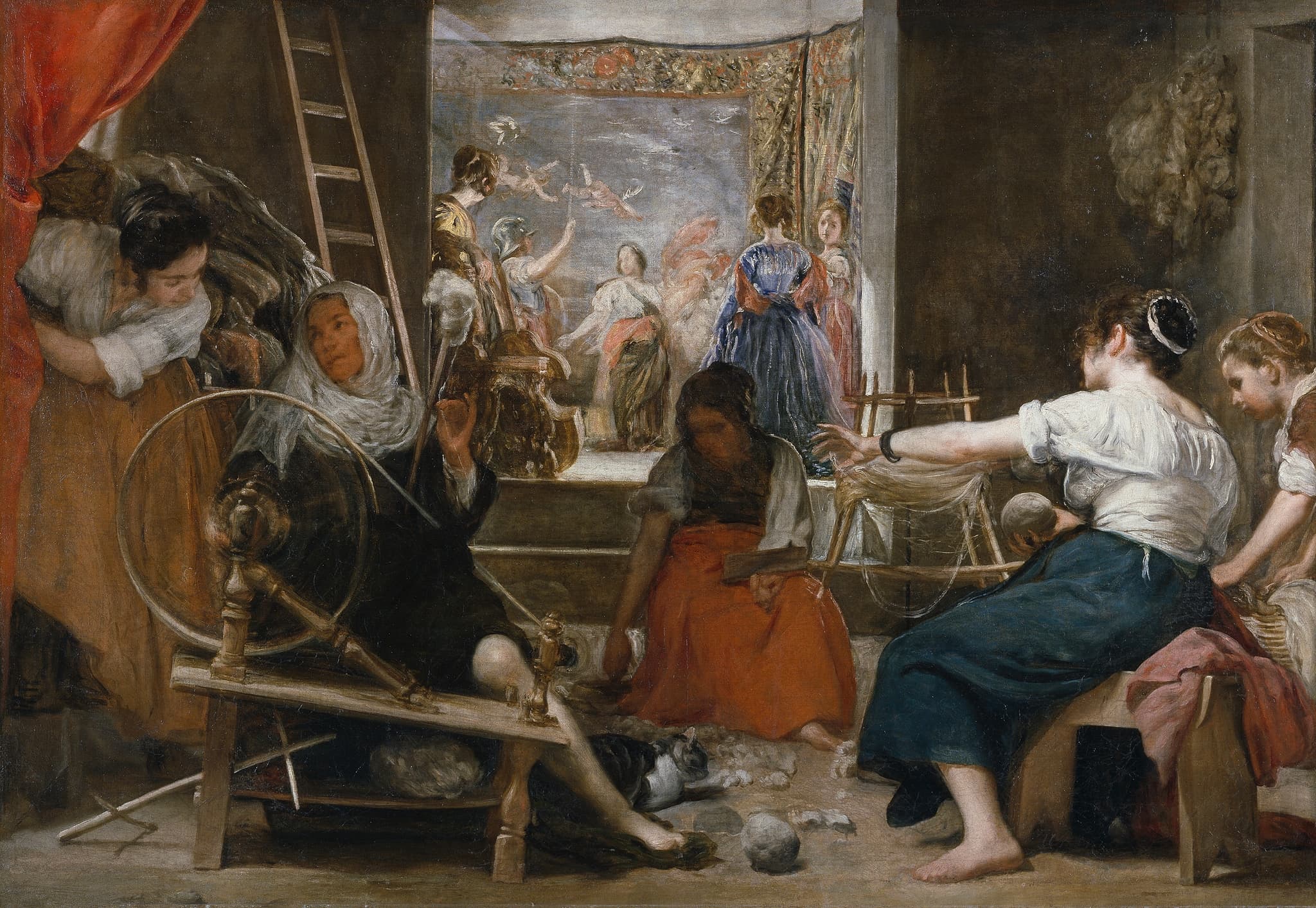
Hypothetical open‑market value for Diego Velázquez’s The Spinners (Las hilanderas, The Fable of Arachne) is estimated at $200–500 million. This range extrapolates from the artist’s thin public record and aligns with pricing achieved for the rarest, trophy‑level Old Masters. The painting is a canonical late masterpiece, but as Prado state patrimony it is non‑tradeable; this is a strictly hypothetical valuation.
Valuation Analysis
Conclusion. If freely tradable and exportable, Diego Velázquez’s The Spinners (Las hilanderas, The Fable of Arachne) would command approximately $200–500 million. The painting is a late, canonical masterpiece—central to Velázquez’s exploration of artistic invention and illusion—now in the Museo Nacional del Prado and therefore not market‑testable under Spanish patrimony law [1][2].
Method. The estimate is derived by extrapolating from Velázquez’s scarce auction record and cross‑artist Old Master trophy benchmarks. The artist’s standing public record—$17.0m for Saint Rufina (Sotheby’s, 2007)—is not demand‑constraining; rather, it reflects the near absence of unimpeachable autograph works on the market [3]. A fully accepted, multi‑figure late Velázquez of this intellectual and art‑historical weight would trade in a different strata from devotional or smaller portraits that set past records.
Benchmarks. Recent trophy‑level Old Masters establish the bandwidth within which a masterpiece of this scarcity can clear: Botticelli’s Portrait of a Young Man Holding a Roundel at $92.2m (2021) [4]; Rubens’s Massacre of the Innocents at c.$76m (2002) [5]; and the category‑defining outlier, Leonardo’s Salvator Mundi at $450.3m (2017) [6]. Within Velázquez’s own market, Sotheby’s 2024 guidance (~$35m) for a full‑length royal portrait—withdrawn but widely reported—signals substantially higher expectations today for top material than the 2007 record implies [7].
Why this work sits at the pinnacle. The Spinners is a touchstone of Velázquez’s late style and a sophisticated meditation on the making of images, weaving myth, and staged illusion. Its complexity, scale, and seminal status—often discussed alongside Las Meninas, The Surrender of Breda, and the Rokeby Venus—place it squarely among the artist’s most important works [1]. In a free‑trade scenario, institutional and sovereign‑backed competition would be intense, supporting pricing at or above the upper Old Master trophy band.
Condition and physical history. The painting’s expansions and later adjustments (documented in scholarship) are material to any pricing exercise but do not diminish its canonical importance; full technical disclosure would be prerequisite to underwriting at the top of the range [8].
Positioning. Balancing unparalleled art‑historical significance, absolute rarity of late multi‑figure masterpieces in private hands, robust cross‑category comparables, and the likely presence of guarantees and global competition in any hypothetical offering, a fair open‑market estimate is $200–500 million. Note: as Prado state property, the work is inalienable under current law; the valuation is hypothetical only [1][2].
Key Valuation Factors
Art Historical Significance
High ImpactThe Spinners is a culminating statement of Velázquez’s late career and a foundational text in Western painting. It fuses genre and myth, staging the Fable of Arachne as a self‑reflexive meditation on artistic invention, illusion, and status. Its complex, two‑zone composition, masterful light, and psychological naturalism are repeatedly cited in the canon alongside Las Meninas and The Surrender of Breda. As such, it is not merely representative of Velázquez but exemplary of his intellectual ambitions and technical command. Works that redefine an artist’s oeuvre and broader art history command a premium that transcends standard Old Master pricing bands. This centrality to scholarship, pedagogy, and museum narratives materially supports a trophy‑level valuation.
Market Rarity and Demand
High ImpactFully accepted autograph Velázquez paintings almost never come to market; the best examples have been absorbed into museums and royal/state collections for centuries. The artist’s standing auction record is therefore artificially low, reflecting supply starvation rather than limited demand. When blue‑chip Old Masters of real rarity surface, buyers expand beyond traditional collectors to include museums, private foundations, and sovereign wealth—pushing prices up sharply. Cross‑category evidence (Botticelli, Rubens, and Leonardo benchmarks) shows the market can sustain valuations north of $90 million and, in singular instances, many multiples more. Against this backdrop, a late, multi‑figure Velázquez masterpiece would likely experience exceptional, international competition and aggressive underwriting.
Condition and Physical History
Medium ImpactThe Spinners has a well‑documented physical history, including enlargements and later adjustments to the composition. While such interventions are typical of works with long royal/museum histories, they are material to underwriting, loan approvals, and pricing. In a hypothetical sale, buyers and guarantors would require comprehensive technical imaging, conservation reports, and a clear chronology of alterations. Provided the surface condition and structural stability align with current scholarly understanding, these factors would likely moderate but not suppress trophy‑level pricing—given the work’s canonical status. If unforeseen condition risks emerged, the upper bound of the estimate could compress, though the significance premium would remain pronounced.
Legal/Export Constraints and Provenance
Medium ImpactThe painting’s impeccable provenance—from early collection in Spain through the Royal Collections to the Museo Nacional del Prado—confers unmatched institutional prestige. However, Spanish patrimony protections render Prado holdings inalienable and tightly restrict export; thus, no normal market transaction is possible under current law. This valuation therefore assumes a counterfactual scenario in which lawful deaccession and unrestricted export are permitted. In that open‑market context, the same provenance becomes a value amplifier, signalling authenticity, cultural importance, and museum‑level visibility. The constraint affects feasibility, not intrinsic value; if removed, such provenance would encourage guarantees and global bidding, supporting a result toward the upper end of the range.
Sale History
The Spinners (Las hilanderas, The Fable of Arachne) has never been sold at public auction.
Diego Velazquez's Market
Velázquez (1599–1660) is among the scarcest and most coveted Old Masters. Public auction comparables are thin because masterworks reside in museums and royal/state collections. The current auction record, $17.0 million for Saint Rufina at Sotheby’s London (2007), understates demand for top‑tier works; it reflects limited supply. Historically, Velázquez has produced landmark prices when material of quality appears (e.g., Juan de Pareja set the first £1 million auction milestone in 1970). In 2024, a full‑length royal portrait was guided around $35 million before withdrawal, indicating materially higher expectations today. In private‑sale contexts, blue‑chip Velázquez works would likely attract competition from institutions, major collectors, and sovereign buyers.
Comparable Sales
Saint Rufina
Diego Velázquez
Same artist; widely accepted autograph work and the standing auction record for Velázquez. Useful as a conservative artist benchmark (though earlier, smaller and single-figure religious subject).
$17.0M
2007, Sotheby's London
~$26.1M adjusted
Portrait of Juan de Pareja
Diego Velázquez
Same artist; historic, museum-grade portrait and landmark auction sale (first painting over £1m). Demonstrates demand escalation for prime Velázquez, even if subject and scale differ from a late mythological multi-figure.
$5.5M
1970, Christie's London
~$45.4M adjusted
Portrait of a Gentleman (rediscovered)
Diego Velázquez
Same artist; autograph at time of sale (some debate in scholarship). Indicates pricing for smaller/autograph portraits, far below a canonical late masterpiece like The Spinners.
$4.7M
2011, Bonhams London
~$6.6M adjusted
The Massacre of the Innocents
Peter Paul Rubens
Close category comp: Baroque, large multi-figure narrative by a blue-chip contemporary of Velázquez. Trophy market signal for museum-grade 17th‑century history painting.
$76.0M
2002, Sotheby's London
~$134.3M adjusted
Portrait of a Young Man Holding a Roundel
Sandro Botticelli
Old Master trophy benchmark in recent years. Though a portrait and earlier period, it evidences depth of demand above $90m for canonical, museum-grade Old Masters.
$92.2M
2021, Sotheby's New York
~$108.2M adjusted
Salvator Mundi
Leonardo da Vinci
Ceiling/outlier for Old Masters. While attribution debates persist, it shows the market’s capacity for extreme pricing for ultra‑rare, brand‑defining works.
$450.3M
2017, Christie's New York
~$584.4M adjusted
Current Market Trends
Old Masters remain a two‑speed market: fresh, museum‑grade rarities command intense competition and strong prices, while secondary material is selective. After a softer 2024, top‑end demand rebounded, with new artist records and strong totals in 2025–2026 driven by scarcity, guarantees, and cross‑category buyers seeking historical blue chips. Trophy works by canonical names (Botticelli, Rubens, Leonardo) demonstrate sustained capacity for prices above $90 million and, in outlier cases, multiples of that level. Given the near‑zero supply of prime Velázquez, any unimpeachable masterpiece would sit at the market’s apex, benefiting from global marketing, institutional interest, and sovereign capital—conditions consistent with a $200–500 million outcome.
Sources
- Museo Nacional del Prado – The Spinners (Las hilanderas, The Fable of Arachne)
- Spain’s Historical Heritage Law (Ley 16/1985, Patrimonio Histórico Español)
- The Art Wolf – Velázquez’s 'Saint Rufina' sold for a record
- The Art Newspaper – Botticelli portrait sells for record $92.2m
- Wikipedia – Massacre of the Innocents (Rubens) sale record
- The Guardian – Leonardo da Vinci’s Salvator Mundi sells for $450m
- The Art Newspaper – Velázquez’s $35m Spanish queen withdrawn from Sotheby’s
- La Vanguardia (Historia y Vida) – Las Hilanderas: dimensiones originales y añadidos