How Much Is The Surrender of Breda (Las Lanzas) Worth?
Last updated: April 27, 2026
Quick Facts
- Methodology
- extrapolation
The Surrender of Breda (Las Lanzas) is a Museo del Prado–held national treasure and effectively not for sale. If hypothetically placed on the open market under clear legal/export conditions, a reasoned valuation range is USD 150 million–USD 400 million, reflecting extreme scarcity, institutional significance and Old Master comparables.
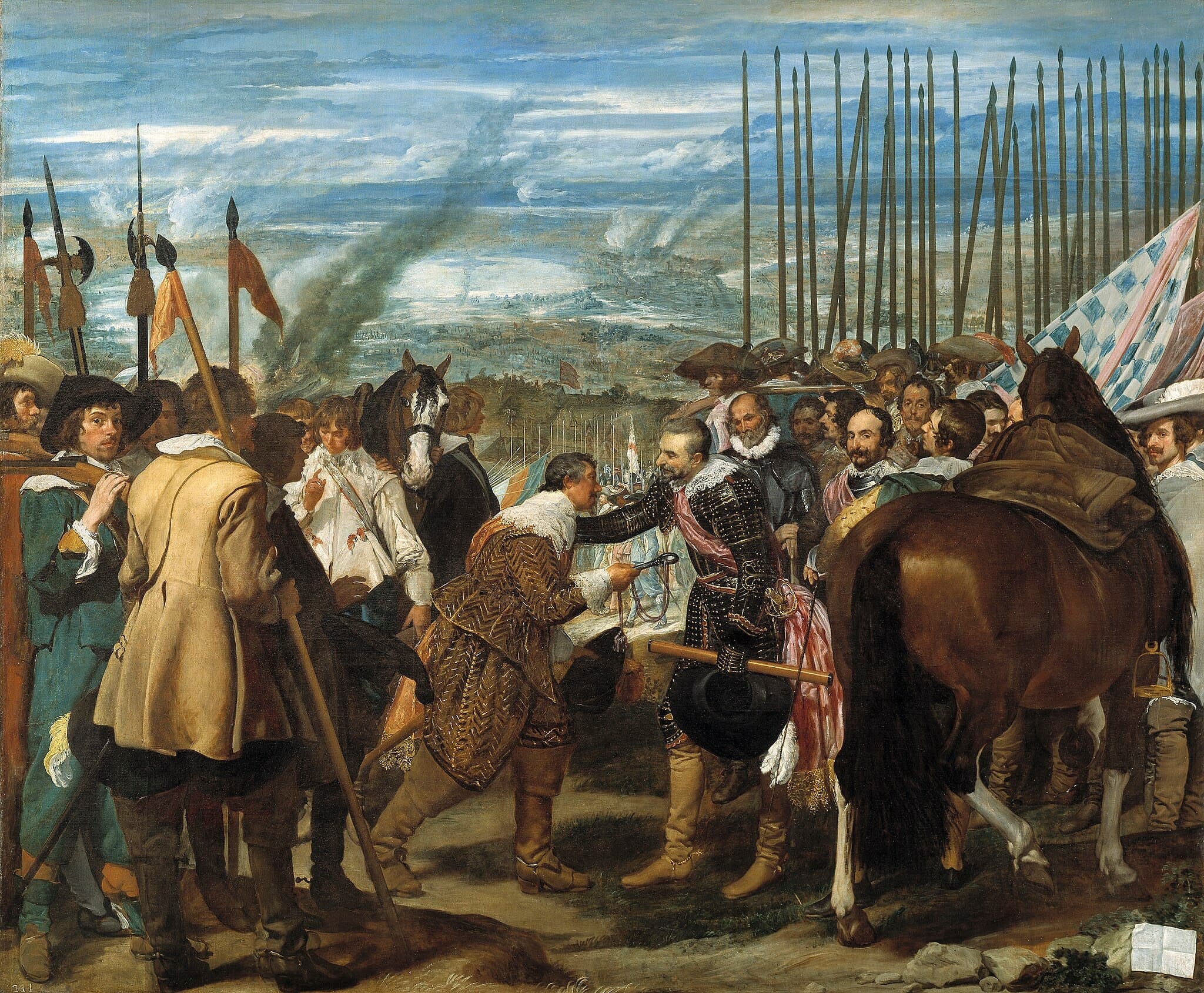
The Surrender of Breda (Las Lanzas)
Diego Velazquez, 1634 • Oil on canvas
View more by Diego Velazquez →Valuation Analysis
Valuation conclusion: The Surrender of Breda (Las Lanzas) by Diego Velázquez (1634–35) is a museum‑held national treasure in the Museo Nacional del Prado and is effectively off the market [1]. If, counterfactually, the painting were to be offered for sale under clear legal and export terms, a reasoned market valuation range is approximately USD 150 million to USD 400 million.
This range is not a price derived from a single recent sale but an extrapolation from three principal considerations: (a) the painting’s canonical art‑historical importance; (b) the extreme scarcity of securely‑attributed, museum‑quality Velázquez canvases available to private buyers; and (c) precedent results for top‑tier Old Master masterpieces and institutional acquisition behavior. Public auction evidence for securely‑sold Velázquez works is limited and clustered in far lower realized figures, but those sales are poor direct comparables because they are typically smaller, portrait works or pieces with contested attribution. In contrast, national‑treasure canvases—when they do change hands—capture premiums that push values into the high‑eight to low‑nine‑figure territory.
The methodology used here is an informed extrapolation that combines comparable sales (adjusted historical results and outlier private purchases), replacement/insurance logic used by major museums, and market dynamics for Old Masters. Adjusted benchmarks include the small set of public Velázquez results and broader Old Master sales that show the market ceiling when provenance, condition and national significance align. Importantly, non‑market constraints would heavily influence any real sale: Spain’s cultural patrimony rules and the intense public/institutional interest mean a sale would likely be resisted or pre‑empted, as recent high‑profile withdrawals and ownership disputes in the Old Master market have illustrated [2].
Key risks and uncertainties are legal/ethical restraints, the essentially zero supply of comparable autograph canvases, and the limited bidder pool (governments, major museums, or a tiny number of ultra‑high‑net‑worth collectors). Condition and conservation history would also materially affect insurance and replacement valuations; however, the Prado’s stewardship suggests strong preservation. Given those factors, the lower bound of USD 150 million reflects a conservative market‑premium for a flagship, museum‑grade Velázquez, while the upper bound of USD 400 million accounts for competitive sovereign or institutional bidding that could occur if export/ownership barriers were resolved.
For context, the modern public‑market record for securely attributed Velázquez pieces is modest because near‑all canonical works are museum‑held; large Old Master sales for comparable names have, on occasion, broken into the low hundreds of millions when private treaty or cross‑institutional competition occurs. Using those noisy comparables, museum insurance/replacement logic, and the unique national‑treasure status of Las Lanzas supports the stated USD 150–400 million hypothetical range. To refine further would require Prado insurance/replacement figures, conservation reports, and auction‑house specialist input; absent that, the painting should be treated as effectively priceless in institutional terms but valued, under a forced‑sale hypothetical, at roughly USD 150–400 million.
Key Valuation Factors
Art Historical Significance
High ImpactLas Lanzas is one of Velázquez’s principal large‑scale history paintings, executed for the Buen Retiro Palace’s Hall of Realms and forming a central part of Spanish Golden Age visual culture. Its scale, technical mastery and public role in royal propaganda make it a canonical work widely cited in scholarship and museum programming. Canonical masterpieces do not trade as ordinary market lots: their value includes cultural and symbolic premiums that far exceed normal per‑square‑inch metrics. For valuation purposes, the painting’s unmatched art‑historical status is the single strongest upward driver, converting academic and national importance directly into monetary premium by attracting institutional and sovereign bidders in any hypothetical sale.
Provenance & Legal Restrictions
High ImpactPainted for the Spanish crown and remaining within royal/state collections until its Prado stewardship, Las Lanzas has exemplary provenance that enforces both legal protection and public sentiment in Spain. Spanish cultural patrimony laws, inalienability rules and export restrictions make deaccession/export legally complex and politically sensitive. These protections effectively narrow the pool of potential buyers to sovereign entities, major museums or exceptional private actors with state‑level approvals. This legal environment reduces practical marketability and creates a high probability of governmental pre‑emption or objection, which both suppresses true sale likelihood and increases the premium a buyer would need to pay to secure a transfer.
Market Scarcity / Liquidity
High ImpactSecurely attributed, museum‑quality Velázquez canvases almost never appear on the open market, producing an effective supply of zero for comparable works. Scarcity pushes theoretical values upward because the small field of eligible buyers—museums, states, and a handful of ultra‑wealthy collectors—compete in an otherwise thin market. At the same time, that illiquidity increases valuation uncertainty: there are few auction precedents to anchor a firm price, and realization risk is high. Liquidity constraints both elevate hypothetical pricing and widen the possible range of outcomes depending on the identity and motives of potential bidders.
Comparable Sales / Auction Evidence
Medium ImpactDirect auction comparables for a Prado‑grade Velázquez are sparse and imperfect. Historic public sales (museum purchases and a small number of Velázquez‑attributed auction lots) occur at far lower nominal prices because they are typically portraits, contested attributions or smaller works. Broader Old Master comparables demonstrate that when provenance, condition and institutional interest align, prices can reach tens to low hundreds of millions. Because these comparables are noisy, they support an extrapolated top‑end estimate but cannot precisely predict a realized price; comparables inform the ceiling more than the exact figure.
Condition & Conservation / Display Size
Medium ImpactLarge canvases carry both premium and logistical considerations. The Surrender of Breda’s scale and condition, maintained by the Prado, increase its exhibition and replacement value, supporting a high insurance valuation. Conversely, transport, conservation history, and any documented structural interventions are scrutinized by buyers and insurers: unresolved conservation issues would reduce appetite and lower offers. In practice, a clean conservation record and museum‑grade preservation increase bidder confidence and push realizable value upward; conversely, conservation complications would create discounts against the hypothetical estimate.
Sale History
The Surrender of Breda (Las Lanzas) has never been sold at public auction.
Diego Velazquez's Market
Diego Velázquez is a preeminent Old Master whose canonical works form the core of major museum collections—primarily the Prado—making his market extremely illiquid. Public auction results for firmly attributed Velázquez canvases are limited and historically sit well below the top ranges seen for comparable Titians or Rubens, not because demand is weak but because supply is effectively nil. When Velázquez‑attributed works do appear, outcomes are highly dependent on attribution confidence, institutional interest and legal status. As a result, market valuations for authentic, museum‑grade Velázquez paintings are driven by scarcity and institutional premiums rather than by frequent, arms‑length sales.
Comparable Sales
Santa Rufina
Diego Velázquez
Same artist; cited as Velázquez's modern auction high — useful as an auction-market ceiling for securely-attributed Velázquez at that time.
$17.0M
2007, Sotheby's, London
~$26.1M adjusted
Portrait of Juan de Pareja
Diego Velázquez
Landmark museum purchase of a major Velázquez in the modern market — shows institutional willingness to pay premium prices for canonical Velázquez works.
$5.5M
1970, Christie's, London (acquired by the Metropolitan Museum of Art)
~$45.4M adjusted
Portrait of an Unknown Gentleman (attributed to Velázquez)
Diego Velázquez (attribution debated)
Recent Spanish-market sale of an attributed Velázquez where attribution uncertainty capped the price; useful to gauge how contested attributions perform in market.
$4.7M
2022, Abalarte, Madrid
~$5.2M adjusted
Portrait of Monsignor Cristoforo Segni (co-attributed: Velázquez + Pietro Martire Neri)
Diego Velázquez / Pietro Martire Neri (co-attributed)
Recent seven-figure result for a Velázquez-related lot with co-attribution — illustrates market outcomes when attribution is qualified.
$4.1M
2025, Sotheby's Masters Week (spring 2025)
Current Market Trends
The Old Masters market is cyclical; after a downturn in 2023–24 it showed pockets of recovery where marquee lots reappeared in 2025. Demand for top‑tier works is concentrated among museums, sovereign collections and specialist collectors, and legal/attribution complexities continue to constrain transactions. For Velázquez‑class works, strong theoretical demand exists but realized sales remain infrequent and are highly sensitive to provenance, national‑heritage issues and attribution certainty.