How Much Is The Surrender of Breda Worth?
Last updated: May 22, 2026
Quick Facts
- Methodology
- comparable analysis
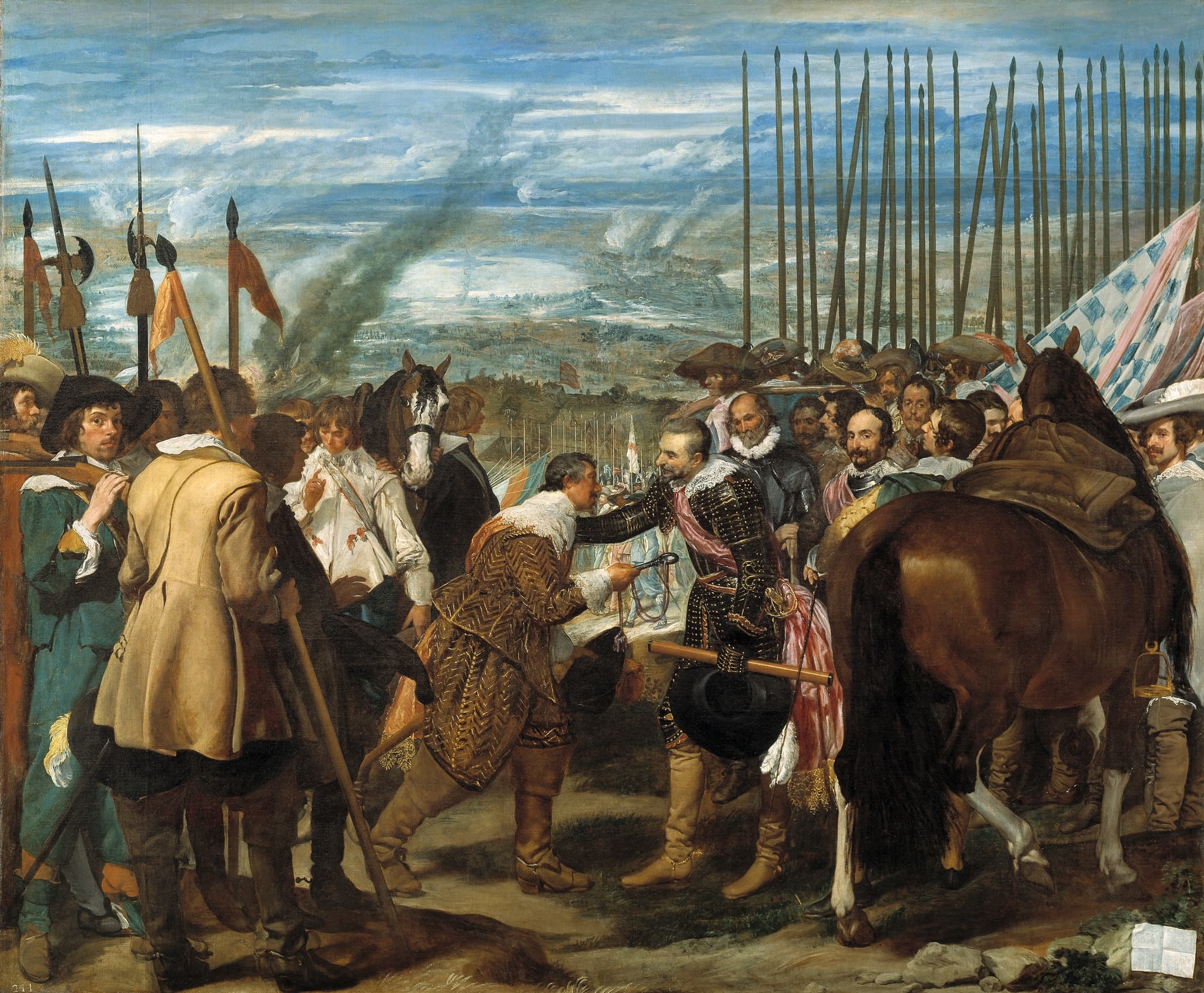
The Surrender of Breda (Las Lanzas) is a cornerstone of Velázquez’s oeuvre and Spain’s cultural patrimony at the Museo del Prado. It has never been on the market and is inalienable under Spanish heritage law, so this valuation is hypothetical. On unrestricted, open-market terms, its stature and rarity support a notional value of $300–600 million.
Valuation Analysis
Overview. Diego Velázquez’s The Surrender of Breda (Las Lanzas, c. 1635) is a monumental, career-defining history painting in the Museo Nacional del Prado. Commissioned for the Hall of Realms and preserved in Spain’s state collections, it has never been offered for sale and is effectively inalienable under Spanish heritage law, meaning any price is necessarily hypothetical and for open-market benchmarking only [1][2].
Method and comparables. With no sale history for this specific painting, the estimate relies on apex Old Master benchmarks. Leonardo’s Salvator Mundi achieved $450.3 million at Christie’s in 2017—proof that singular, pre-Modern trophies can command many hundreds of millions when global demand converges [3]. Sovereign and museum-level appetite is evidenced by the 2016 private-treaty acquisition of Rembrandt’s pendant full-length portraits for €160 million by the Rijksmuseum and the Louvre [4]. In the public auction arena, recent peaks include Botticelli’s $92.2 million portrait (2021) [5] and the earlier Rubens Massacre of the Innocents at £49.5 million (2002) [6]. Despite a softer Old Masters market in 2024, fresh, masterpiece-caliber works proved resilient: a Canaletto made $43.9 million in 2025 [8], and a Titian set a $22.2 million artist record in 2024—signals that the very top end remains selectively strong [9].
Deriving the range. Among Velázquez’s achievements, Breda ranks just behind Las Meninas—and alongside Juan de Pareja and the Portrait of Innocent X—as an apex, universally taught masterpiece. It is uniquely rich in narrative empathy and martial pageantry, and at more than three meters wide, it has singular wall power and institutional centrality [1]. The market for autograph Velázquez is extraordinarily thin; the artist’s public auction record—$17.0 million for Santa Rufina (2007)—simply reflects the absence of anything close to this caliber at auction, not his true market ceiling [7]. A planned 2024 Sotheby’s offering of a full-length royal portrait, guided around $35 million before being withdrawn, underscores how scarce high-quality opportunities are and how sharply values would step up for a canonical work [10].
Conclusion. On unrestricted international terms (i.e., disregarding legal inalienability only for valuation purposes), The Surrender of Breda would draw sovereign buyers, top museums, and the world’s largest private foundations. Its status, scale, rarity, and unbroken royal-to-state provenance justify a notional valuation of $300–600 million, slotting below Leonardo’s 2017 high-water mark but well above standard Old Master records [1][3][4][5][6]. In practical terms, however, the work remains a non-market, “priceless” pillar of Spain’s national heritage [2].
Key Valuation Factors
Art Historical Significance
High ImpactBreda is a flagship Baroque history painting and one of Velázquez’s most celebrated canvases, often ranked just behind Las Meninas in the artist’s oeuvre. Its narrative of martial magnanimity, sophisticated composition (the diagonal of lances, the psychological exchange between victor and vanquished), and painterly authority make it a staple of art‑historical curricula and a defining image of the Spanish Golden Age. Canonical status is the single most powerful value driver in pre‑Modern art. Works at this level transcend normal comparables because they anchor national and museum identities; that institutional centrality and extreme cultural resonance sustain valuations in the many hundreds of millions in any theoretical open‑market scenario.
Rarity and Market Scarcity
High ImpactAutograph Velázquez paintings are exceptionally scarce, with the great majority in museums. When works surface, they tend to be smaller, more specialized, or contested in attribution. The artist’s public auction record remains a modest $17.0 million (2007) only because true masterpieces never appear publicly; a withdrawn 2024 royal portrait guided at c.$35 million indicates a large pricing step-up even for strong but non‑iconic material. For a monumental, museum‑centerpiece Velázquez with unbroken provenance, scarcity exerts a powerful premium. In practice, the buyer pool for such a hypothetical opportunity would be limited but exceptionally deep-pocketed (sovereigns, national museums, blue-chip foundations), supporting a valuation far above standard Old Master ceilings.
Provenance and Legal Status
High ImpactCommissioned for Philip IV’s Hall of Realms, the painting retains an unbroken royal‑to‑state provenance culminating at the Museo del Prado. That pedigree eliminates typical authenticity or title risks and maximizes cultural capital. Spanish heritage law renders the work inalienable and non‑exportable, so this valuation is necessarily hypothetical. Paradoxically, such legal protections increase perceived scarcity (and therefore theoretical value) because the world understands that acquisition is effectively impossible. When modeling a price for an unrestricted, open‑market counterfactual, this ironclad provenance and the impossibility of substitution (there is no equivalent Velázquez history painting available) justify a valuation well into the hundreds of millions.
Demand Base and Cultural Resonance
High ImpactDemand for an object of this stature would come from a concentrated but extraordinarily capable buyer set: nation-states, sovereign wealth-backed museums, and the largest private foundations with public missions. Breda’s narrative of honor and reconciliation, its monumental scale, and its identity as a symbol of Spanish nationhood create broad public recognition and soft power—attributes that motivate sovereign or quasi‑sovereign acquisitions at prices beyond typical private collecting thresholds. Recent apex Old Master results show that when truly great, widely exhibited works surface, competition is intense and price resistance low. In this context, Breda’s cultural weight would be a decisive catalyst for a valuation of $300–600 million.
Sale History
The Surrender of Breda has never been sold at public auction.
Diego Velazquez's Market
Diego Velázquez sits among the most revered Old Masters, but his public market is extremely thin because the vast majority of autograph works reside in museums. His standing auction record is $17.0 million for Santa Rufina (Sotheby’s London, 2007), a figure that understates his true market potential given the absence of prime masterpieces at auction. A scheduled 2024 Sotheby’s sale of a full-length royal portrait guided around $35 million was withdrawn, highlighting both heightened interest and structural constraints on supply. Collectors and institutions prize Velázquez for his psychological acuity and painterly economy; when credible opportunities arise, they tend to resolve privately or under state heritage regimes rather than in open bidding.
Comparable Sales
Salvator Mundi
Leonardo da Vinci
Apex Old Master price benchmark showing what a universally prized, trophy-level pre-Modern painting can command on the open market.
$450.3M
2017, Christie's New York
~$580.9M adjusted
Pendant portraits of Maerten Soolmans and Oopjen Coppit
Rembrandt van Rijn
State-backed acquisition of canonical 17th‑century masterpieces; demonstrates sovereign-level appetite and pricing for irreplaceable Old Masters.
$176.0M
2016, Private treaty (Rothschilds to Rijksmuseum/Louvre)
~$230.6M adjusted
The Massacre of the Innocents
Peter Paul Rubens
Monumental Baroque history painting with martial drama; closest genre/scale proxy among high-profile public sales.
$76.7M
2002, Sotheby's London
~$135.8M adjusted
Portrait of a Young Man Holding a Roundel
Sandro Botticelli
Prime Old Master portrait that set a modern auction benchmark for Renaissance masters; indicates top-tier OM demand at auction.
$92.2M
2021, Sotheby's New York
~$108.8M adjusted
Rest on the Flight into Egypt
Titian
Record-setting Titian in 2024; shows contemporary pricing climate for museum-quality Old Masters amid a thin supply environment.
$22.2M
2024, Christie's London
~$22.8M adjusted
Santa Rufina (Saint Rufina)
Diego Velázquez
Artist’s standing auction record; underscores extreme scarcity of autograph Velázquez on the market, though far smaller and less important than Breda.
$17.0M
2007, Sotheby's London
~$26.2M adjusted
Current Market Trends
Old Masters experienced a soft 2024 at auction, with fewer >$10 million lots and cautious consignors. Yet the segment remains bifurcated: when museum-caliber, fresh works surface, demand is strong and results can be exceptional. In 2025, a Canaletto set a $43.9 million artist record, while in 2024 Titian achieved a $22.2 million record—both bellwethers for selective strength at the top. These outcomes suggest that true masterpieces with proven provenance can still attract deep global competition. Against that backdrop, a once‑in‑a‑generation Velázquez of canonical status—if hypothetically available and free of legal constraints—would command “many hundreds of millions,” well beyond standard Old Master benchmarks.
Sources
- Museo del Prado – ‘Las lanzas o La rendición de Breda’
- Boletín Oficial del Estado – Ley 16/1985 del Patrimonio Histórico Español
- BBC News – Leonardo da Vinci painting sells for record $450m
- The Art Newspaper – Rembrandt’s portraits sold to Louvre and Rijksmuseum for €160m
- Sotheby’s – Botticelli portrait sells for $92.2 million
- The Guardian – Rubens painting sells for record £49.5m
- The Art Wolf – Velázquez’s ‘Santa Rufina’ sold for £8.42m ($17m)
- Christie’s Press – Classic Week led by Canaletto’s record-breaking masterpiece
- Christie’s Press – Titian record (Rest on the Flight into Egypt), July 2024
- The Art Newspaper – Velázquez’s $35m ‘Spanish queen’ withdrawn from Sotheby’s