How Much Is The Triumph of Bacchus (Los Borrachos / The Drinkers) Worth?
Last updated: April 27, 2026
Quick Facts
- Methodology
- extrapolation
The Triumph of Bacchus (Los Borrachos) is a canonical, museum‑held Velázquez that has no modern market sale—any monetary estimate is hypothetical. Based on scarce public comparables, the dynamics of high‑end Old Master private sales, and the premium attached to museum‑grade national treasures, a conservative, defensible hypothetical market band is $100–150 million.
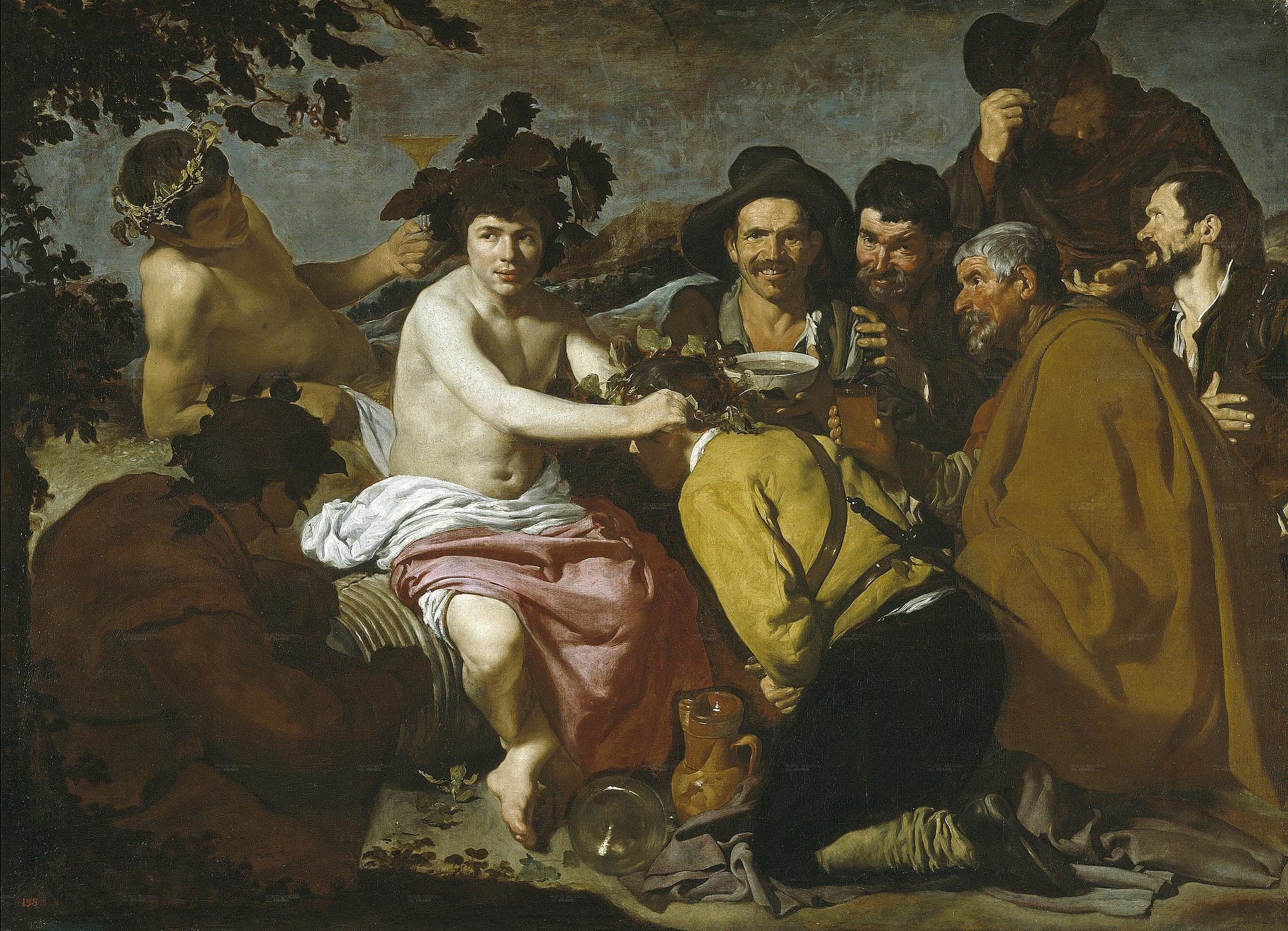
The Triumph of Bacchus (Los Borrachos / The Drinkers)
Diego Velazquez, 1628 • Oil on canvas
View more by Diego Velazquez →Valuation Analysis
Context and headline: The Triumph of Bacchus (Los Borrachos) is a major, Prado‑held Velázquez and has not been offered on the modern market; it is effectively a national treasure in public hands [1]. Because there is no recent, uncontested sale of this canvas, the valuation below is an informed extrapolation that combines the few realized Velázquez auction comparables, recent high‑end Old Master private‑sale dynamics, and the likely buyer set for a painting of this importance.
Comparables and market signals: Public auction evidence for autograph Velázquez is sparse and clusters in the low‑to‑mid millions (for example, modern public sales such as Saint Rufina demonstrate auction appetite but not the full market potential for a flagship Prado masterpiece) [3]. More recent market events—most notably the guaranteed but then withdrawn Isabel de Borbón offering in 2024—illustrate both strong institutional/collector interest in major Velázquez works and how delicate price discovery can be when legal, export or ownership questions arise [2]. Taken together, these datapoints show a relatively low transparent auction ceiling but a much higher latent private value when museums or major collectors negotiate directly.
Why $100–150M: The band reflects three interacting forces. First, scarcity: canonical Velázquez canvases rarely come to market, producing strong bidding competition whenever a truly museum‑grade work becomes available. Second, buyer profile: potential purchasers are large national museums, major private collectors and foundations that are willing to pay significant premiums to secure iconic, canonical works. Third, private‑sale dynamics and strategic negotiation (museum‑to‑museum deals, sovereign/departmental purchases, or private treaty sales) typically produce materially higher outcomes than headline auction results for comparably important works. The chosen band is intentionally conservative relative to some theoretical upper ranges (where strategic private deals could push prices higher) but it acknowledges that a legitimate market valuation for a work of this profile sits well above the handful of public auction comparables.
Key caveats: This estimate assumes clear attribution, a generally sound conservation state and a market environment in which export/deaccession obstacles are resolved (or the sale is confined to a domestic institutional buyer). The figure is not an insured valuation and is not an offer. Because of Spain’s cultural‑heritage protections and the Prado’s custodial status, an actual sale is improbable—any realized price would depend strongly on legal/administrative outcomes, the condition report, and direct institutional interest. For greater precision, a formal technical conservation report, confirmation of legal deaccessioning/exemption status, and confidential consultations with Old Master desks at major auction houses would materially refine the band.
Key Valuation Factors
Art Historical Significance
High ImpactThe Triumph of Bacchus is one of Velázquez’s most studied and reproduced works, an early masterpiece that uniquely blends mythological subject matter with naturalistic, genre‑like figures. Its place in the Prado collection and its centrality to narratives about Velázquez’s development make it a work of exceptional cultural and scholarly value. For collectors and institutions, canonical works with deep art‑historical significance are worth a premium because they fill gaps in institutional narratives and confer enduring prestige. That intrinsic, non‑fungible value drives demand that is not well reflected in routine auction comps.
Market Scarcity & On‑Market Availability
High ImpactMost of Velázquez’s greatest canvases are in national or major museum collections, creating acute supply scarcity. Because so few autograph works reach the market, public auction comparables understate the latent value of a flagship Prado canvas. Scarcity concentrates prospective buyers (national museums, large foundations, established private collectors), which generally increases the potential sale price—especially in private treaty negotiations where confidentiality and institutional competition can push outcomes well above transparent auction results.
Legal / Export Constraints
High ImpactSpanish heritage law, inexportability designations, and the Prado’s custodial role make the work effectively inalienable in practice. Any attempted sale would require navigating national acquisition rights, export permits and political scrutiny; these constraints limit the pool of feasible buyers and commonly convert market interest into protracted, negotiated transactions (often museum‑to‑museum) rather than open auctions. Legal obstacles therefore both depress liquidity and, paradoxically, increase the price a successful buyer must pay to secure the work.
Condition & Conservation
Medium ImpactCondition materially affects insurable and market value. Structural issues (canvas relining, major restorations), surface losses or unstable pigments reduce marketability and may cap offers. Conversely, a well‑documented conservation history and recent technical validation increase buyer confidence and could unlock top prices. Because no current public technical report has been reviewed for this valuation, an explicit condition assessment could move the estimate meaningfully in either direction.
Buyer Appetite & Competitive Set
High ImpactPotential buyers are predominantly museums, sovereign/departmental collectors and a handful of ultra‑high‑net‑worth private collectors with the infrastructure to steward a national treasure. When multiple institutions compete (domestically or internationally), strategic premiums are likely. However, domestic acquisition rights and export difficulty may limit international bidders, concentrating demand among a small set of deep‑pocketed institutional buyers and driving negotiated prices above ordinary auction discovery.
Sale History
The Triumph of Bacchus (Los Borrachos / The Drinkers) has never been sold at public auction.
Diego Velazquez's Market
Diego Velázquez is a top‑tier Old Master and the principal Spanish painter of the 17th century; his most important works are overwhelmingly held by museums, especially the Prado. Because canonical Velázquez canvases rarely enter the market, realized auction records are sparse and cluster in low‑to‑mid millions for smaller or contested works. That scarcity elevates the market value of any truly autograph, museum‑quality Velázquez when it does appear, but price discovery is often private, guaranteed, or negotiated between institutions—conditions that reduce public comparables but increase potential private sale outcomes.
Comparable Sales
Saint Rufina
Diego Velázquez
One of the few uncontested, autograph Velázquez paintings to reach public auction in modern times; demonstrates top-end public auction demand for authenticated Velázquez compositions.
$17.0M
2007, Sotheby's, London
~$25.3M adjusted
Portrait of Juan de Pareja
Diego Velázquez
Landmark institutional purchase (buyer: Metropolitan Museum). A canonical Velázquez that set an historic precedent—useful as an institutional willingness‑to‑pay benchmark once inflation‑adjusted.
$5.5M
1970, Christie's, London
~$43.8M adjusted
Portrait of a Gentleman (rediscovered attribution)
Diego Velázquez (rediscovered attribution)
Example of a rediscovered/recently attributed Velázquez reaching mid‑single‑millions at auction; shows market reaction to new attributions (smaller scale and less culturally iconic than Los Borrachos).
$4.7M
2011, Bonhams, London
~$6.4M adjusted
Portrait of Monsignor Cristoforo Segni
Attributed to Diego Velázquez with workshop/collaborative involvement
A collaborative/part‑workshop lot showing market pricing for works with partial or uncertain autograph status; useful to bracket values for non‑fully‑autograph or collaborative Velázquez attributions.
$4.1M
2018, Sotheby's, New York
~$4.8M adjusted
Portrait of a Girl (attributed Velázquez) — Abalarte sale
Attributed to Diego Velázquez
Recent Spanish sale of an attributed Velázquez for €8m (converted here to USD). Illustrates domestic market appetite, state/inexportability intervention risk, and how attribution + provenance/legal context affect realized price.
$9.0M
2017, Abalarte (Madrid)
~$11.0M adjusted
Current Market Trends
The high‑end Old Masters market has been characterized by limited supply, increased reliance on guarantees and private treaties, and selective institutional buying; after a soft patch in 2024 the segment rebounded in 2025. For canonical names like Velázquez, scarcity and institutional demand favor negotiated sales over transparent auction price discovery.
Sources
- Museo Nacional del Prado — Los Borrachos (The Triumph of Bacchus) collection entry
- The Art Newspaper — Velázquez’s $35m Spanish queen withdrawn from Sotheby’s (coverage of the 2024 withdrawal)
- Sotheby’s — Old Master Paintings evening sale (Saint Rufina lot / 2007)
- Art Basel & UBS Global Art Market reporting — Old Masters market trends