The Bottles and Oranges in A Bar at the Folies-Bergère
A closer look at this element in Édouard Manet's 1882 masterpiece
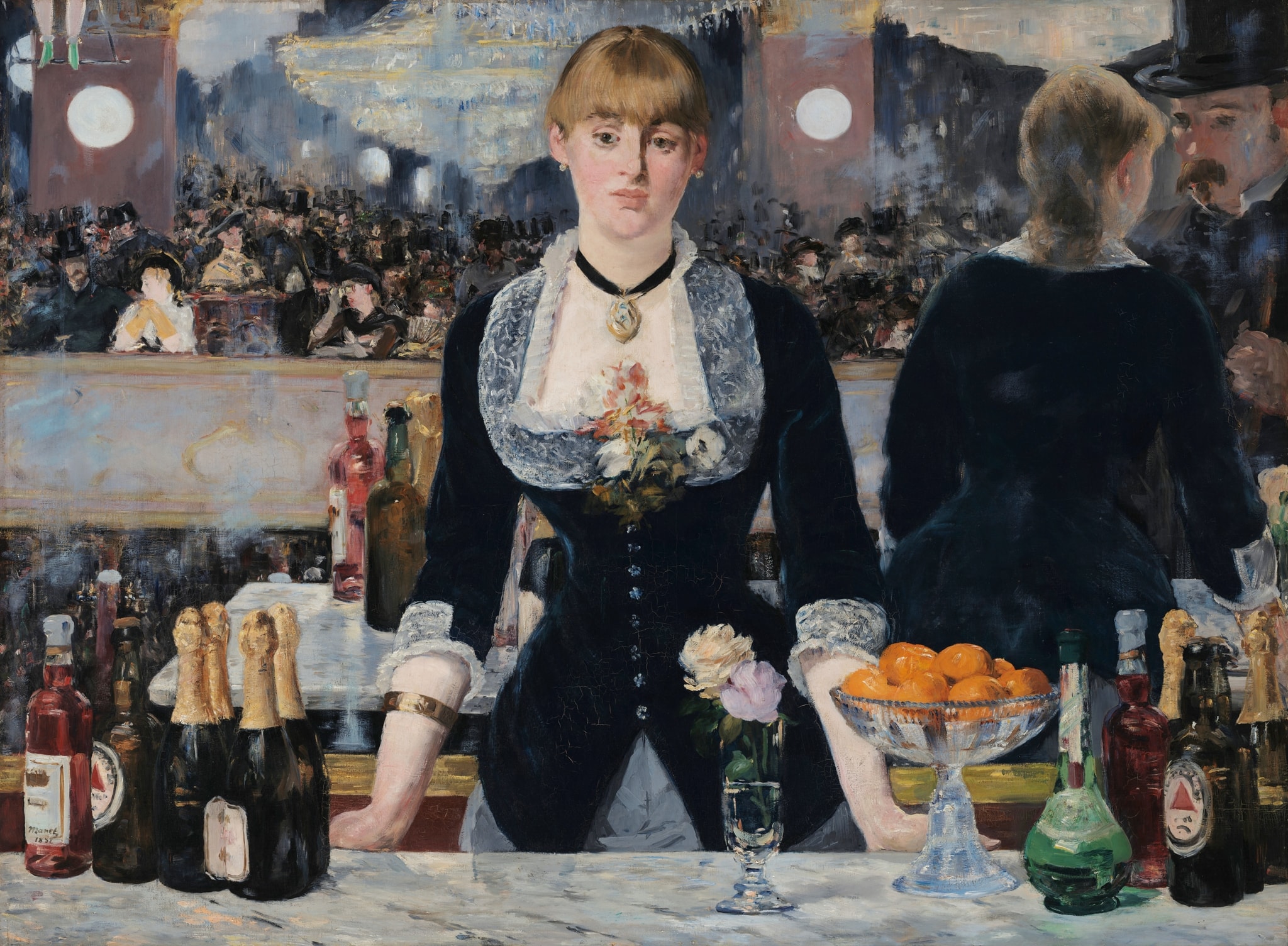
Bottles of champagne and beer flank a glittering glass compote piled with oranges—an eye‑level sales display that embodies the Folies‑Bergère’s culture of spectacle and consumption. Manet turns these tangible commodities into the painting’s hinge, where branding, desire, and modern urban life converge.
Historical Context
Painted in 1882, A Bar at the Folies-Bergère captures the café‑concert as a theater of modern life. Manet situates us at the mezzanine counter of the venue’s fashionable "American Bar", renowned for imported drinks. The counter’s still life—champagne on the left, beer on the right, and a bowl of oranges—functions as a deliberate sales array that announces the pleasures on offer and anchors the composition in the commerce of entertainment 12.
Manet’s attention to labeling is exacting and contemporary. He not only depicts recognizable brands but also signs and dates the painting on a bottle’s label at the far left, fusing authorship with commodity display. The arrangement reflects a late‑19th‑century Paris where consumption, spectacle, and cosmopolitan taste met at the bar, and where labeled goods signaled international networks of trade and fashion. In this setting, the bottles and oranges are not incidental props; they identify the venue, specify its offerings, and embody the modernity that Manet set out to describe 12.
Symbolic Meaning
The counter’s objects condense modern desire into a still life of commodities. Scholars have shown how Manet aligns the bar’s glittering array with new practices of urban display, positioning the viewer as a consumer among competing sights and temptations. Ruth E. Iskin argues that the bottles form a seductive retail tableau emblematic of Parisian consumer culture and the plural gazes it orchestrates 4.
Within this field of commodities, oranges carry a debated charge. A long‑circulating interpretation, associated with Larry L. Ligo, treats oranges in Manet’s work as a discreet sign of prostitution, thus aligning the fruit beside the barmaid with sexual commerce at the Folies‑Bergère 7. Other readings, however, stress how the fruit contributes to the painting’s rhetoric of display and appetite without fixing a single allegory, reinforcing the tension between goods for sale and the woman who mediates them 4.
Branding intensifies these meanings. The red‑triangle labels of Bass beer—among the first registered trademarks in Britain—signal the rise of modern branded goods and the international character of the bar’s offerings 6. Commentators have underscored the painting’s proto–product‑placement effect and even noted visual rhymes between the Bass triangles and the barmaid’s red corsage, linking her to the commodity field that frames her 5.
Artistic Technique
Manet renders the bottles, cut glass, and oranges with crisp, tactile strokes and pinpoint highlights that make them gleam at the picture plane, while the mirror behind them dissolves into looser, flickering reflections. This contrast heightens the still life’s palpable immediacy against the optical ambiguities of the reflected hall 3.
Composed as a horizontal band, the bottles and fruit create a bright barrier between viewer and barmaid; their reflections are knowingly misaligned, deepening the painting’s play with perspective and the viewer’s shifting vantage. Manet also makes the modern label a painterly surface by inscribing his signature and date on a bottle, yoking artistic authorship to commercial design and turning packaging into part of the artwork’s visual syntax 13.
Connection to the Whole
The counter still life is the painting’s point of contact with us: drinks and fruit feel graspable, while the woman remains psychologically distant and optically complicated by the mirror. This friction—sensual availability versus human inaccessibility—structures the work’s modern mood 3.
Flanking the barmaid like commercial brackets, the labeled bottles tie a living person to a field of goods, aligning her presence with the spectacle of consumer choice. The branded cues and glittering surfaces make the bar a stage where exchange, desire, and identity are negotiated in real time. In short, the bottles and oranges do not decorate the scene; they articulate its meaning, turning Manet’s final masterpiece into a lucid image of branded modernity and the commerce of looking 15.
Explore More from This Painting
This detail is one part of A Bar at the Folies-Bergère. Use the links below to return to the full interpretation, browse the full set of details, or view the painting's valuation if available.
Sources
- Courtauld Gallery – Beyond the Label: A Bar at the Folies-Bergère
- Art UK – Manet’s ‘A Bar at the Folies-Bergère’
- Smarthistory – Édouard Manet, A Bar at the Folies-Bergère
- Ruth E. Iskin – Modern Women and Parisian Consumer Culture (Cambridge UP excerpt)
- Artnet News – Manet and early ‘product placement’ readings
- Wikipedia – Bass Brewery (red triangle trademark)
- Wikipedia – A Bar at the Folies-Bergère (debated oranges reading)