The Mirror Reflection Mystery in A Bar at the Folies-Bergère
A closer look at this element in Édouard Manet's 1882 masterpiece
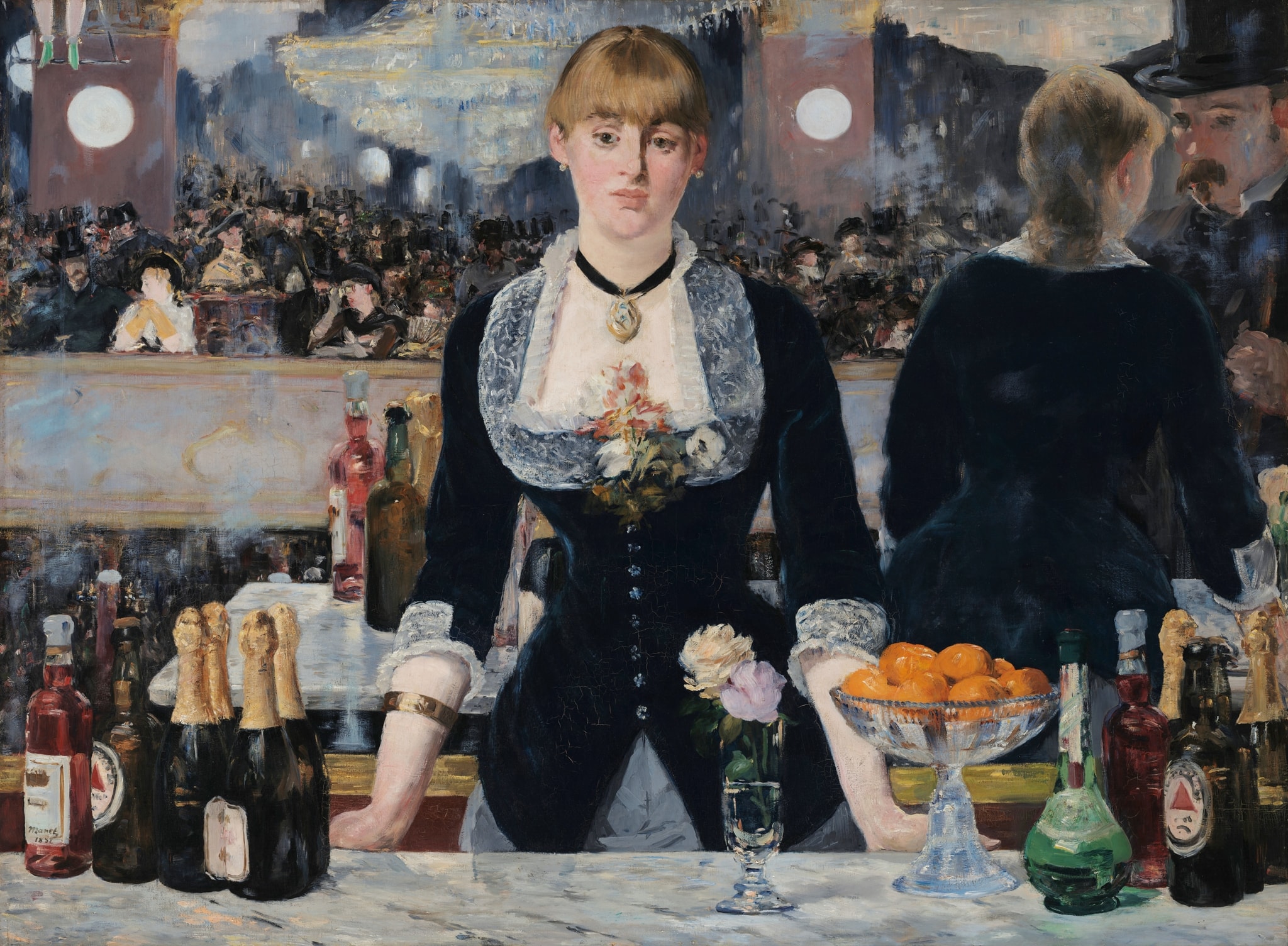
The painting’s gilded mirror displaces the barmaid’s reflection to the right, breaking optical rules and turning a crowded nightclub scene into a riddle about where we stand. Manet uses this deliberate misalignment to probe spectatorship, modern desire, and the uneasy commerce between seller and customer.
Historical Context
Manet completed A Bar at the Folies-Bergère in 1882, drawing on sketches made at the famous Paris music hall and finishing the canvas in his studio with a real barmaid, Suzon, as model. He reportedly built a mock bar to orchestrate the pose, bottles, and the vast gold-framed mirror that spans the composition. In this mirror he intentionally ignored normal perspective: the barmaid’s and a male customer’s reflections are shifted to the right, and several still-life objects fail to align exactly with their mirrored doubles 1.
The Folies-Bergère was renowned for spectacle and wall-to-wall mirrors, a modern interior that multiplied views of crowds, chandeliers, and acts high above the floor. Manet seized that setting to stage a contemporary encounter between worker and public while destabilizing the viewer’s position. The Getty frames the mirror as a visual puzzle that refuses any single, correct vantage—an effect that makes seeing itself the painting’s subject and binds the optical game to the social theater of Parisian nightlife 2.
Symbolic Meaning
The displaced reflection transforms the mirror from a recording device into a conceptual instrument. Rather than securing a stable viewpoint, it unsettles us: are we the customer glimpsed at right, the crowd in the glass, or an impossible frontal observer? The Getty links this to the long tradition of painting-as-mirror and shows how Manet modernizes it by denying a single spectator and making perception itself precarious 2. In doing so, he recasts mirror imagery familiar from Velázquez or van Eyck into a tool for thinking about modernity—electrified interiors, mass leisure, and fractured attention.
The bar’s commodity display—champagne, cordial bottles, oranges—meets the mirror’s solicitation of the eye. Ruth E. Iskin argues that the bar stages metropolitan consumption, where display culture seduces passersby and collapses boundaries between looking and buying; the mirror recruits the crowd and the viewer into that economy of desire 5. Readings influenced by T. J. Clark further interpret the barmaid as both salesperson and commodity within a milieu associated with clandestine prostitution, a slippage intensified by the mirror’s conflicted space 7. Writers also stress the Folies-Bergère’s celebrated mirrors, whose reflections heighten a sense of theatrical unreality, sharpening the image’s allure and estrangement 8.
Artistic Technique
Manet sets a crisply painted foreground—bottles, fruit dish, flowered corsage—against a looser, flickering reflection of chandeliers and crowd, heightening the divide between our space and the mirror-world 2. The mirror runs parallel to the picture plane, yet its contents are deliberately displaced: the barmaid and customer slide right, and bottle positions misregister with their mirrored doubles—evidence, as the Courtauld notes, of “ignoring normal perspective” 1.
Scholars have reverse-engineered the geometry. Malcolm Park’s reconstruction shows that an off-axis viewpoint far to the barmaid’s left can account for much of the rightward shift while the painting still feigns a frontal address 23. Thierry de Duve demonstrates how Park’s schema explains certain bottle/reflection mismatches, even as remaining anomalies signal Manet’s will to sustain ambiguity through compositional choice 4.
Connection to the Whole
The reflection puzzle is the painting’s engine, not an error to be corrected. By scrambling alignments, Manet fuses the commerce of the bar with the spectacle of the hall and makes the act of looking unstable. The frontally posed barmaid—self‑contained, unreadable—anchors this whirl of desire and display, even as her doubled image suggests a split between person and role 1.
The result is a modern meditation on spectatorship and exchange: the viewer becomes a participant in the transactional space the mirror constructs, poised between object and subject, purchase and gaze. In this way the displaced reflection binds the still life, the crowd, and the worker into a single, disorienting allegory of urban modern life 25.
Explore More from This Painting
This detail is one part of A Bar at the Folies-Bergère. Use the links below to return to the full interpretation, browse the full set of details, or view the painting's valuation if available.
Sources
- Courtauld Gallery, Collection entry: A Bar at the Folies-Bergère
- J. Paul Getty Museum, exhibition site: Manet’s Bar at the Folies-Bergère
- Los Angeles Times, review summarizing Malcolm Park’s reconstruction
- Thierry de Duve, “Intentionality and Art Historical Methodology: A Case Study,” Nonsite.org
- Ruth E. Iskin, “Selling, Seduction, and Soliciting the Eye: Manet’s Bar at the Folies-Bergère,” The Art Bulletin 77, no. 1 (1995)
- Art UK, overview: Édouard Manet’s A Bar at the Folies-Bergère
- Wikipedia, A Bar at the Folies-Bergère (for synthesized scholarly context)
- Artnet News, explainer on the Folies-Bergère mirrors and the reflection’s unreality