The Trapeze Artist's Legs in A Bar at the Folies-Bergère
A closer look at this element in Édouard Manet's 1882 masterpiece
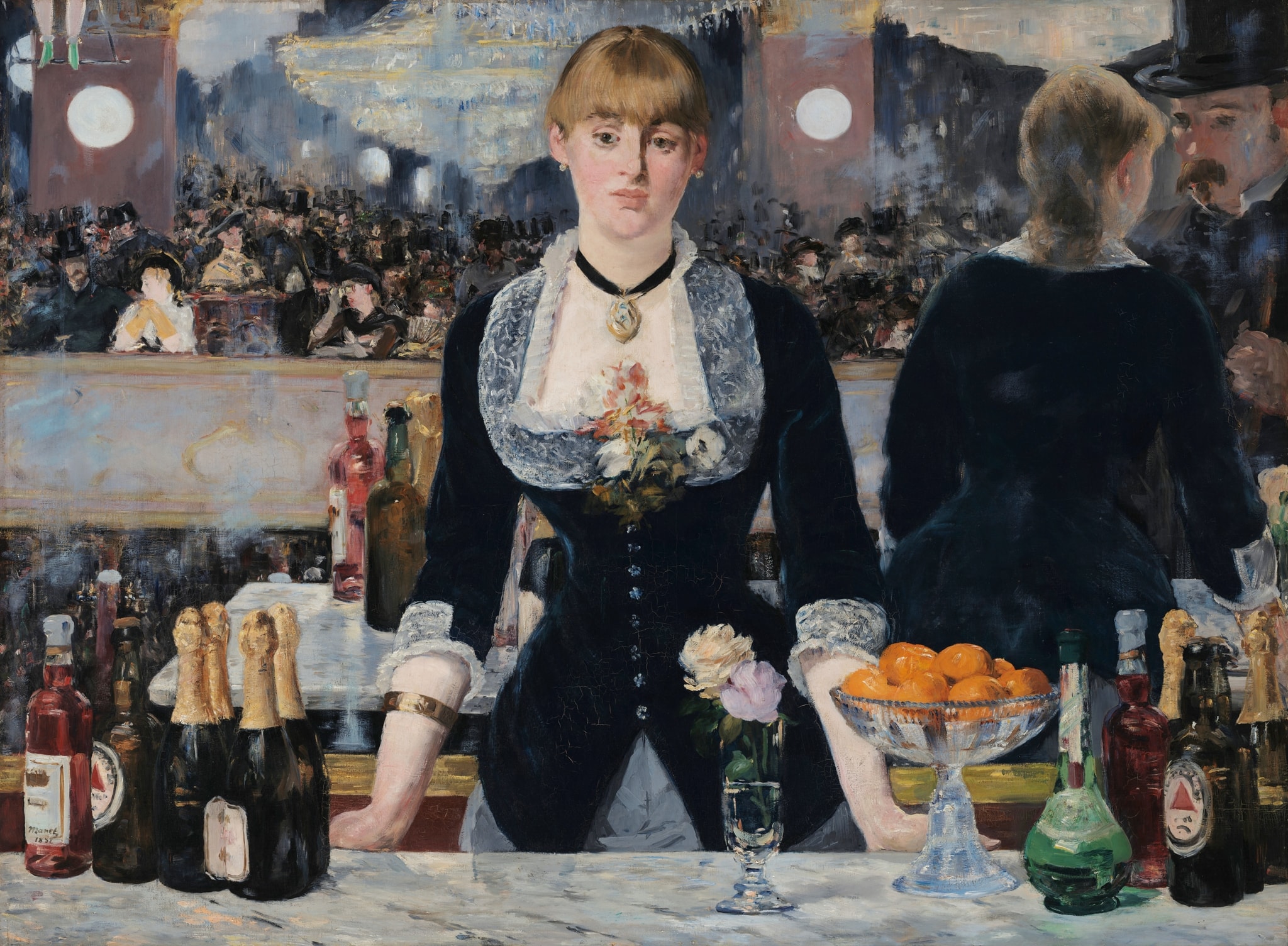
At the very top-left of Manet’s canvas, a pair of cropped calves in bright green boots dangles into view—the legs of a trapeze artist performing at the Folies-Bergère. Glimpsed in the mirror behind the barmaid, this witty fragment captures the hall’s circus energy and Manet’s modern, camera-like cropping in a single stroke. It turns a near-miss detail into a key to performance, perception, and urban pleasure.
Historical Context
Painted for the 1882 Salon, A Bar at the Folies-Bergère places viewers in Paris’s premier café-concert, a venue famed for a mixed program of popular entertainments that included acrobatics. Manet signals that variety bill through the upper-left fragment of a performer’s legs: the Courtauld identifies this as a trapeze artist in green boots, visible within the large mirror that reflects the bustling auditorium behind the barmaid 1. The Courtauld’s extended label further clarifies that the two green marks are the boots of an acrobat, a concise visual cue that anchors the painting to the Folies-Bergère’s real attractions in the early 1880s 2.
The choice was timely and legible to contemporary audiences. By showing only the lower legs and footwear, Manet evokes the momentary, spectacular acts that punctuated an evening at the music hall while maintaining focus on the bar’s transactional foreground. The performer belongs to the onstage action below the balcony; we perceive it only indirectly, as a sliver caught in reflection. This deft insertion situates the painting within modern Parisian leisure culture and embeds live entertainment into the picture’s spatial logic 12.
Symbolic Meaning
The dangling, green-booted calves encapsulate the spectacle of modern life that animates the café-concert. Smarthistory highlights how Manet locates us amid entertainment that feels “a little more circus-like,” and the acrobat’s legs become a minimal but pointed sign of mass amusement and the commodified pleasures circulating through the hall and across the bar counter 3. Set against Suzon’s reserved pose, this fragment contrasts working stillness with aerial excitement, amplifying the painting’s meditation on performance, desire, and exchange—a tension also underscored by period commentary on the Folies-Bergère’s variety program 5.
Equally potent is the leg detail as a cropped fragment—a modern way of seeing that implies a wider, continuous world beyond the frame. In Masked Ball at the Opera, Manet used similarly truncated, dangling legs to announce that we witness only part of a larger scene; that parallel clarifies the Folies-Bergère fragment as a device of modern perception, akin to a photographic snap 7. Located within the mirror’s ambiguous field, the legs participate in Manet’s optical games: Getty’s analysis of the work’s “offset” viewpoint shows how reflections disorient and energize our looking, and the acrobat’s abrupt appearance sharpens that perceptual play 4. As Art UK notes, this easily missed sliver rewards alert viewers, inviting them to read the painting as a theater of glances and fragments 6.
Artistic Technique
Manet renders the acrobat with extreme economy: a few brisk strokes for pale calves and a concentrated note of vivid green for the boots. That chromatic accent pops against the darker ceiling zone, making the performer legible at a glance while remaining subordinate to the barmaid and counter 13. The summary handling fits the looser facture of the reflected background, whose greys and browns suggest motion and crowd energy 3.
Compositionally, the figure is decisively cut by the canvas edge—a deliberate crop Manet had explored earlier. Museum commentary on Masked Ball at the Opera explains how such truncations assert a world extending beyond sight; the same principle heightens immediacy here 7. Britannica’s contrast between crisp foreground and hazier reflection also frames the legs as part of an atmospheric, shifting realm, reinforcing their status as a transient flash of spectacle rather than a fixed narrative episode 5.
Connection to the Whole
This small detail crystallizes the painting’s core themes. It registers the Folies-Bergère as a site of continuous entertainment while keeping our attention on the commerce of the bar, a counterpoint that structures the picture’s social drama. The acrobat’s sudden intrusion prompts the eye to rove the mirror, connecting the quiet, frontal presence of Suzon to the teeming spectacle behind her 13.
Spatially, the legs sit inside the painting’s most conceptually charged zone: the mirror. Getty’s account of the work’s offset optics explains how Manet destabilizes viewpoint and expectation; the trapeze fragment intensifies that effect, materializing motion and risk inside the reflective field 4. As a modernist sign of life beyond the frame, it helps the canvas convey urban modernity as a chain of partial, glancing perceptions.
Explore More from This Painting
This detail is one part of A Bar at the Folies-Bergère. Use the links below to return to the full interpretation, browse the full set of details, or view the painting's valuation if available.
Sources
- Courtauld Gallery — A Bar at the Folies-Bergère (official object page/highlight)
- Beyond the Label (Courtauld Collection project): A Bar at the Folies-Bergère
- Smarthistory — Manet, A Bar at the Folies-Bergère
- Getty Museum — Manet’s Bar at the Folies-Bergère: One Scholar’s Perspective
- Encyclopaedia Britannica — A Bar at the Folies-Bergère
- Art UK — Édouard Manet’s ‘A Bar at the Folies-Bergère’
- National Gallery of Art — Manet, Masked Ball at the Opera