How Much Is A King and a Beggar Maid Worth?
Last updated: May 11, 2026
Quick Facts
- Last Sale
- $1.1M (2014, Sotheby's London)
- Methodology
- comparable analysis
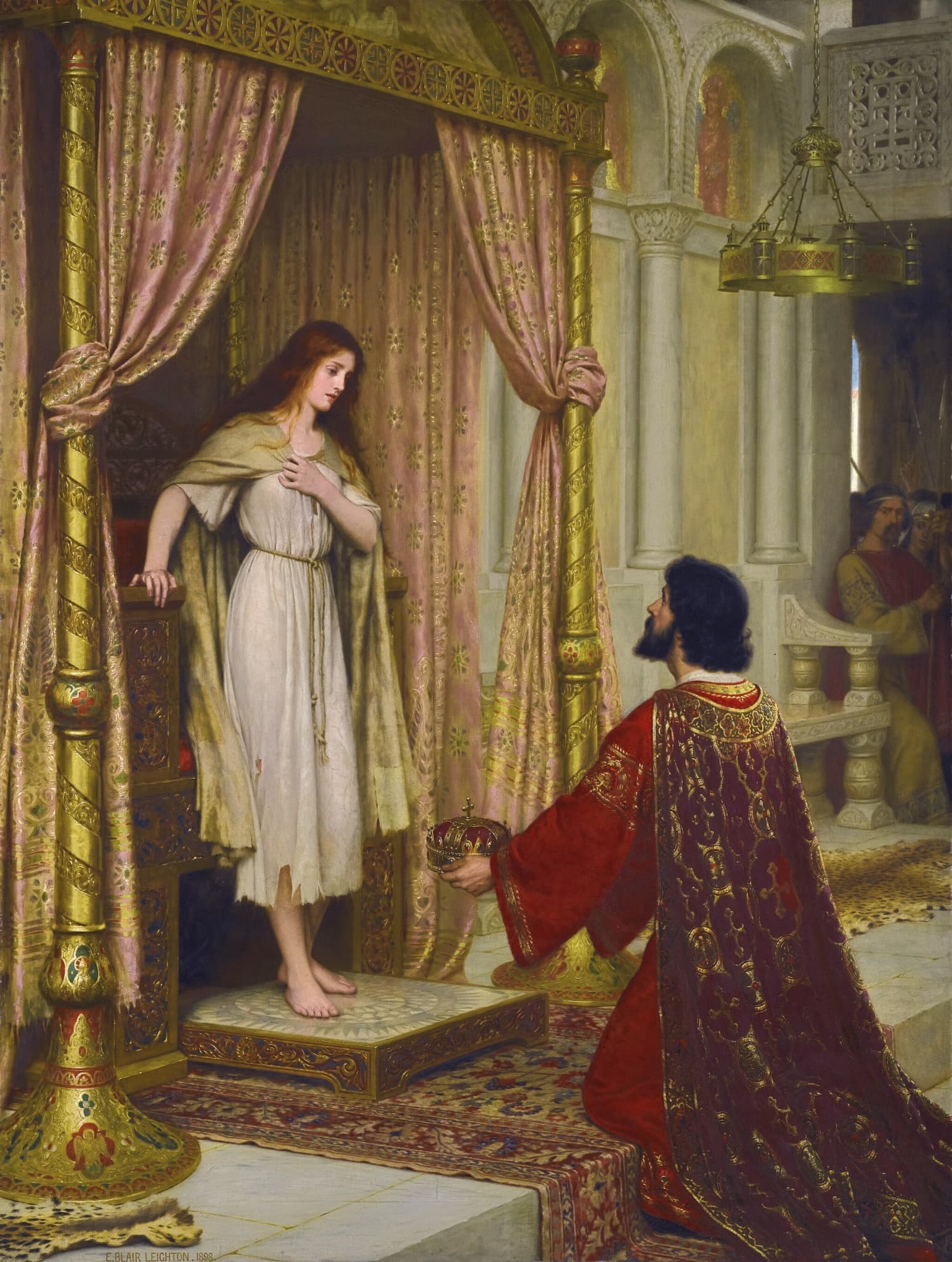
Anchored to the confirmed Sotheby’s London sale of 22 May 2014 (GBP 662,500 realized), a realistic auction estimate for Edmund Blair Leighton’s A King and a Beggar Maid today at a major house is approximately $1.3–$1.9M. The lower bound assumes good but not pristine condition or limited campaigning; the upper bound assumes excellent condition, intact original presentation, and strong RA/exhibition provenance and marketing.
Valuation Analysis
Headline conclusion: The most direct market anchor is the confirmed Sotheby’s London sale of 22 May 2014 (lot 211), which realised GBP 662,500 (≈ USD 1,116,710 at the sale date) and is documented in the lot records [1]. Using that sale as the primary datum and comparing to other major Leighton results, I place a practicable auction valuation for an identical painting offered today in a major-house evening/specialist sale at approximately $1.3–$1.9 million (USD). The low point of this band assumes good but not pristine condition or limited pre-sale promotion; the high point assumes outstanding condition, intact original framing, secure RA exhibition provenance and a major-house marketing campaign.
How the band was derived: The 2014 Sotheby’s result provides a clear realized precedent for this composition and quality level and therefore receives the greatest weight in the comparable analysis [1]. Historic high-water comparables for Leighton (notably large, fully finished chivalric canvases sold at Christie’s and Sotheby’s) demonstrate that museum-quality examples can reach the mid‑to‑high six-figure range and occasionally break into low seven figures, validating the top end of the band [2]. I reconciled the raw 2014 sterling result with purchaser currency movement and with post-2014 market dynamics: while simple inflation/currency adjustments would place the 2014 lot nearer the middle of this band, market cooling at the very top since 2019–2023 and the specialist nature of the buyer pool justify a conservative but realistic $1.3–$1.9M auction range.
Primary value drivers and sensitivities: Condition and conservation history, secure provenance/Royal Academy exhibition citation, scale and degree of finish, and sale venue are the critical variables. Condition and relining status can alter value materially (conservatively by ±20–40% in extreme cases), so a full conservator’s report is essential. Provenance that includes Agnew’s, RA exhibition citation and the documented Christie’s/Sotheby’s appearances materially reduce attribution risk and attract institutional and high-net-worth collectors, supporting the upper end of the estimate [1]. Scale/composition matters: large, fully finished narrative canvases command markedly higher bids than reduced studies or copies (see comparable large Leighton works sold at Christie’s) [2].
Sale strategy and practical next steps: To convert the estimate into a sale-ready reserve I recommend obtaining high-resolution images (full and detail shots), a written conservator’s condition report, and all provenance/exhibition documentation. If condition and provenance are excellent, present the picture to the Victorian/British painting specialists at Sotheby’s or Christie’s for an evening/specialist sale; this maximizes the likely buyer pool and press exposure. If the work has significant conservation issues or limited provenance, consider a carefully timed regional or specialist sale or a private-treaty approach. This valuation is evidence-based and anchored to the cited auction record, but remains sensitive to the condition/provenance data you can provide [1][2].
Key Valuation Factors
Art Historical Significance
High ImpactA King and a Beggar Maid is firmly rooted in Edmund Blair Leighton’s mature production of romantic/medieval narrative painting and benefits from a Royal Academy exhibition citation (1898) and early dealer handling, which elevates it above routine genre panels. The subject type—chivalric narrative—matches the collector profile that historically pays premiums for Leighton’s best work. Although not as universally iconic as The Accolade, RA exhibition history, early dealer association and placement in published catalogues make this composition materially more desirable to institutional and specialist collectors. For valuation purposes, art‑historical significance is a high-impact factor because it widens the credible buyer pool and underwrites the applicability of high-end comparables.
Condition & Conservation
High ImpactCondition is among the single most decisive influences on price. An original, stable canvas with minimal retouching, intact ground and an original or period frame will secure buyer confidence and support the upper estimate; conversely, heavy relining, major restoration or pervasive inpainting will depress the outcome significantly. Structural issues (canvas tears, unstable paint, adhesion loss) materially restrict the sale routes and buyer appetite. A professional, written conservator’s report addressing relining, varnish state and any restorative interventions is essential to translate the theoretical top-house value into a practical reserve and to set accurate marketing language for condition—hence the factor’s high impact.
Provenance & Exhibition History
High ImpactSecure, documented provenance — here including passage via Thomas Agnew & Sons, Royal Academy citation (1898) and recorded Christie’s and Sotheby’s appearances — materially reduces attribution risk and increases institutional interest. Named collectors or inclusion in published collections (e.g., the Ross collection) and repeated market/institutional exposure increase transparency and desirability. When provenance confirms RA exhibition and reputable ownership, auction houses can market to museums and specialist collectors with greater confidence, typically improving realised prices and reducing the risk of post‑sale disputes. For this painting, provenance/exhibition history is therefore a high-impact value driver.
Scale & Composition
High ImpactSize and the level of finish determine which comparables are appropriate. Large, fully finished narrative canvases by Leighton (the type represented by the 2014 Sotheby’s lot and historically by works like God Speed) perform at a markedly higher level than smaller domestic scenes or studies. Large compositions reproduce better in catalogues, read strongly in salerooms, and attract institutional buyers and serious collectors—all of which lifts realizations. If the painting is a studio replica, reduced version or informal study, it will align with the lower value band; if it is full scale and richly finished, it aligns with the top-house comparables. This factor is therefore high-impact.
Sale Venue & Market Demand
High ImpactWhere and when the painting is offered has an outsized effect. Major-house evening/specialist sales at Sotheby’s or Christie’s (London/NY) consistently attract the deepest specialist bidder pools and press coverage, which can lift a work to the high end of its estimate. Regional houses and online-only sales (Bonhams, Bukowskis) typically produce lower median outcomes but can occasionally surprise. Market cycles since 2019 have reduced the frequency of reliable seven-figure results in this category, so careful timing and targeted marketing to Victorian/Pre‑Raphaelite collectors remain essential. For these reasons sale venue and market demand are a high-impact factor.
Sale History
From the artist to Thomas Agnew & Sons; Royal Academy exhibition (1898)
Christie's (London)
Christie's (London)
Christie's (London)
Sotheby's (London), lot 211
Edmund Leighton's Market
Edmund Blair Leighton occupies a stable niche market: highly collectible among enthusiasts of late‑Victorian romantic and academic painting, but not a mainstream blue‑chip artist. Top, museum‑quality Leighton canvases with strong provenance and RA exhibition history have historically achieved mid‑to‑high six figures and occasional low‑seven‑figure results when marketed through leading departments. Conversely, numerous smaller genre works and studies trade in the low five‑figure band or below. Demand is consistent from specialist collectors, dealers and occasional institutional buyers; therefore provenance, condition and sale venue are the primary determinants of realized price.
Comparable Sales
A King and a Beggar Maid
Edmund Blair Leighton
Identical work — same painting offered and sold at a major house; RA 1898 exhibition provenance and catalogue essay make this the primary market benchmark.
$1.1M
2014, Sotheby's London
~$1.5M adjusted
God Speed
Edmund Blair Leighton
Large, museum‑quality Leighton composition (knightly/historical subject) sold at Christie’s — a historical high‑end comparable for scale, finish and market significance.
$1.1M
2000, Christie's (London)
~$2.0M adjusted
Faded Laurels
Edmund Blair Leighton
Recent strong regional‑house result for a substantial Leighton canvas — useful to show mid‑/upper‑market demand outside top London/NY salerooms.
$96K
2023, Bukowskis (Stockholm)
~$102K adjusted
The Window Seat
Edmund Blair Leighton
Small/medium domestic subject sold at Bonhams (2024) — representative of the lower market band for many Leighton genre pictures and helpful to bracket price dispersion by size/subject.
$15K
2024, Bonhams (London)
~$15K adjusted
Sally
Edmund Blair Leighton
Recent regional/online sale for a small Leighton work — illustrates routine lower‑end outcomes for the artist in standard market conditions.
$12K
2025, Shapiro Auctions (New York)
Current Market Trends
Through 2024–2026 the global art market has cooled at the absolute top while transaction volume has strengthened in lower price tiers. Victorian and Pre‑Raphaelite adjacent works remain a specialist category with steady but selective demand: good examples still command premiums, but frequent seven‑figure outcomes are rarer. Sellers should maximise venue, condition and provenance to capture scarce top‑end buyer interest.
Sources
- Sotheby's London – British & Irish Art, 22 May 2014, Lot 211 (A King and a Beggar Maid)
- Christie's – Notable Leighton comparables (e.g., God Speed sale information)
- Bukowskis – Important Winter Sale (Faded Laurels; regional strong result)
- Bonhams – Edmund Blair Leighton, The Window Seat (example of a lower-mid market recent sale)