How Much Is Stitching the Standard Worth?
Last updated: May 11, 2026
Quick Facts
- Methodology
- comparable analysis
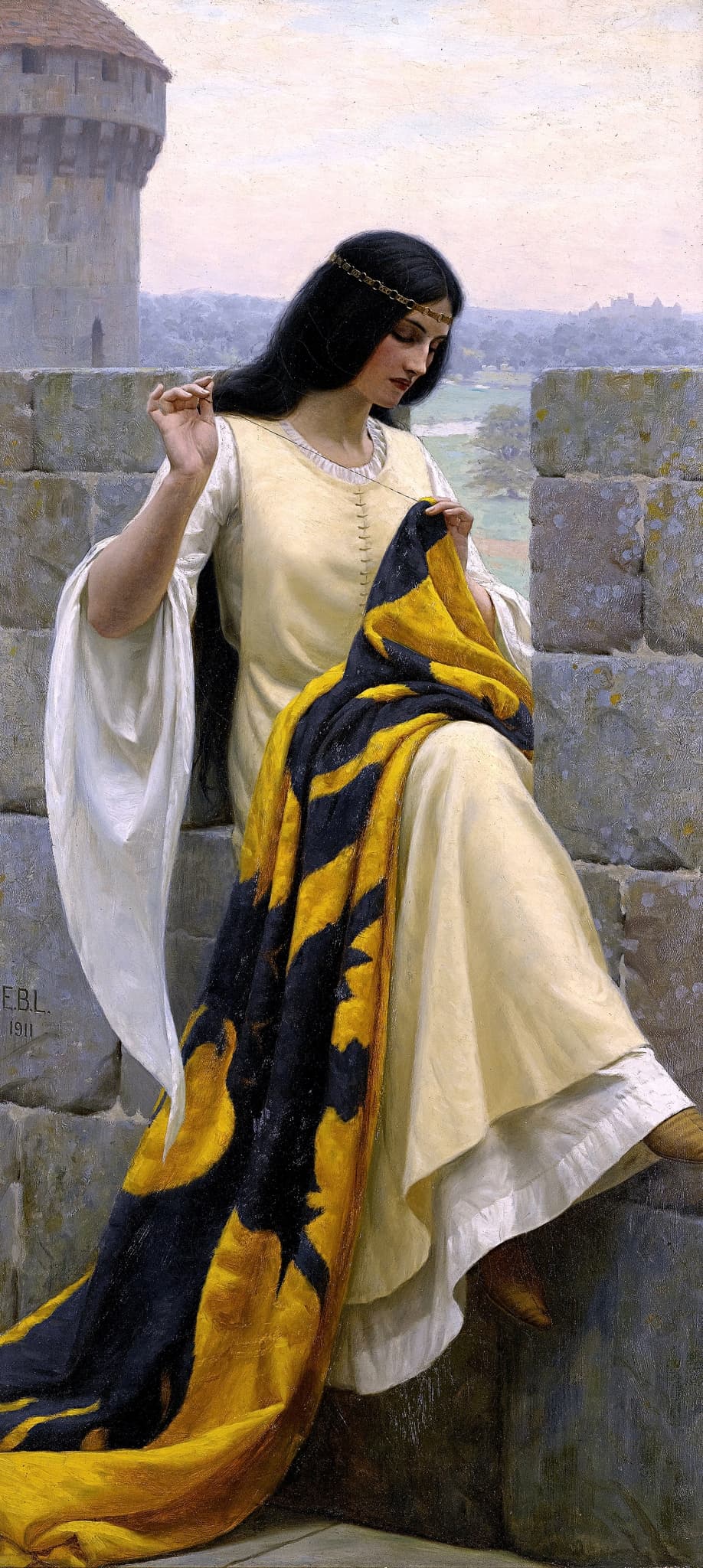
Assuming the painting is the documented 1911 oil (approx. 98 × 44 cm), original and in exhibition‑quality condition with sound attribution and ordinary private provenance, I value Edmund Leighton’s Stitching the Standard at approximately $220,000–$420,000 USD. Provenance gaps, condition problems or attribution doubts could reduce value sharply; museum interest or exceptional provenance could push the painting above this band.
Valuation Analysis
Valuation conclusion: Anchoring to Sotheby’s 2011 catalogue treatment (estimate GBP 150,000–200,000) and to known auction comparables for Edmund Blair Leighton, the most supportable current auction range for Stitching the Standard is approximately $220,000–$420,000 (USD) for an attributed, exhibition‑quality 1911 oil on canvas of the documented dimensions and ordinary private provenance [1]. This range reflects inflation/market movement since 2011, the mid‑market strength for Leighton canvases, and observed realised levels for comparable exhibited pictures.
Comparables & market anchors: Sotheby’s explicit 2011 estimate gives a direct institutional anchor to the work’s market positioning in a major London sale [1]. At the top end of the artist’s market, examples such as God Speed (Christie’s, 2000) establish a ceiling in the low‑seven‑figure range and confirm that Leighton can achieve substantially higher results for rarities and museum‑quality canvases — but those sales are exceptional and rare [2]. More typical exhibited Leighton canvases in the last decade have performed in the mid‑five‑figure to low‑six‑figure bands, consistent with the midpoint of the range above.
Key value drivers: The most important determinants that would move this estimate materially are condition (original paint, restorations, relining), secure attribution (clear, verifiable signature and studio records), and provenance/exhibition history. A clean condition report and documented exhibition provenance will keep the picture comfortably in the stated band; significant restoration, overpainting or attribution questions would depress value toward the lower tens of thousands.
Risks and upside: Downside scenarios: if the canvas is a small study, substantially damaged, or suffers attribution uncertainty, expect realized prices well below the stated range (commonly <$50k in the market for lesser Leighton works). Upside scenarios: if archival provenance or a strong museum interest / loan history is established (or if Sotheby’s 2011 lot realised above estimate with a demonstrable market reaction), the painting could achieve results above $420k and, in rare cases of exceptional quality and provenance, enter the higher six‑figure territory for the artist.
Recommended next steps to firm the valuation: obtain high‑resolution images (front, reverse, signature, stretcher/labels), a professional condition/conservation report, and the exact realized price (if any) for the 15 Nov 2011 Sotheby’s appearance (the public lot page shows the estimate but hides the result behind a login) [1]. With that information a specialist auction house valuation or an independent RICS/ISA appraisal can convert this working range into a firm pre‑sale estimate.
Notes: this valuation assumes the canvas in question is the painting catalogued at Sotheby’s in 2011 and described in the provenance trail. The estimate is market‑oriented (auction resale) rather than an insurance or liquidation figure.
Key Valuation Factors
Art Historical Significance
Medium ImpactEdmund Blair Leighton is a recognised and collectible late‑Victorian/Edwardian narrative painter whose idealised medieval subjects have established steady collector demand. However, 'Stitching the Standard' is not, in the literature and exhibition record currently available, one of Leighton’s canonical or widely‑reproduced masterpieces, which moderates its art‑historical premium. The painting’s subject and date (1911) are typical of the artist’s mature production and therefore attractive to genre collectors, but absence of a major museum accession or high‑profile scholarly treatment keeps its academic premium at a medium level rather than high.
Condition & Conservation
High ImpactPhysical condition is the single most important near‑term driver of auction value. Original varnish, intact paint surface, and conservative restoration will keep buyer confidence high and support the estimated range. Significant overpainting, heavy retouching, structural issues (loose canvas, major relining), or evidence of loss will materially reduce sale prospects and drive value downward, sometimes by an order of magnitude. A formal condition report from a qualified conservator should be obtained before marketing or insurance as it will directly influence house estimates and buyer bids.
Provenance & Exhibition History
High ImpactDocumented sale appearances at Christie’s (1928), Phillips (1977) and Sotheby’s (1978 and 2011) give the work an identifiable chain of public movement, which strengthens market confidence even where realized prices are not publicly disclosed. Clear ownership history, exhibition loans, or inclusion in a published catalogue raisonné would uplift the painting’s marketability and price. Conversely, gaps, ambiguous attributions, or private sales without documentation introduce buyer caution and reduce estimates.
Comparables & Auction Demand
Medium ImpactComparable realized sales for Leighton range widely — from sub‑$25k for small studies to several hundred thousand dollars (and above) for exhibited canvases; historic top sales reached ~£600–700k (USD ~1.0M at earlier exchange rates). Sotheby’s 2011 estimate for this specific picture placed it in the mid‑market for the artist, and recent mid‑market auction activity supports a mid‑to‑low six‑figure band for similar exhibited canvases. Active marketing through a major house and the timing of the sale relative to Victorian/Pre‑Raphaelite auctions will influence demand and final price.
Rarity / Size / Subject Appeal
Medium ImpactThe composition (medieval/ceremonial subject) is commercially appealing to the established pool of Victorian narrative collectors. The recorded dimensions (approx. 98 × 44 cm) produce a slender vertical format that is visually striking but potentially more specialist in display, which can both attract focused collectors and slightly narrow the buyer pool. Size and subject together produce a moderate positive effect on value; they are unlikely on their own to push the work into the very top price brackets without additional provenance or rarity factors.
Sale History
Christie's (London)
Phillips (London)
Sotheby’s (Belgravia)
Sotheby’s — Victorian & Edwardian Art (London)
Edmund Leighton's Market
Edmund Blair Leighton (1853–1922) occupies a solid, collectible niche in the late‑Victorian/Edwardian narrative genre market. His best canvases have historically reached low‑seven‑figure levels at auction, but the bulk of his market trades in the five‑figure to low‑six‑figure bands. Demand is steady among collectors of academic and medieval‑revival painting; prices are determined primarily by scale, condition, provenance and exhibition history. Leighton is well‑regarded but has not experienced the recent scholarship or institutional reappraisal that would broadly uplift mid‑market prices across the catalogue.
Comparable Sales
God Speed
Edmund Blair Leighton
Same artist; large, museum-quality narrative composition and the artist's commonly cited auction high — useful to define the market ceiling for Edmund Leighton works.
$1.0M
2000, Christie's, London
~$1.9M adjusted
A King and a Beggar Maid
Edmund Blair Leighton
Same artist; high‑value, large narrative picture sold at a major house — demonstrates a repeat high benchmark for premium Leighton canvases.
$1.1M
2014, Sotheby's, London
~$1.5M adjusted
My Lady Passeth By
Edmund Blair Leighton
Same artist; mid‑market exhibited canvas realised at auction — a useful direct comparator for Stitching the Standard's likely band if similar in size/quality/provenance.
$188K
2019, Christie's
~$233K adjusted
The Letter
Edmund Blair Leighton
Same artist; small study/lesser work — provides a lower‑end benchmark and illustrates the wide spread in Leighton prices by scale and importance.
$20K
2022, Deutscher & Hackett, Sydney
~$21K adjusted
Current Market Trends
The market for Victorian/Pre‑Raphaelite/academic British painting has shown stability at entry and mid levels but softness at the very top since 2022–2023. Collectors remain active for well‑conditioned, exhibited works; however, sales are selective and sensitive to provenance and condition. Auction houses continue to present Leighton works in specialist sales, and occasional museum programming for related artists can boost interest, though such effects are usually incremental.