How Much Is Tristan and Isolde (The End of the Song) Worth?
Last updated: May 11, 2026
Quick Facts
- Last Sale
- $361K (2000, Christie's, London (Important British Art, lot 17))
- Methodology
- comparable analysis
For the documented 1902 Royal Academy-exhibited oil on canvas (approx. 50½ x 58 in.), I estimate a present-day market value of USD 200,000–600,000. This range is anchored to the Christie's London sale of 14 June 2000 (GBP 240,250 ≈ USD 361,144 at the time) and adjusted for current market conditions, condition/provenance, and recent comparables.
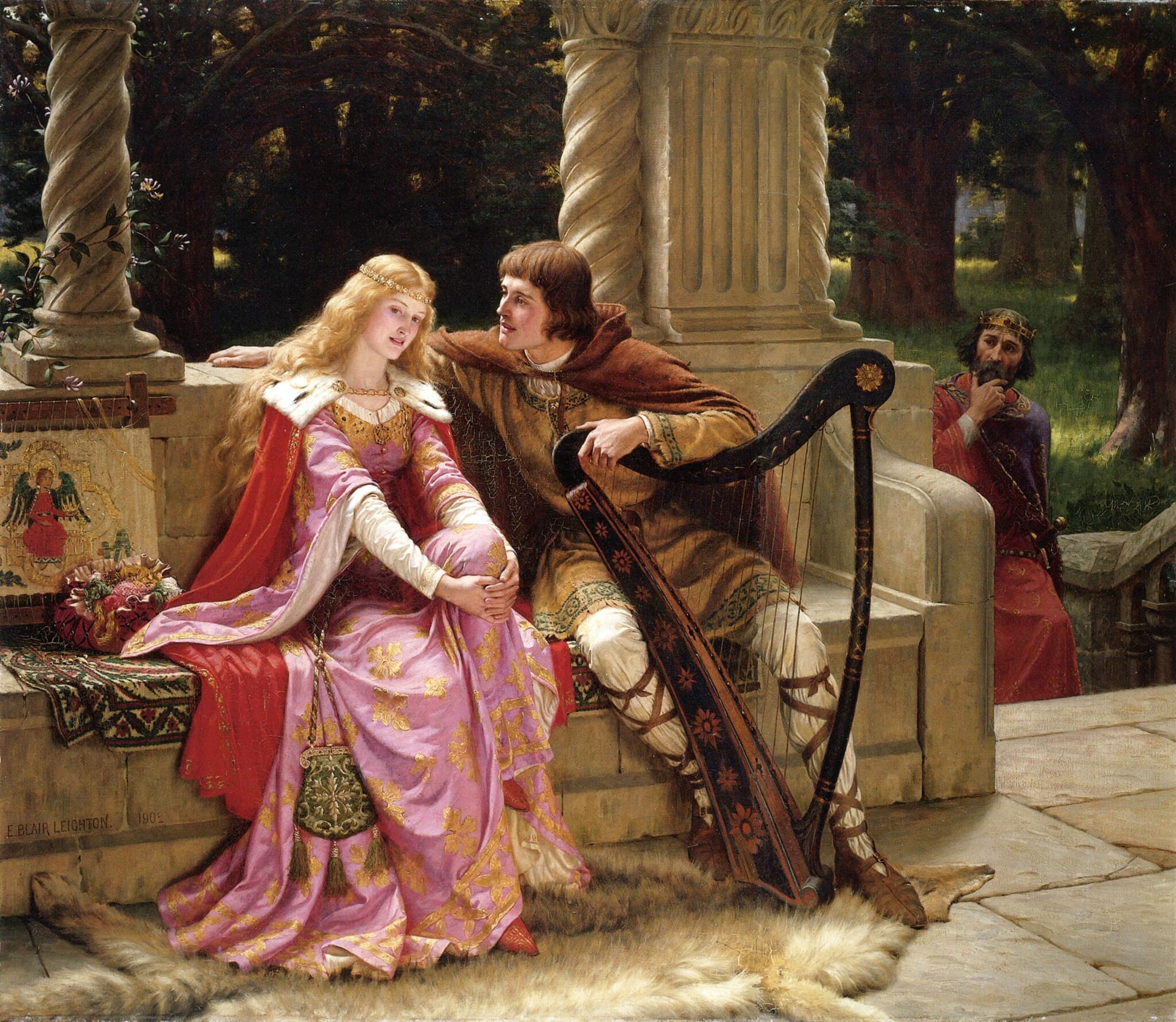
Tristan and Isolde (The End of the Song)
Edmund Leighton, 1902 • Oil on canvas
View more by Edmund Leighton →Valuation Analysis
Valuation headline: For the 1902 Royal Academy-exhibited oil on canvas 'Tristan and Isolde (The End of the Song)' (c. 50½ x 58 in., signed E. Blair Leighton), I place a present-day auction/market value at USD 200,000–600,000. This primary range is anchored to the Christie’s London sale on 14 June 2000 (hammer GBP 240,250; ≈USD 361,144 at the time) for the same RA canvas and adjusted for current market context and relevant comparables [1].
The lower part of the band reflects a strong but not exceptional presentation and an open auction without special guarantees; the upper bound assumes excellent original condition, solid, documented provenance (including the early R. Schumacher ownership and RA exhibition record), and active international bidding at a major house. If the object is a small panel variant or study rather than the RA canvas, market expectation drops materially (typically into the low thousands to low five figures).
Why this range: the Christie’s 2000 result for the RA-exhibited canvas is the single best direct precedent and establishes a robust market anchor [1]. That anchor is tempered by two countervailing realities: (a) inflation and nominal appreciation since 2000 would push the 2000 figure materially higher in 2025 dollars, and (b) the late‑cycle and post‑2022 market has reduced depth at the absolute top end, making seven‑figure outliers less likely absent exceptional provenance or institutional interest. Recent specialist/regional sales show that well-presented Leighton canvases can still clear mid‑five figures to low‑six figures when fresh to market (for example, a Bukowskis December 2023 single‑owner offering), while small studies continue to sell for only a few thousand USD [2].
Primary value drivers are: confirmed dimensions/medium, condition and conservation history, documented exhibition/catalogue references (the RA 1902 listing is a strong positive), and an unbroken provenance chain. Significant restoration, heavy overpaint, or an unclear attribution would move realizability toward the lower end; conversely, an intact original surface, early documented ownership, and visible RA provenance will support estimates toward the upper end of the band.
Recommended next steps: provide high‑resolution images (full, signature, verso), exact dimensions and any labels or dealer stamps, and obtain a conservator’s condition report. With those materials I can confirm whether this is the Christie’s RA canvas and tighten the estimate to a narrower band. For sale, consignment to a specialist British 19th‑century sale at a major house with international marketing is the optimal route to realize upper‑band values; private sale or regional houses can be efficient but typically lower price expectations and pool depth.
Final note: the USD 200,000–600,000 band is a market‑facing, sale‑ready estimate for the RA 1902 50½ x 58 in. canvas in typical transaction conditions. I recommend an in‑person inspection and formal condition report before any insured valuation or guaranteed offer is accepted.
Key Valuation Factors
Art Historical Significance
High ImpactEdmund Blair Leighton is an established figure within late‑Victorian and Edwardian academic and romantic painting. A finished Royal Academy work on a medieval/literary subject such as Tristan and Isolde carries demonstrable art‑historical weight because it speaks to the period's narrative interests and collecting patterns. RA exhibition status increases the painting's research and loan potential, making it more attractive to institutions and specialist collectors. While this picture is not as universally iconic as the artist's single top images, its subject, execution, and RA provenance give it above‑average scholarly and curatorial interest. That significance translates directly into market desirability when combined with condition and provenance.
Provenance & Exhibition History
High ImpactDocumented provenance and exhibition history are decisive value drivers. The Christie’s lot entry for the RA‑exhibited canvas lists early ownership (R. Schumacher 1913) and Royal Academy exhibition in 1902—both strong positives that materially uplift buyer confidence and marketability. A continuous provenance from the exhibitor and early 20th‑century owner reduces attribution risk and simplifies title checks, which collectors and institutions prize. Gaps in ownership, lack of exhibition citations, or absence from catalogues raisonnés will reduce the asset's appeal and lower achievable price. Clear provenance enables higher estimates, institutional loans, and publication potential.
Condition & Conservation
High ImpactCondition is a primary determinant of realizable price. For a large narrative canvas, structural integrity (stretcher/frame, relining history), paint‑layer stability, varnish tone, inpaint and retouch extent, and any evidence of heavy restoration all influence buyer willingness to bid. A clean, original surface with minimal, well‑documented conservation intervention will preserve or increase value; conversely, heavy overpainting, extensive inpainting, or unstable paint can reduce value sharply. A conservator’s condition report — noting any relining, original ground, or non‑period interventions — is essential to firm the estimate and to set realistic reserves or guarantees.
Size & Composition (Rarity/Scale)
Medium ImpactLarge, museum‑scale narrative canvases by Leighton are scarcer on the market than small panels and studies, and they tend to command a premium because they are more suitable for institutional display and collector feature pieces. The 50½ x 58 in. scale of the RA canvas is a positive rarity factor relative to plentiful small workshop variants. The compositional quality — how effectively the canvas conveys narrative, figure grouping, and finish — further modulates demand: superior composition and painterly handling will attract stronger bids. Size alone does not guarantee top pricing; it must be paired with condition and provenance.
Market Comparables & Demand
High ImpactDirect comparables anchor this valuation: the Christie’s June 2000 sale of the RA canvas (GBP 240,250) is the strongest precedent and sets a concrete market baseline. Top Leighton canvases (e.g., God Speed) have established the artist’s ceiling in the high five‑ to low six‑figure band in past cycles, but market depth at the top has softened since 2022. Recent specialist sales show that well‑marketed single‑owner offerings can still achieve mid‑five‑figure to low‑six‑figure outcomes, while small panels and studies trade for a small fraction of that. The balance of these comparables supports the USD 200k–600k band for the RA canvas when other positive attributes are present.
Sale History
Christie's, London (Important British Art, lot 17)
Sotheby's (Billingshurst regional sale)
Bukowskis, Stockholm (Important Winter/Spring sale)
Bonhams, London
Edmund Leighton's Market
Edmund Blair Leighton (1865–1922) is well established within the late‑Victorian/Edwardian academic/romantic tradition and maintains a dedicated collector base. His market is bifurcated: a handful of museum‑quality, exhibition‑backed canvases have historically achieved high five‑figure to low six‑figure prices, while the larger volume of smaller studies and decorative examples trade within the low thousands to low five figures. Sales outcomes are highly sensitive to scale, condition, and provenance; top houses and specialist sales obtain the strongest results. Leighton remains collectible, but demand is narrower and more specialist than for the most widely known 19th‑century names.
Comparable Sales
The End of the Song (Tristan and Isolde)
Edmund Blair Leighton
This is the exact RA‑exhibited 1902 canvas (50½ x 58 in.) — direct primary precedent and the strongest market anchor for valuation.
$361K
2000, Christie's, London (Important British Art, lot 17)
~$667K adjusted
God Speed (1900)
Edmund Blair Leighton
Large, exhibition‑quality Leighton that set a market ceiling for the artist in the same sale season — useful ceiling/comparator for top‑tier RA canvases.
$1.1M
2000, Christie's, London
~$2.0M adjusted
The song is ended (small panel variant)
Edmund Blair Leighton
Same subject but a small oil‑on‑panel variant/study — illustrates pricing for studies/variants (much lower than large RA canvases).
$3K
1996, Sotheby's (Billingshurst regional sale)
~$6K adjusted
Faded Laurels
Edmund Blair Leighton
Recent regional/top‑specialist sale showing that high‑quality single‑owner Leighton canvases can still clear mid‑five figures (≈$96–100k realised).
$98K
2023, Bukowskis, Stockholm (Important Winter/Spring sale, Dec 2023)
~$102K adjusted
The Window Seat
Edmund Blair Leighton
Smaller work sold in 2024 — demonstrates the present mid‑market for modest Leighton paintings (low five figures, incl. premium).
$15K
2024, Bonhams, London
~$15K adjusted
Current Market Trends
The market for Victorian and academic narrative painting is currently selective: top‑quality, fresh‑to‑market works with strong provenance can still command significant prices, but the global art market's upper echelons have cooled since 2022. Mid‑market activity (sub‑$50k) is relatively resilient, while trophy 19th‑century pieces appear less frequently and require careful international marketing to realize peak value.