How Much Is A Bar at the Folies‑Bergère Worth?
Last updated: May 21, 2026
Quick Facts
- Last Sale
- $4K (1896, Hôtel Drouot, Paris (Chabrier Collection Sale))
- Methodology
- extrapolation
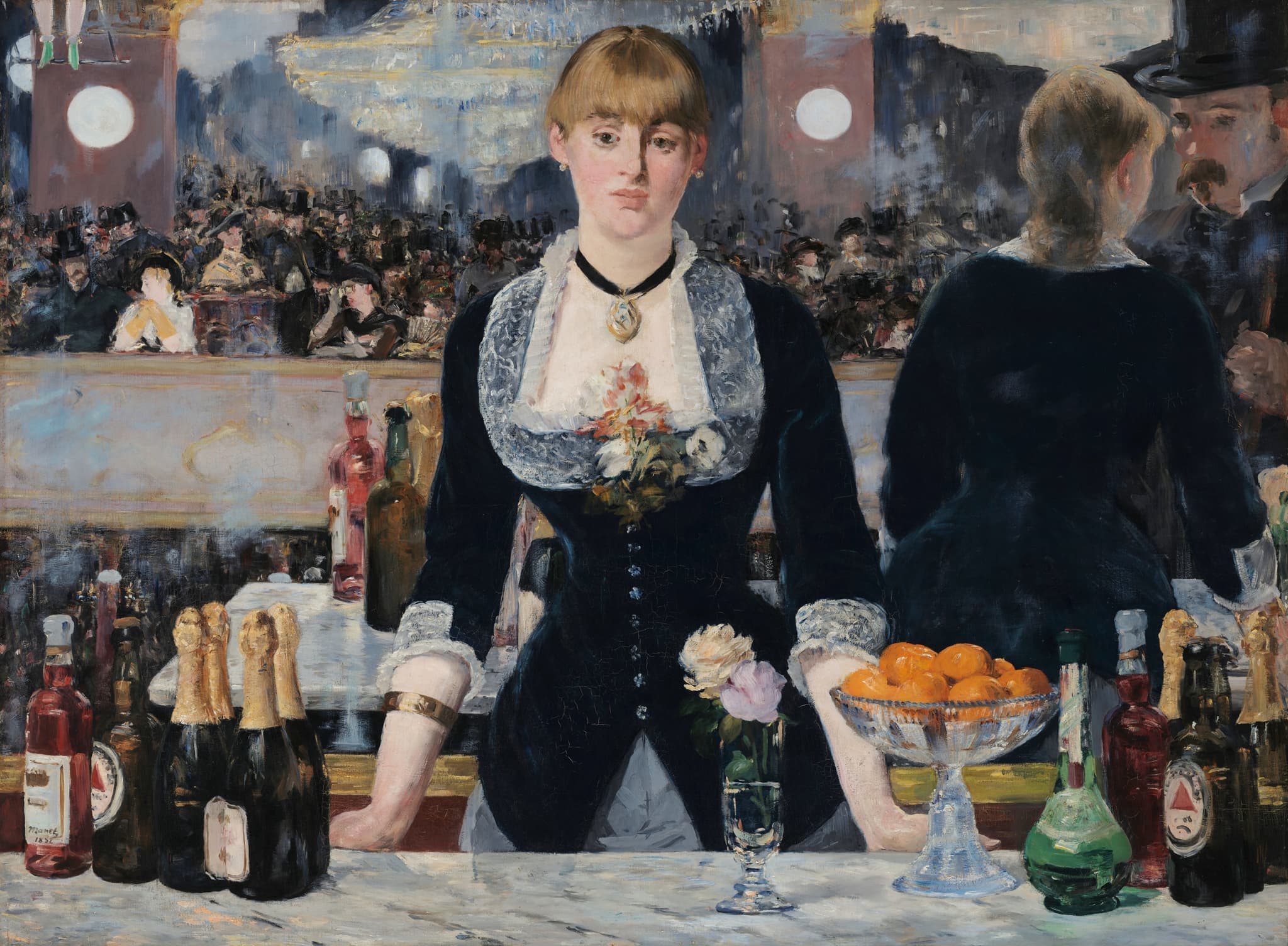
A Bar at the Folies‑Bergère (1882) is a canonical masterpiece by Édouard Manet in The Courtauld Gallery. Extrapolating from Manet’s $65.1m auction record and nine‑figure outcomes for peer masterpieces, a realistic open‑market estimate today is $150–250 million. A sale would reset the artist’s record by a wide margin.
Valuation Analysis
Conclusion. A Bar at the Folies‑Bergère (1882) is one of Manet’s defining masterpieces and a pillar of The Courtauld Gallery’s collection. If hypothetically offered today with appropriate marketing and a robust guarantee, we estimate an open‑market value of $150–250 million. This would eclipse Manet’s standing auction record and align the work with nine‑figure pricing established for museum‑level late‑19th‑century masterworks.
Identity, ownership, significance. The painting is the seminal 1882 oil at The Courtauld (Samuel Courtauld Trust). It is widely regarded—alongside Olympia and Le Déjeuner sur l’herbe—as among Manet’s most important images, often cited as his last major work and a symbol of modern Parisian life [1]. Its institutional status means the estimate is necessarily hypothetical, but based on demonstrated market behavior for comparable trophies.
Method: extrapolation from artist benchmarks. Manet’s current auction record is Le Printemps (1881) at $65.1 million (Christie’s, 2014) [2]. A closely related subject comparable—the smaller 1881 first version of the Folies‑Bergère motif—brought about $26.8 million at Sotheby’s London in 2015, confirming deep collector appetite for this iconography [3]. More recently, a high‑quality late still life realized $10.1 million at Sotheby’s (May 2024), indicating durable liquidity for desirable Manet oils even in a selective market [6]. Given the Courtauld painting’s fame, scale, and art‑historical primacy, it would command a multiple of these artist‑specific benchmarks.
Cross‑artist comparables and scarcity. The upper tier of late‑19th/early‑modern masterpieces has repeatedly achieved nine figures, exemplified by Seurat’s Les Poseuses (petite version) at $149.2 million and Cézanne’s Montagne Sainte‑Victoire at $137.8 million in the Paul G. Allen sales (2022) [4][5]. Manet’s canonical status within the genealogy of modern art—and the fact that nearly all works of equivalent caliber reside in museums—creates pronounced scarcity. In such circumstances, trophy buyers routinely bid well beyond intra‑artist records to secure singular, museum‑level opportunities.
Positioning and risks. We therefore place the Courtauld Bar at $150–250 million. Upside toward the top of the band would be most likely in a marquee New York sale or discrete private process with irrevocable interest and competitive underbidders; downside risk reflects that Manet’s commercial market, while blue‑chip, is shallower than Monet’s or Picasso’s. Institutional ownership and potential UK export controls (if deaccession were ever contemplated) are structural, not pricing, considerations. Overall, the painting’s art‑historical importance, exhibition/literature pedigree, and extreme scarcity justify a clear nine‑figure valuation grounded in both artist benchmarks and cross‑category trophy outcomes [1][2][3][4][5][6].
Key Valuation Factors
Art Historical Significance
High ImpactThis canvas is universally recognized as one of Manet’s supreme achievements and a touchstone of modernity, on par with Olympia and Le Déjeuner sur l’herbe. Its complex mirror space, depiction of urban spectacle, and emblematic barmaid epitomize Manet’s late style and his pivotal role bridging Realism and Impressionism. It is frequently taught, widely reproduced, and central to scholarship. Works of this canonical status typically command substantial premiums over the artist’s ordinary record because they appeal to museums and the most competitive private buyers. The painting’s place as Manet’s last major work further elevates its desirability, creating a once‑in‑a‑generation opportunity in any hypothetical sale.
Rarity and Supply
High ImpactThe very small number of Manet’s absolute top‑tier oils reside almost entirely in museums, and the Courtauld’s Bar is among the least likely ever to trade. The only closely related market datapoint is the smaller 1881 first version of the motif, which sold strongly but is qualitatively and historically less significant. This near‑total supply drought means that collectors who want a definitive Manet of modern‑life subject have effectively no substitutes. Scarcity of this magnitude reliably drives prices far above prior artist benchmarks when an equivalent masterpiece does surface, especially in well‑staged sales supported by guarantees and global marketing.
Provenance and Exhibition History
High ImpactThe painting’s provenance is exemplary: from the 1884 Manet studio sale to Emmanuel Chabrier, through leading dealers (Durand‑Ruel, Bernheim‑Jeune, Cassirer), major collectors, and ultimately Samuel Courtauld. It has an extensive exhibition and literature record, and is a centerpiece of The Courtauld Gallery. This continuous, well‑documented chain reduces transactional risk, supports buyer confidence, and is a decisive premium factor at the very top end of the market. Works with bulletproof provenance and institutional pedigrees are the ones most likely to attract competition from both museums and trophy‑driven private buyers, sustaining nine‑figure valuations.
Market Benchmarks and Cross‑Artist Comparables
High ImpactWhile Manet’s auction record stands at $65.1m for Le Printemps (2014), peer‑group masterpieces have reached nine figures—e.g., Seurat at $149.2m and Cézanne at $137.8m in 2022. The 1881 first version of the Folies‑Bergère motif sold for ~$26.8m, and a late floral reached $10.1m in 2024, illustrating category liquidity and subject appeal. Extrapolating from these datapoints to an artwork of higher fame, scale, and art‑historical primacy supports a $150–250m range. The delta versus Manet’s record reflects the trophy premium typically paid to secure a museum‑level, once‑in‑a‑generation icon in a competitive setting.
Sale History
Hôtel Drouot, Paris (Chabrier Collection Sale)
Sale of the Collection Emmanuel Chabrier, lot 8. Reported at 23,000 French francs; ≈$4,438 using gold‑parity conversion. Buyer not recorded.
Hôtel Drouot, Paris (Manet Studio Sale)
Manet Studio Sale, lot 7. Reported at 5,850 French francs; ≈$1,129 using gold‑parity conversion. Bought by Emmanuel Chabrier.
Édouard Manet's Market
Édouard Manet is a foundational figure of modern art whose market is characterized by extreme scarcity of first‑rank oils. His auction record is $65.1 million for Le Printemps (Christie’s, 2014). Strong, period‑defining subjects (modern‑life scenes, key portraits, late florals) command the most demand; lesser works trade from low‑ to mid‑seven figures, while high‑quality oils can reach eight figures. Because the great majority of top Manets reside in institutions, the public market for A‑tier examples is thin, with prices highly sensitive to subject importance, provenance, and freshness. In the current climate, museum‑grade Manets would likely trigger intense competition and have clear potential to reset the artist’s record.
Current Market Trends
At the very top of the late‑19th/early‑modern category, demand for museum‑caliber works remains deep, with multiple trophies clearing nine figures in recent seasons. The market is selective: blue‑chip works with outstanding provenance, literature, and narrative perform strongly, while mid‑tier material can be price‑sensitive. Auction houses increasingly rely on guarantees and third‑party support to engineer competitive outcomes, especially for seven‑ to nine‑figure lots. Within this context, an iconic Manet of the highest order would benefit from cross‑category trophy demand and international institutional interest, positioning it well for a nine‑figure result even in a disciplined, bifurcated market.
Sources
- The Courtauld Gallery – Object record: A Bar at the Folies‑Bergère
- Christie’s – Post‑sale release (Nov 5, 2014): Manet’s Le Printemps achieves $65,125,000
- The Art Wolf – London Impressionist & Modern (June 2015) results, incl. Manet’s first Folies‑Bergère version
- The Art Newspaper – Paul G. Allen Evening Sale results (Nov 9, 2022): Seurat at $149.2m
- Forbes – Paul Allen Collection reaches records (Nov 9, 2022), incl. Cézanne at $137.8m
- Sotheby’s – New York Sales May 2024 Highlights (includes Manet still life at $10.101m)