How Much Is A Young Tiger Playing with its Mother Worth?
Last updated: May 4, 2026
Quick Facts
- Methodology
- comparable analysis
The painting A Young Tiger Playing with its Mother (c.1830–31) is a Louvre accession (RF 1943) and therefore not marketable under normal circumstances. Hypothetically, using market comparables for Delacroix animal compositions and recent rediscoveries, a reasoned auction range if offered would be approximately $5,000,000–$12,000,000.
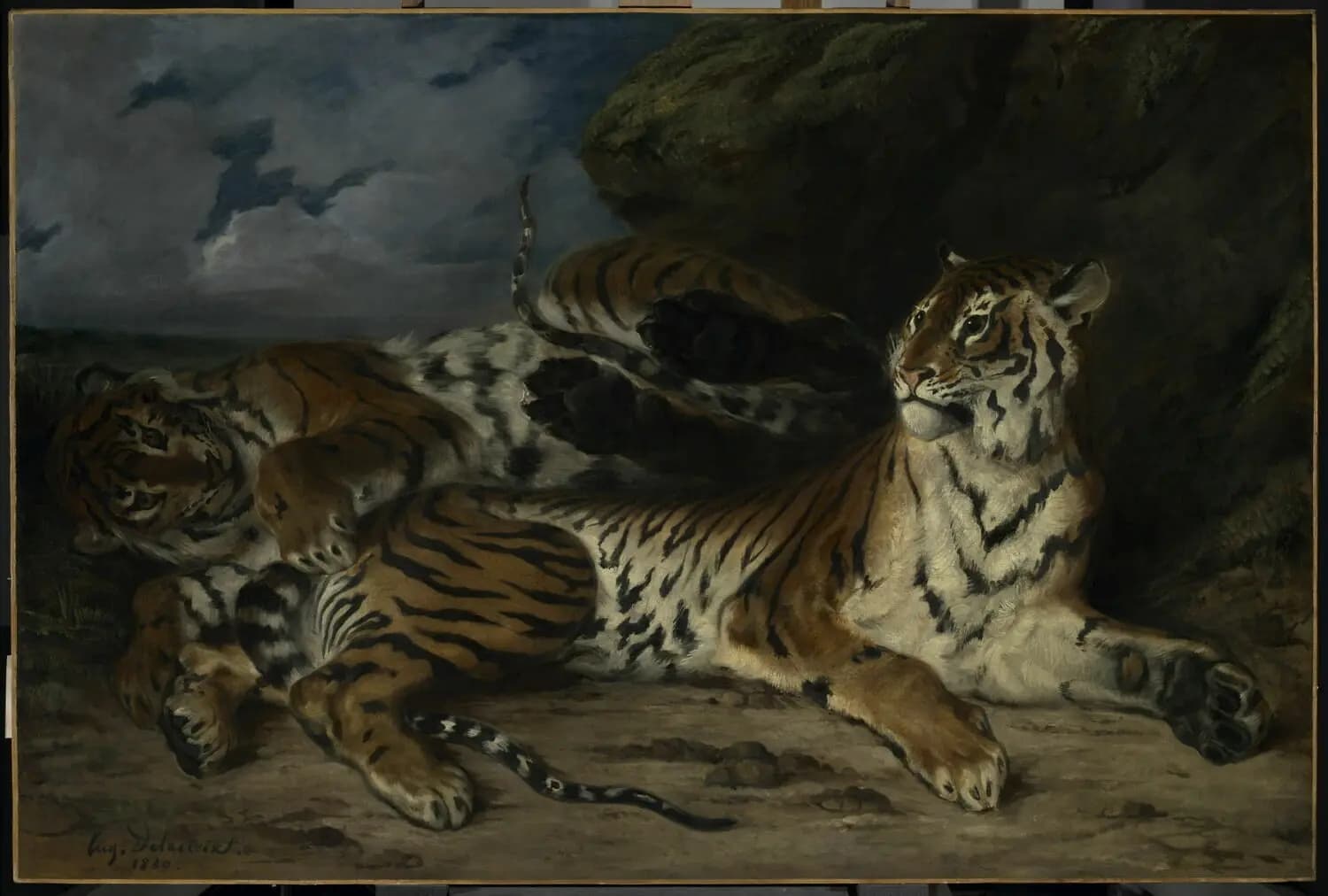
A Young Tiger Playing with its Mother
Eugene Delacroix • Oil on canvas
View more by Eugene Delacroix →Valuation Analysis
Identification and market posture: A Young Tiger Playing with its Mother (Jeune tigre jouant avec sa mère), dated c.1830–31 and listed in the Musée du Louvre (inv. RF 1943), is a large oil on canvas (museum dimensions ca. 131 × 194.5 cm) and carries an institutional provenance that removes it from normal market circulation [1]. Because the work is museum‑held and was bequeathed into the Louvre collection, there is no modern auction record for this specific canvas.
Method and comparables: The valuation below is based on a comparative analysis of three market data points and the painting’s museum status. The modern auction ceiling for Delacroix animal compositions is exemplified by Tigre jouant avec une tortue, which sold at Christie’s New York (Rockefeller collection) in May 2018 for $9,875,000 [2]. Mid‑market evidence includes a 2023 Bonhams result (Delacroix from the Alain Delon sale, c. €775,100) and a 2025 rediscovery of a lion study at Hôtel Drouot (c. €455,000) that attracted strong interest as a studio/animal study [3][4]. These comparables show a wide dispersion driven by scale, provenance and condition.
Why $5–12M: If hypothetically offered, a Louvre‑held, large, well‑preserved Delacroix animal composition with clear catalogue‑raisonné entry and extensive exhibition/publication history would be expected to sit at the upper mid‑market to trophy tier. The lower bound of $5M assumes the painting is structurally sound but lacks recent high‑profile exhibitions or contains visible restoration that dilutes buyer confidence. The upper bound of $12M assumes excellent condition, unambiguous attribution, inclusion in the Delacroix catalogue‑raisonné, a strong exhibition/publication record, and favourable market conditions—factors that can push a major Delacroix oil into the many‑millions range and in line with the artist’s best single‑owner comparables [2][3].
Marketability and caveats: Practically speaking, the Louvre accession makes an actual sale extraordinarily unlikely; French institutional holdings are subject to strict inalienability and deaccession protocols, and disposals of this caliber are rare and legally complex [1]. Therefore the figure above should be read as a hypothetical auction valuation under the assumption that the painting could be lawfully and credibly placed on the market. Any formal selling estimate or insurance/replacement figure would require inspection, a technical/condition report, provenance documentation, and confirmation of catalogue‑raisonné entry by Delacroix specialists.
Recommended next steps: For a formal appraisal: obtain high‑resolution imagery, dimensions and condition notes from the Louvre entry; confirm catalogue‑raisonné references; commission technical analysis (infrared/X‑ray/pigment); and consult senior specialists at major houses (Christie’s/Sotheby’s) for pre‑sale advisement. These steps materially narrow the range and convert a hypothetical figure into a market‑actionable estimate [1][2][4].
Key Valuation Factors
Art Historical Significance
Medium ImpactWhile Delacroix is a pivotal figure of French Romanticism, A Young Tiger Playing with its Mother is not one of his iconic history‑painting masterpieces (e.g., Liberty Leading the People). It is, however, an important example of his interest in exotic fauna and animal study that reflects recurring themes in his oeuvre. The subject matter is collectible—animal and hunting scenes by Delacroix attract specialist buyers—but it ranks below his large historical and figurative canvases in canonical importance. Scholarly attention, catalogue‑raisonné entry and inclusion in key exhibitions would therefore increase desirability materially.
Provenance & Institutional Ownership
High ImpactThe painting’s provenance (early purchase from Delacroix, later bequest and entry into the Louvre, inv. RF 1943) is the single most value‑enhancing attribute. Institutional ownership by the Louvre conveys superior documentation, conservation and public exposure, factors that typically lift valuations. Paradoxically, institutional ownership also makes market transference unlikely: legal/tax and cultural‑heritage protections in France mean the work is effectively off‑market under routine circumstances. If it were ever lawfully deaccessioned, the Louvre provenance would propel the lot toward the top of the comparable band.
Size & Condition
High ImpactThe substantial scale of the canvas (museum dimensions c. 131 × 194.5 cm) places it among Delacroix’s larger animal compositions; scale is a strong positive in market valuation. Condition is critical: heavy restorations, relinings or structural instability can reduce market value by multiples; conversely, original paint surface and stable canvas can preserve premium pricing. As a Louvre object the presumption is careful conservation, but an in‑person condition and technical report is required to confirm and quantify condition effects on price.
Exhibition & Publication History
High ImpactWorks that have been exhibited in major retrospectives or cited in the catalogue‑raisonné carry a measurable premium. The Louvre’s holding increases the likelihood of prior exhibitions and scholarly citation; explicit references in Delacroix monographs or major exhibition catalogues convert hypothetical value into realized market confidence. Absence of exhibition/publication history reduces visibility and buyer competition, compressing price toward the mid‑market comparables.
Market Comparables & Rarity
High ImpactRecent comparables—Christie’s 2018 Tiger (≈$9.9M), Bonhams 2023 Delacroix from a notable private collection (≈€775k), and a 2025 Drouot rediscovery (≈€455k)—illustrate wide price dispersion that hinges on rarity, scale and provenance. Large, museum‑quality Delacroix animal compositions are scarce; when they appear with high‑quality provenance they push into the multi‑million tier. The Louvre work’s rarity as a large, institutional Delacroix tiger composition therefore supports a valuation at the upper end of the comparable band.
Sale History
A Young Tiger Playing with its Mother has never been sold at public auction.
Eugene Delacroix's Market
Eugène Delacroix is a core figure of 19th‑century French Romanticism; his market features a high ceiling for large, dramatic oils and a broad mid‑market for studies and works on paper. The artist’s auction record is set by a tiger composition sold at Christie’s New York in 2018 (≈$9.9M), which establishes the upper market for his best single‑owner canvases [2]. Smaller oils, drawings and watercolors trade from five‑figures to low‑six‑figures, with provenance and exhibition history determining whether a work will reach the higher bands. Collectors and institutions prize well‑documented Delacroix paintings, keeping market demand steady.
Comparable Sales
Tigre jouant avec une tortue (Tiger Playing with a Tortoise)
Eugène Delacroix
Same artist; large, dramatic animal subject (tiger); top-market benchmark for Delacroix modern sales and demonstrates the ceiling for major Delacroix oil paintings.
$9.9M
2018, Christie's, New York (Rockefeller collection)
~$12.2M adjusted
Cheval arabe attaché à un piquet
Eugène Delacroix
Same artist, oil painting sold from a notable private collection; useful mid‑market reference showing demand for good-provenance Delacroix paintings in the high six-figure band.
$849K
2023, Bonhams / Cornette de Saint Cyr, Paris (Alain Delon collection)
~$900K adjusted
Study of Reclining Lions (studio rediscovery)
Eugène Delacroix
Rediscovered animal study by Delacroix sold at a specialist French sale—a direct subject match (big cats) and a recent market data point for studio/study works.
$495K
2025, Hôtel Drouot, Paris
Current Market Trends
Since 2023 the high end of the auction market has been selective, with renewed collector interest in museum‑quality 19th‑century material and works on paper. Rediscoveries and estate consignments have generated press and bidding strength in the mid‑market; institutional pre‑emptions of paper lots demonstrate continued museum appetite. Overall, a cautious high end combined with active mid‑market interest favors well‑provenanced Delacroix works while making trophy sales dependent on marquee consignments [3][4].
Sources
- Musée du Louvre collection entry — Jeune tigre jouant avec sa mère (A Young Tiger Playing with its Mother), inv. RF 1943
- Christie's — Eugène Delacroix, Tigre jouant avec une tortue (Tiger Playing with a Tortoise), sale: 8 May 2018 (Rockefeller collection)
- Bonhams press release — Delacroix lot from the Alain Delon collection, Paris sale 22 June 2023
- Artnet News — Rediscovered Delacroix studio study of reclining lions sold at Hôtel Drouot (March 2025)
- Sotheby’s — example Master Works on Paper listing (recent Delacroix watercolor sale, Feb 2026)