How Much Is Death of Sardanapalus Worth?
Last updated: June 5, 2026
Quick Facts
- Last Sale
- $60K (1921, Réunion des Musées Nationaux (for the Louvre))
- Methodology
- extrapolation
Hypothetical open‑market valuation for the original 1827–28 Death of Sardanapalus (Louvre) is $150–250 million. This range extrapolates far above Delacroix’s auction record to reflect the painting’s singular art‑historical stature, scale, and trophy appeal, despite its inalienable museum status.
Valuation Analysis
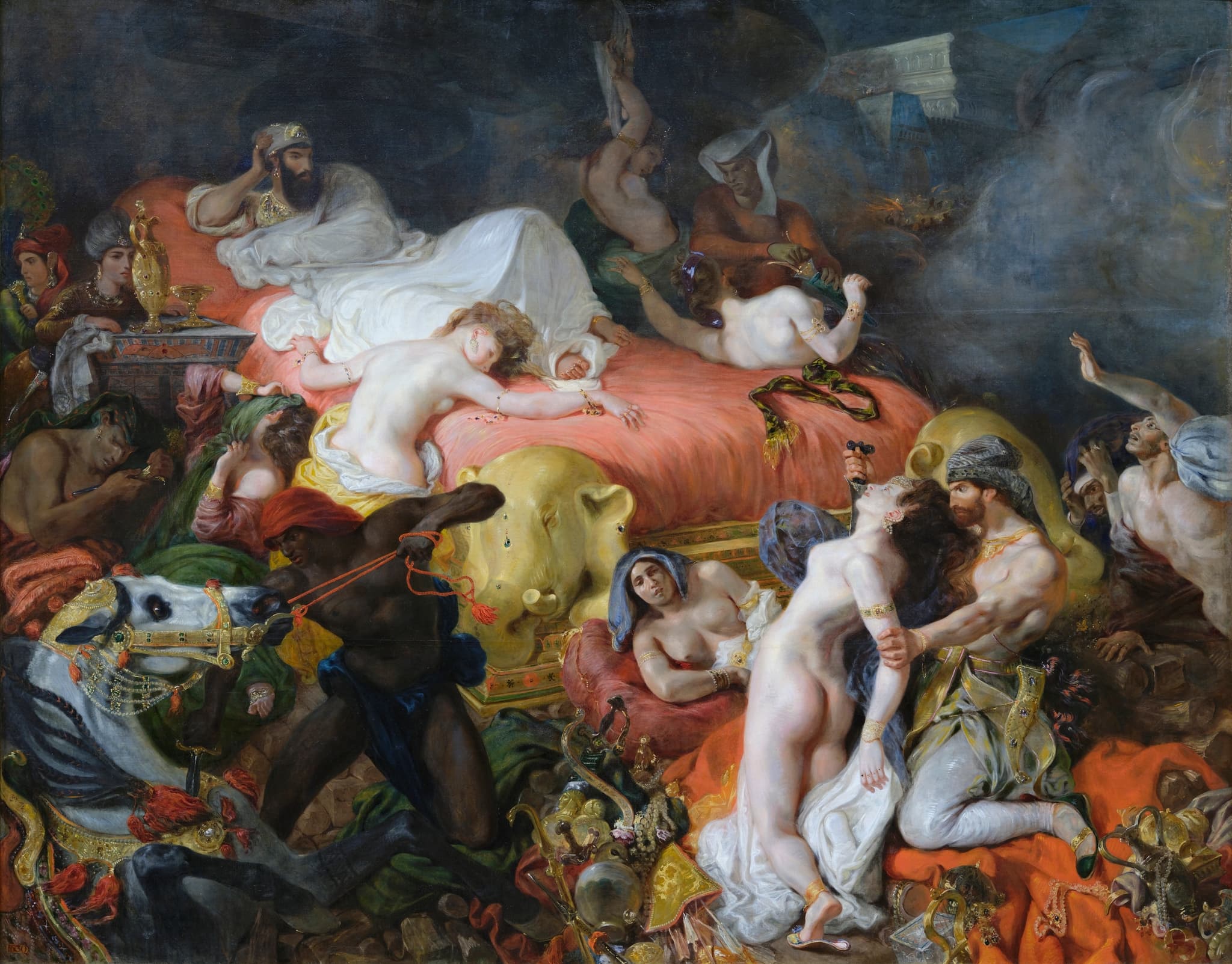
Scope. This valuation addresses the original 1827–28 Salon canvas of Eugène Delacroix’s Death of Sardanapalus in the Musée du Louvre, a cornerstone of 19th‑century Romanticism and state property in France [1]. It is not a market object. The $150–250 million range expresses a realistic hypothetical open‑market or replacement/insurance valuation for a work of this cultural magnitude if trade were possible.
Method. The estimate is derived by extrapolation from: (i) Delacroix’s modern auction ceiling ($9.875 million for Tiger with a Tortoise, Christie’s, 2018) [3]; (ii) price behavior for cross‑category Old Master and 19th‑century trophies that achieve $50–100m+ when supply, subject, and provenance align; and (iii) the painting’s unique combination of authorship, scale (nearly 4 × 5 meters), and canonical status in art history [1]. The absence of directly comparable, publicly traded Delacroix masterpieces necessitates a premium over the artist’s record by an order of magnitude.
Historical prices (not current comps). The Louvre’s collections record documents two 19th‑century public auctions—Drouot, 1873 (100,800 FF ≈ $19,460) and Drouot, 1889 (34,000 FF ≈ $6,560)—and the 1921 acquisition for the French state at 700,000 FF. At the devalued 1921 exchange rate (≈6.9–9.0¢ per franc), that equates to roughly $48,000–$72,000, underscoring that these are period‑bound financials rather than present‑day comparables [1][4]. They confirm documented trade history, not contemporary market value.
Version hierarchy and scarcity. Only one other autograph oil exists: a reduced 1844 replica in the Philadelphia Museum of Art, itself a major work but secondary to the Louvre canvas [2]. Were the Philadelphia painting tradable, a plausible range would be $30–70 million. By contrast, the Louvre original—monumental in scale, the locus classicus of the composition, and a touchstone of Romanticism—commands a multiple consistent with cross‑category trophy dynamics.
Market context and depth. Old Master/19th‑century evening sales remain selective, with buyer caution evident in recent London cycles; nonetheless, truly great, museum‑grade works attract disproportionate attention and pricing power when they (rarely) appear [5]. Delacroix’s record sits well below Impressionist and blue‑chip Old Master peaks, but that largely reflects supply: masterpieces of named subjects are museum‑held. In any hypothetical offering, global trophy buyers (cross‑category) would likely compete, lifting the work well beyond the artist’s historic auction ceiling.
Conclusion. The $150–250 million corridor synthesizes the painting’s unmatched art‑historical significance, monumental scale, extreme scarcity (two autograph versions, both museum‑held), and the demonstrated premium for top‑tier historical trophies. It is a reasoned, defensible replacement/open‑market proxy for an icon that effectively cannot trade in today’s market [1][2][3][5].
Key Valuation Factors
Art Historical Significance
High ImpactDeath of Sardanapalus is one of Delacroix’s defining masterpieces and a central document of French Romanticism. Its audacious composition, chromatic daring, and scale influenced generations from Manet to the moderns, and it remains a staple of art‑historical literature, teaching, and exhibition discourse. Works at this level are valued not simply as artworks but as cultural anchors—objects that define movements and national museum narratives. That status justifies a valuation far above the artist’s auction record: the piece competes not with typical Delacroix market comparables but with the handful of 19th‑century and Old Master icons capable of galvanizing cross‑category trophy demand and institutional interest.
Authorship and Version Hierarchy
High ImpactThere are only two autograph oils: the original 1827–28 Salon canvas (Louvre) and a reduced 1844 replica (Philadelphia Museum of Art). The Louvre painting is the ur‑composition—monumental in scale, earliest in date, and the work that fixed the image in the canon. The Philadelphia version, while significant, is explicitly a later autograph variant. This clear hierarchy places a unique premium on the Louvre canvas. In valuation terms, the primary version commands a multiple over any variant or study, much as first states, full‑scale cartoons, or prime versions do in adjacent Old Master categories.
Market Rarity and Legal Constraints
High ImpactThe painting is state property in France and held by the Louvre, subject to stringent patrimony and deaccession norms. Practically, it cannot be sold or exported, which is why no contemporary market price exists. Paradoxically, this inalienability elevates the notional value: collectors and institutions know the supply of icon‑level Delacroix oils is effectively zero. If a sale were hypothetically permitted, scarcity premiums and global trophy bidding would likely converge, producing a result far beyond ordinary artist‑record logic. The legal constraints therefore suppress observable pricing but support a higher replacement/open‑market proxy.
Market Benchmarks and Trophy Dynamics
Medium ImpactDelacroix’s auction record is $9.875 million (Christie’s, 2018) for a late tiger subject, reflecting the thin supply of great oils at auction. Yet top Old Master/19th‑century trophies routinely clear $50–100m+ when the subject, scale, and provenance align. Death of Sardanapalus checks all boxes—named subject, museum‑grade provenance, and architectural scale. The buyer pool at this level is cross‑category and motivated by cultural reach as much as connoisseurship. The main moderating factor is the 19th‑century segment’s narrower depth than, say, Renaissance super‑brands; hence the proposed $150–250m corridor balances trophy potential with realistic category liquidity.
Sale History
Hôtel Drouot (Paris)
Wilson collection sale; bought by Paul Durand‑Ruel (hammer 96,000 FF; with fees 100,800 FF).
Hôtel Drouot (Paris)
Duncan collection sale; bought by Étienne‑François Haro (hammer 34,000 FF).
Réunion des Musées Nationaux (for the Louvre)
Acquired from Joseph Raphaël Vitta at 700,000 FF (≈$48k–$72k at 1921 FX); state acquisition, not an auction.
Eugene Delacroix's Market
Eugène Delacroix’s market is established but comparatively thin at the top end. His world auction record stands at $9.875 million (Christie’s, New York, 2018) for Tigre jouant avec une tortue [3]. Consistent demand centers on dynamic Orientalist scenes, animal combats, and powerful figural compositions; drawings are widely collected and range from mid‑five figures to low‑seven figures for exceptional sheets. Supply of museum‑quality oils is extremely limited because many masterpieces reside in institutions. As a result, price discovery often occurs in rediscoveries, studies, or strong mid‑tier works, rather than in canonical, named subjects—which helps explain why the artist’s record understates the potential value of an icon like Sardanapalus.
Comparable Sales
The Death of Sardanapalus (original Salon canvas, 1827–28)
Eugène Delacroix
Identical object; first documented public auction of the painting (Wilson sale). Direct historical benchmark for the work itself.
$19K
1873, Hôtel Drouot (Paris)
~$506K adjusted
The Death of Sardanapalus (original Salon canvas, 1827–28)
Eugène Delacroix
Identical object; later public auction (Duncan collection). Confirms 19th‑century market behavior for the same painting.
$7K
1889, Hôtel Drouot (Paris)
~$230K adjusted
The Death of Sardanapalus (original Salon canvas, 1827–28)
Eugène Delacroix
Identical object; museum acquisition at 700,000 FF (with franc well below par). Most substantial historical transaction for this painting.
$60K
1921, Private sale to Réunion des Musées Nationaux (for the Louvre)
~$1.1M adjusted
Tiger Playing with a Tortoise (Tigre jouant avec une tortue)
Eugène Delacroix
Artist’s auction record; mature autograph oil with violent, dynamic subject—anchors modern upper end for Delacroix oils at auction.
$9.9M
2018, Christie's New York
~$12.6M adjusted
Études de lions couchés (oil study)
Eugène Delacroix
Recent rediscovered autograph oil with violent animal theme; shows current appetite and pricing for vigorous Delacroix oil studies.
$491K
2025, Daguerre at Hôtel Drouot (Paris)
Current Market Trends
Old Master and 19th‑century evening sales have been selective, with 2024 London cycles described as muted—few fireworks but disciplined bidding for quality. This underscores a broader flight to established names, strong provenance, and visually compelling subjects. In such conditions, true masterpieces with museum‑level importance attract disproportionate attention relative to mid‑tier works. While Delacroix’s category does not enjoy the same depth as Impressionism or Renaissance blue‑chips, the scarcity of top works and cross‑category trophy appetite support premium pricing for icons—particularly those with clear authorship, compelling narratives, and publication/exhibition histories.
Sources
- Musée du Louvre collections entry: La Mort de Sardanapale (1827–28)
- Philadelphia Museum of Art: Death of Sardanapalus (1844)
- Christie’s (Rockefeller Sale) – Delacroix record $9,875,000
- Federal Reserve Bulletin (1922): French franc–USD exchange rates
- The Art Newspaper (Jul 4, 2024): Muted Old Master evening sales in London