How Much Is Greece on the Ruins of Missolonghi Worth?
Last updated: May 4, 2026
Quick Facts
- Methodology
- comparable analysis
La Grèce sur les ruines de Missolonghi (1826) is a large, museum‑held salon history painting by Eugène Delacroix (Musée des Beaux‑Arts de Bordeaux, acquired 1852). If offered as a securely authenticated, well‑conditioned autograph canvas in a blue‑chip evening sale, a realistic auction range is approximately $7.5–20 million, with final outcome dependent on condition, sale context, and institutional interest.
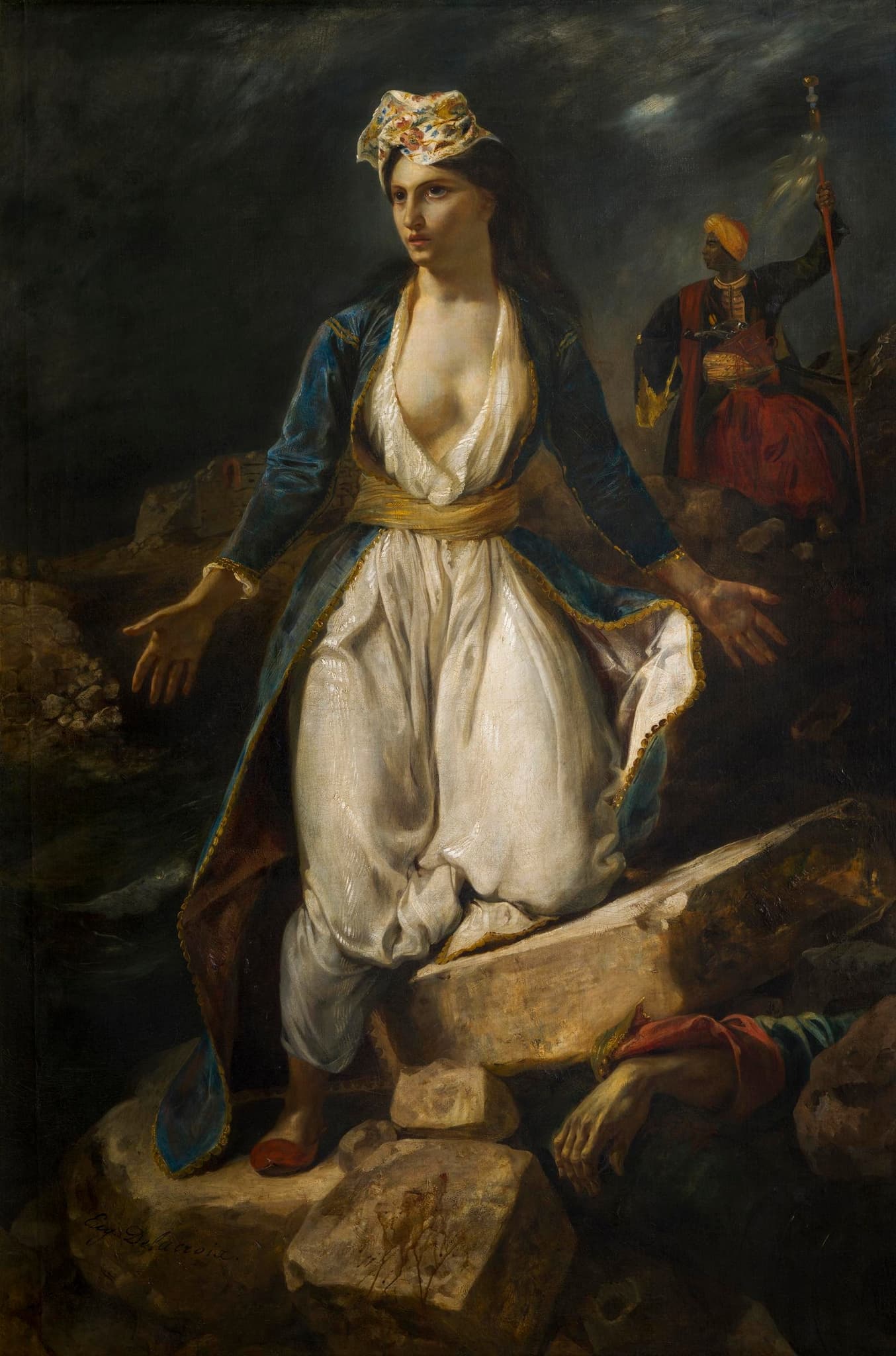
Greece on the Ruins of Missolonghi
Eugene Delacroix, 1826 • Oil on canvas
View more by Eugene Delacroix →Valuation Analysis
Work and provenance overview: La Grèce sur les ruines de Missolonghi (1826) is documented in the Musée des Beaux‑Arts de Bordeaux collection (inventory Bx E 439) and is recorded as signed EUG. DELACROIX 1826; the museum notes acquisition in 1852 and current institutional loan activity [1]. These facts supply a secure attribution and long‑standing museum provenance—two primary value drivers for 19th‑century French history painting.
Why the painting merits a multi‑million valuation: The canvas is a large, finished Salon‑scale history composition (213 × 142 cm) tied to a high‑profile contemporary political event (the fall of Missolonghi) and to the philhellenic sentiments that shaped Delacroix’s early career. Large, autograph history canvases by Delacroix are rare on the market and therefore attract a scarcity premium; museum provenance and exhibition history further strengthen scholarly desirability and institutional appeal.
Market comparables and anchoring: The artist’s modern public auction ceiling for oils is exemplified by the Christie’s Rockefeller evening sale result (Tigre jouant avec une tortue, $9.875M realized in 2018), which functions as a high‑end market anchor for exceptional Delacroix oils [2]. At the same time, rediscovered autograph paintings and high‑quality studies have realized in the mid‑six‑figure band, and works on paper trade at far lower levels—evidence of a wide dispersion depending on medium, scale and provenance [3][4]. Taking scarcity, subject importance and museum provenance together, the considered hypothetical auction range for Missolonghi is $7.5–20 million: the low end reflects sale in a specialist/lesser week or condition concerns; the high end assumes a top‑tier evening sale with full institutional and scholarly backing.
Key caveats and actionable next steps: This estimate is explicitly hypothetical—MusBA Bordeaux has held the canvas since 1852 and it is currently on loan, so it is effectively off‑market. A formal market valuation would require (a) a current, professional conservation/condition report, (b) the museum’s complete provenance dossier and any acquisition documentation, and (c) pre‑sale market-testing with 19th‑century specialists at major houses (Christie’s/Sotheby’s). Condition issues or unresolved title/export constraints could reduce realizations materially; conversely, a major exhibition or high‑profile monograph could lift buyer interest and push results toward the upper estimate band.
Key Valuation Factors
Art Historical Significance
High ImpactLa Grèce sur les ruines de Missolonghi is an early, politically engaged history painting that directly addresses European philhellenism and the fall of Missolonghi (1826). As an academically finished Salon‑scale canvas (213 × 142 cm) painted at a formative moment in Delacroix’s career, it carries substantial scholarly weight and institutional interest. Such works contribute to understanding the artist’s development and public reputation, and institutions prize them for exhibitions and cataloguing. This intrinsic art‑historical importance raises relative market value compared with routine studio sheets or studies, because museums and major collectors place a premium on canonical, publishable pictures with demonstrable contextual significance.
Attribution & Condition
High ImpactThe painting is recorded as signed EUG. DELACROIX 1826 and has been in MusBA Bordeaux since 1852, supporting a secure autograph attribution—arguably the single most important value determinant for Delacroix oils. Museum custody generally implies appropriate conservation, but the public record does not substitute for a current, technical condition report. Any structural issues, campaign of overpainting, or invasive restorations would materially reduce market value; conversely, excellent, unrestored condition will push a sale price toward the upper estimate band. A professional conservation assessment is therefore indispensable to firm up the valuation.
Provenance & Exhibition History
High ImpactContinuous institutional provenance (acquisition recorded 1852) substantially strengthens buyer confidence and scholarly standing, raising the work’s publishability and loan potential. Museum provenance reduces attribution dispute risk and increases the painting’s attractiveness to major institutions and foundation collectors. Recent loans and exhibitions, such as the Missolonghi loan, further enhance interpretive value and marketability. The trade‑off is liquidity: museum‑held canonical works seldom enter the market, and when they do, competition among institutions and elite collectors may push prices higher but sale opportunities are rare.
Market Liquidity & Comparables
Medium ImpactDelacroix’s top‑end market is supply‑limited: most large salon oils are held by public collections, so when comparable works appear they can attract intense bidding. The artist’s modern auction high for an oil sits in the mid‑seven figures (Christie’s 2018 Rockefeller sale), while rediscoveries and studies have realized mid‑six‑figure sums. Because realized prices vary with sale context (evening vs. specialist sale), consignment story, and institutional interest, liquidity is a moderating factor on price certainty even as scarcity supports high potential ceilings.
Sale History
Eugene Delacroix's Market
Eugène Delacroix is a blue‑chip 19th‑century Romantic master whose highest‑quality oils are largely museum‑held and therefore infrequently offered at auction. The artist’s public auction record for an oil is in the mid‑seven figures (Christie’s Rockefeller result, $9.875M realized, 2018); works on paper and rediscovered painted studies trade at substantially lower levels. Collectors value securely attributed, well‑provenanced salon canvases with exhibition history; when such works appear under optimal conditions they can reach the upper tiers of Delacroix’s market, but examples are rare and results depend heavily on sale strategy.
Comparable Sales
Tigre jouant avec une tortue (Tiger Playing with a Tortoise)
Eugène Delacroix
Rare evening‑sale, museum‑quality Delacroix oil that set the modern public auction ceiling for the artist — useful as a high‑end anchor when valuing a large salon/history canvas.
$9.9M
2018, Christie's, New York (The Collection of Peggy & David Rockefeller sale)
~$12.3M adjusted
Study of Reclining Lions (rediscovered painted study)
Eugène Delacroix
High‑profile rediscovery of an autograph painted study; demonstrates mid‑six‑figure demand for rediscovered Delacroix paintings and the premium provenance/novelty can bring.
$529K
2025, Malo de Lussac / Hôtel Drouot (France)
Vineyards by a track and a farmhouse on a hill (watercolor)
Eugène Delacroix
Recent sale of a Delacroix work on paper; not comparable in scale or medium but useful to show the lower‑end active market (works on paper/drawings) versus finished salon oils.
$51K
2026, Sotheby's, New York
Current Market Trends
Market conditions in 2024 were muted for Old Masters/19th‑century works, with a partial recovery in 2025–early‑2026 driven by rediscoveries and select institutional acquisitions. Demand for Delacroix remains concentrated among institutions and a small pool of high‑net‑worth collectors; supply constraints for major oils support occasional high results, while the broader market volatility means outcomes vary by timing, provenance narrative, and sale format.
Sources
- Musée des Beaux‑Arts de Bordeaux — La Grèce sur les ruines de Missolonghi (object page)
- Christie's — Combined Records and Top Tens / The Collection of Peggy & David Rockefeller sale (2018)
- Artnet News — coverage of rediscoveries and market context (2025)
- Heni — report on recent Sotheby's sale of a Delacroix work on paper (2026)