How Much Is Lion Hunt Worth?
Last updated: June 6, 2026
Quick Facts
- Insurance Value
- $12.5M (Appraisal — replacement value at 125% of high estimate)
- Methodology
- comparable analysis
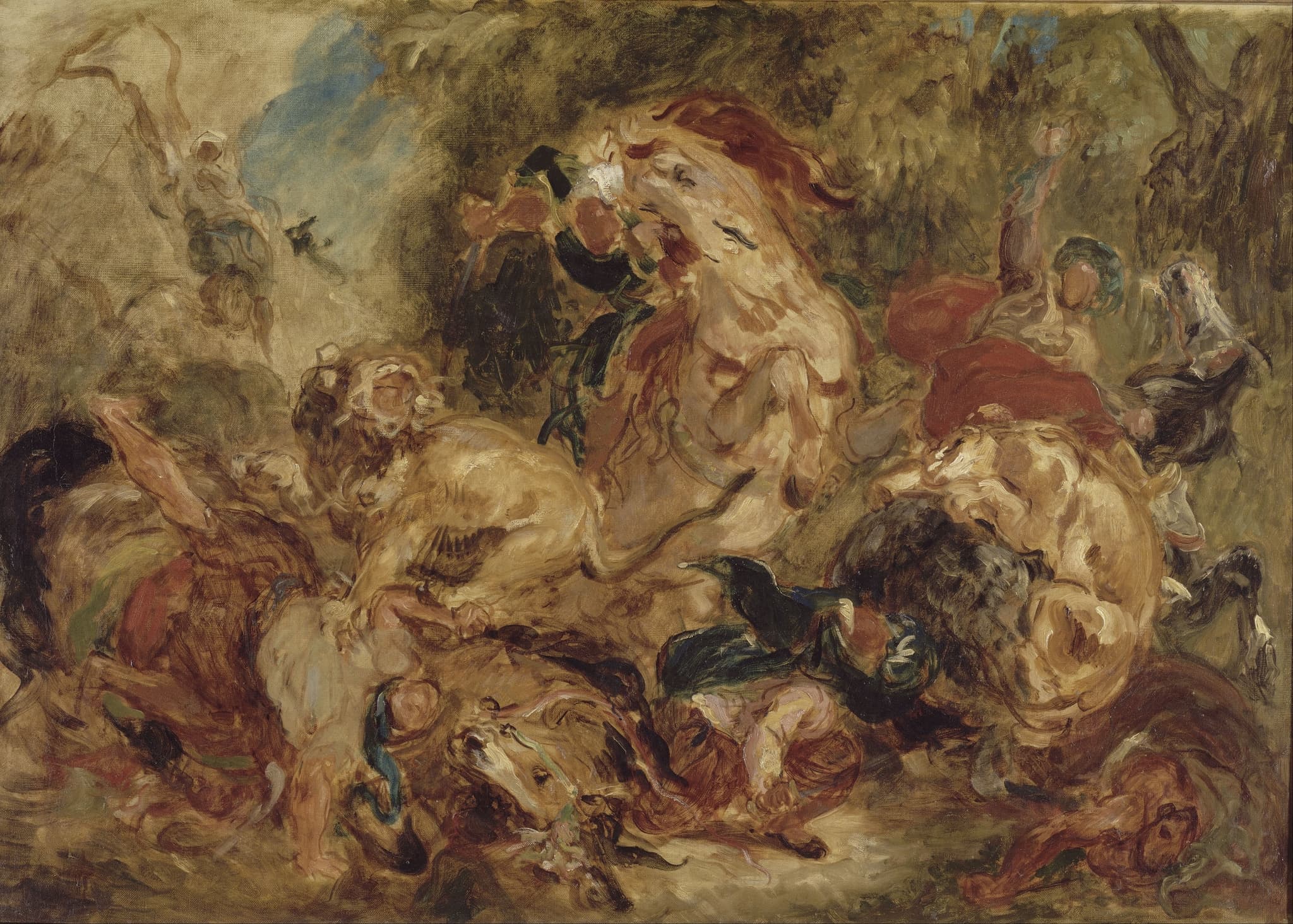
Estimated $4–10 million for a mid-size, finished autograph oil from Delacroix’s Lion Hunt cycle, assuming strong provenance, good condition, and inclusion in the literature. Scarcity of top examples and the subject’s status near the apex of his market support this band.
Valuation Analysis
Assumption: This valuation assumes a mid-size, finished autograph oil on canvas from Eugène Delacroix’s Lion Hunt cycle (c. 1850s), with clean provenance, sound condition, and publication/exhibition history. On that basis, we estimate $4–10 million.
Rationale and comps: Delacroix’s hunt scenes—equestrian figures engaged in combat with lions and tigers—rank among his most coveted subjects, refined after his 1832 Moroccan journey and culminating in the 1850s. The grand, canonical Lion Hunt canvases are held in major museums (e.g., Bordeaux; Stockholm) and are effectively off-market, which concentrates demand on high-quality private examples and strong oil studies [1][2]. The modern auction ceiling for Delacroix is $9,875,000 (Christie’s, 2018) for the late animal-combat oil Tiger Playing with a Tortoise, underscoring what best-in-class, vivid animal subjects can achieve when coupled with elite provenance and presentation [3]. At the other end, lion-focused oils and studies have transacted in the mid–six figures recently (e.g., Études de lions couchés at ~€455k incl. premium in 2025), anchoring a floor for smaller or less narrative material [5]. A related, smaller 1859 hunt subject offered in London in 2024 at £700k–£900k went unsold, reflecting today’s selectivity for scale, finish, and provenance in historical categories [4].
Positioning this estimate: A compelling, mid-size finished Lion Hunt—showing multi-figure action, rich color, and confident handling—merits a premium to study-level material and sits logically below the 2018 record, yielding a $4–10 million range. Works toward the low end would be smaller, less complex, or with lighter publication; those near the high end would feature superior scale/finish, fresh-to-market provenance, and robust literature. Should a large, museum-caliber Lion Hunt with first-rate provenance surface, it could plausibly exceed the 2018 benchmark, entering low-eight-figure territory given subject primacy and scarcity [1][2][3].
Key sensitivities: Autograph status (vs. studio/period replica), inclusion in Lee Johnson’s catalogue raisonné, condition (particularly old lining, overpaint, or fragmentary state), and exportability will materially move the needle. In today’s bifurcated market, best-in-class historical pictures outperform while secondary examples face resistance; this estimate assumes the former profile, with adequate documentation and condition. The recommended insurance value (below) reflects replacement risk and thin supply at the top of Delacroix’s market.
Key Valuation Factors
Art Historical Significance
High ImpactDelacroix’s lion and tiger hunts are a signature theme that synthesize his Rubensian inspiration with observations from his 1832 Moroccan journey. By the 1850s he forged the theatrical, high-keyed compositions that defined the cycle. Within his oeuvre, a finished Lion Hunt ranks just below universally iconic canvases like Liberty Leading the People yet sits at the very top of his market-friendly subjects. This centrality confers high curatorial interest, frequent exhibition potential, and strong cross-collecting appeal (Romanticism, Orientalism, animalia). All else equal, the subject’s art-historical weight justifies a premium over less emblematic motifs and supports the upper end of our range.
Subject Demand and Scarcity
High ImpactDelacroix’s animal-combat and Maghreb subjects are among his most commercially sought-after. Demand is reinforced by cross-regional collectors, including strong MENA interest in Orientalist material. Crucially, the best Lion Hunt canvases are in public collections, restricting supply and pushing premiums for strong private examples. Recent market signals show that vivid animal subjects can reach the artist’s auction apex (e.g., the 2018 record), while smaller lion oils and studies set a credible mid–six-figure floor. This scarcity/demand dynamic is a key driver for a $4–10 million estimate on a mid-size, finished hunt composition.
Scale, Finish, and Autograph Status
High ImpactScale and finish are decisive for historical pictures. Multi-figure, mid-to-large canvases in a resolved state, with dynamic diagonals and rich chromatics, command meaningful premiums over ricordi or bozzetti. Autograph status, reinforced by inclusion in Lee Johnson’s catalogue raisonné and technical concordance, is essential. Our range assumes an autograph, finished oil roughly 50–80 cm on the long side; works that are larger, more complex, or with exceptional finish could exceed the band, while smaller or overtly sketch-like versions would track closer to study-level pricing. Fragments or studio-assistance would curtail value significantly.
Provenance, Literature, and Condition
High ImpactFresh, continuous provenance (ideally tracing to Delacroix’s studio sale or early collectors), publication in the standard literature, and a positive conservation profile materially increase liquidity. Clean condition—original canvas, stable lining, minimal overpaint, and preserved impasto—supports top-tier pricing. Conversely, restoration history that compromises surface vitality, fragmentary states, or gaps in ownership can depress outcomes. Our valuation presumes good condition and proper documentation; if literature and exhibition history are particularly strong, the work would gravitate toward the upper end of the range and attract museum or leading private interest.
Sale History
Lion Hunt has never been sold at public auction.
Eugene Delacroix's Market
Eugène Delacroix is a cornerstone of 19th‑century French Romanticism whose market is defined by scarcity of masterpieces and strong international demand for his most vivid subjects. His auction record stands at $9,875,000 (Christie’s New York, 2018) for Tiger Playing with a Tortoise, setting the modern benchmark for late animal-combat oils. While works on paper and lesser oils often transact below $1 million, high-quality oils with emblematic subjects—Orientalist themes, equestrian combats, and hunt scenes—regularly attract competitive bidding. Supply at the very top is thin, and fresh-to-market provenance, autograph status, and publication/exhibition history are decisive in determining whether a work can approach or surpass multi‑million dollar levels.
Comparable Sales
Tiger Playing with a Tortoise (Tigre jouant avec une tortue)
Eugène Delacroix
Same artist; top-tier late animal-combat oil with strong finish and provenance. Not a lion hunt, but the closest recent auction benchmark for Delacroix’s ferocious animal subjects and market ceiling.
$9.9M
2018, Christie's New York
~$12.3M adjusted
Études de lions couchés (Studies of Reclining Lions)
Eugène Delacroix
Same artist; oil on canvas focused on lion subject; recent public sale. While not a narrative hunt, it anchors pricing for smaller lion oils/studies.
$491K
2025, Daguerre Val-de-Loire, Hôtel Drouot (Paris)
Arab Horse Tied to a Stake (1825)
Eugène Delacroix
Same artist; early Orientalist/animal subject in oil. Not a lion hunt, but adjacent thematically and a helpful mid-market oil benchmark.
$849K
2023, Bonhams Cornette de Saint Cyr, Paris
~$908K adjusted
Procession of Musicians in Mogador
Eugène Delacroix
Same artist; Morocco subject matter linked to the North African cycle that underpins the lion-hunt imagery. On paper and documentary in nature, so a lower-tier but relevant subject comp.
$149K
2026, Christie's Paris
~$146K adjusted
Current Market Trends
The Old Master and 19th‑century segment remains bifurcated: museum‑quality pictures with scale, freshness, and strong provenance achieve robust results, while secondary material faces selective bidding. Within this context, Delacroix benefits from renewed institutional attention and cross‑collecting interest in Orientalist and animal subjects. Recent sales indicate resilient demand for standout works amid generally thin supply, with price leadership concentrated in iconic subjects and best-condition examples. For Delacroix’s Lion Hunt images, this backdrop supports multi‑million dollar outcomes for finished oils, while studies and drawings continue to trade actively at lower price points, reflecting both connoisseur interest and market segmentation.
Sources
- Musée des Beaux-Arts de Bordeaux — The Lion Hunt (collection entry)
- Nationalmuseum, Stockholm — The Lion Hunt (collection entry)
- Christie’s — Eugène Delacroix, Tigre jouant avec une tortue (2018 record)
- Sotheby’s — Hunters Lying in Wait for a Lion (London, 4 Dec 2024, est. £700,000–£900,000)
- Gazette Drouot — Delacroix’s Études de lions couchés result (28 Mar 2025)