How Much Is Scenes from the Massacre at Chios Worth?
Last updated: June 4, 2026
Quick Facts
- Methodology
- comparable analysis
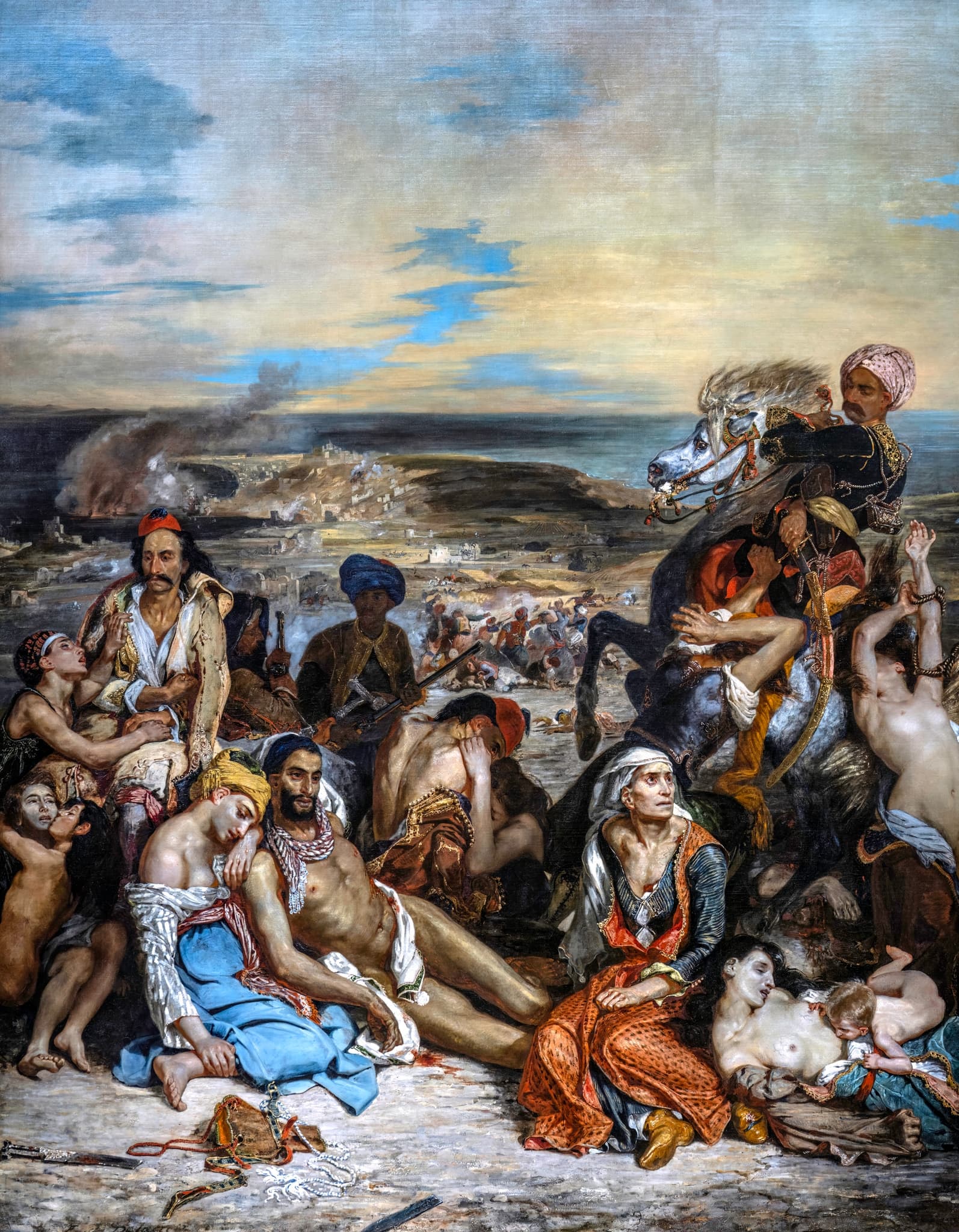
Hypothetical valuation for Delacroix’s Scenes from the Massacre at Chios (Louvre; inalienable) is $180–240 million. This range is anchored to state-level Old Master benchmarks (e.g., Rembrandt’s The Standard Bearer) and major history-painting precedents, with upward adjustment for the work’s canonical status within 19th‑century Romanticism.
Valuation Analysis
Conclusion: A reasoned hypothetical valuation for Eugène Delacroix’s Scenes from the Massacre at Chios is $180–240 million. Although the painting resides in the Louvre and is inalienable under French patrimony law, the estimate reflects what an insurance or private‑treaty indication could reasonably be set at for a national‑treasure‑level, canonical masterpiece of Romantic history painting [1][2].
Why this level: The work is among Delacroix’s most significant canvases—alongside Liberty Leading the People and The Death of Sardanapalus—formative for modern colorism and Romanticism’s expressive turn. Its monumentality, ambition, and centrality to the artist’s reputation create a scarcity profile that is virtually absolute in private markets; the Louvre’s 1824 state purchase (6,000 francs) and uninterrupted public ownership underscore its institutional stature (INV 3823) [1].
Cross‑category benchmarks: The closest pricing anchors for a museum‑grade European icon of this magnitude are recent state‑level acquisitions and top history‑painting results. Rembrandt’s The Standard Bearer sold to the Dutch State for €175 million (~$198 million at the time), demonstrating contemporary willingness to pay high nine figures for a national‑symbol work [3]. The Louvre/Rijksmuseum’s joint acquisition of Rembrandt’s pendant portraits for €160 million (~$180 million) further situates the range for sovereign‑grade trophies [4]. In the auction arena, Rubens’s The Massacre of the Innocents achieved £49.5 million in 2002 (c.~$136 million in today’s terms), a thematically resonant precedent for large‑scale, violent history subjects [5].
Positioning vs. 19th‑century auction peaks: Within Delacroix’s own market, the public auction record—Tiger Playing with a Tortoise at $9.875 million (2018)—reflects the absence of comparable masterpieces on the market, not the ceiling for his greatest works [7]. High‑end Romantic comparables like Turner’s Rome, From Mount Aventine at £30.3 million (~$47.4 million, 2014) signal the public‑auction apex for 19th‑century paintings in private hands, but national‑treasure‑grade icons command a different pricing logic when institutions or states are the natural buyers [6].
Caveats and refinements: French patrimony laws make this work effectively unsellable; any figure is best understood as an insurance/indemnity valuation or a theoretical private‑treaty indication [2]. The $180–240 million range balances museum‑icon prestige and cross‑category nine‑figure precedents against the narrower trophy‑buyer pool for Romantic history painting. A current condition report and any disclosed loan indemnity would further calibrate the figure, but given the painting’s canonical status, the indicated band reliably reflects its standing among European masterworks [1][3][4][5][6][7].
Key Valuation Factors
Art Historical Significance
High ImpactScenes from the Massacre at Chios is a foundational statement of French Romanticism and a cornerstone of Delacroix’s oeuvre. Its radical color, pathos, and modern treatment of historical atrocity position it alongside Liberty Leading the People and The Death of Sardanapalus at the apex of the artist’s achievement. The painting is a textbook image—reproduced, taught, and curated globally—with a direct line of influence on later colorists and modernist expression. Works with this level of canonical status historically command or justify nine‑figure valuations in institutional contexts. The painting’s art‑historical primacy is the single strongest value driver, elevating it beyond standard auction dynamics into a sovereign‑asset tier.
Rarity and Scale
High ImpactThis is a monumental, multi‑figure history painting from 1824—an extremely scarce category in private hands. Comparable Delacroix masterworks of this ambition are essentially locked in museums, producing near‑zero supply. Large, theatrically staged history canvases by first‑rank 19th‑century masters appear only once in a generation (if at all), which sharply compresses comparables. The combination of size, complexity, and early date within Delacroix’s career makes direct market substitutes non‑existent. Such structural scarcity typically commands a valuation premium that lifts the work well above the artist’s public auction record and requires cross‑category benchmarking against national‑treasure‑level European pictures.
Market Comparables and Precedent
High ImpactPricing aligns with sovereign‑grade Old Master precedents rather than Delacroix’s own auction record. State acquisitions like Rembrandt’s The Standard Bearer (~$198m) and the Louvre/Rijksmuseum purchase of the Soolmans/Coppit portraits (~$180m) establish today’s willingness to pay for canonical European icons. Among auctioned history paintings, Rubens’s Massacre of the Innocents (inflation‑adjusted c.~$136m) underscores the nine‑figure territory for violent historical narratives by top masters. These precedents support a $180–240m range for Chios, recognizing its museum‑icon profile and positioning it comfortably above 19th‑century auction peaks (e.g., Turner at ~$47m) while remaining coherent with recent state‑level comparables.
Legal/Patrimony Status and Liquidity
Medium ImpactThe painting is part of France’s inalienable public collections, which means it is not practically marketable. For valuation purposes, this shifts the exercise from auction price discovery to insurance/indemnity and theoretical private‑treaty indication. In practice, such legal constraints narrow transactional pathways and the pool of potential counterparties, typically favoring institutional/state actors over private collectors. While this can reduce market liquidity, for sovereign‑level icons it does not depress notional value; instead, it tends to frame valuation through cross‑category benchmarks and public‑interest considerations. As a result, the work’s legal status moderates—but does not diminish—its justified nine‑figure indication.
Sale History
French State (post-Salon purchase)
Acquired by the French state for 6,000 French francs following the 1824 Salon; now Louvre INV 3823. USD conversion not applicable.
Eugene Delacroix's Market
Delacroix is a pillar of 19th‑century French art, but his public auction market is defined by works on paper, oil studies, and mid‑sized oils; museum‑grade masterpieces are virtually all institutional. The artist’s auction record stands at $9.875 million (Christie’s, 2018) for an animal subject oil from 1862. Quality oils and watercolors trade steadily from the mid‑five to high‑six figures, with occasional seven‑figure outcomes for exceptional provenance and subject. Selectivity has increased in recent years, with buy‑ins for mid‑range historical subjects, yet strong, fresh material—particularly Moroccan/Orientalist and animal themes—continues to find demand. The top of Delacroix’s value spectrum must therefore be extrapolated via cross‑category, sovereign‑grade comparables rather than his own auction ceiling.
Comparable Sales
Tiger Playing with a Tortoise (Tigre jouant avec une tortue)
Eugène Delacroix
Same artist and medium; current auction record for a Delacroix oil; sets the market ceiling for auction-exposed Delacroix works (albeit smaller and later, animal subject, not a history painting).
$9.9M
2018, Christie's New York
~$12.6M adjusted
The Standard Bearer (De Vaandeldrager)
Rembrandt van Rijn
National‑treasure level Old Master acquired by a state; demonstrates current willingness to pay high nine figures for canonical European masterpieces with public-icon status, akin to Chios.
$198.0M
2022, Private sale to the Dutch State/Rijksmuseum
~$216.6M adjusted
Portraits of Maerten Soolmans and Oopjen Coppit (pair)
Rembrandt van Rijn
Landmark private‑treaty benchmark for museum‑grade Old Masters; anchors nine‑figure pricing for state‑level acquisitions (though the price covers two paintings).
$180.0M
2016, Private sale to the Louvre and Rijksmuseum (joint purchase)
~$240.0M adjusted
The Massacre of the Innocents
Peter Paul Rubens
Auctioned Old Master history painting depicting a violent atrocity; thematically closest high‑level precedent for Chios and proof that such subjects command very high prices.
$76.7M
2002, Sotheby's London
~$136.4M adjusted
Rome, From Mount Aventine
J. M. W. Turner
19th‑century Romantic masterpiece in oil by a peer of Delacroix; top‑tier auction price for the century, anchoring what museum‑grade 19th‑century trophies bring at auction.
$47.4M
2014, Sotheby's London
~$64.0M adjusted
The Lock
John Constable
Major 19th‑century British Romantic canvas, sold publicly; close in date to 1824 Chios and indicative of top‑end auction demand for great 19th‑century pictures.
$35.2M
2012, Christie's London
~$49.0M adjusted
Current Market Trends
The upper end of the historic European painting market has stabilized since 2024, with a quality bias: museum‑grade, fresh‑to‑market works command robust competition while middling material faces selectivity. Old Masters and adjacent 19th‑century categories have seen renewed depth for true trophies, evidenced by state‑level purchases and record results in London and New York. Liquidity is thinner than for Impressionist/Modern icons, but when works carry national‑treasure or canonical status, nine‑figure pricing is defensible. Against this backdrop, a Louvre‑level Romantic history painting like Chios aligns with the sovereign‑asset tier informed by Rembrandt and Rubens precedents, rather than the general 19th‑century auction baseline.
Sources
- Musée du Louvre collection record (INV 3823) for Scenes from the Massacre at Chios
- Code du patrimoine (France), inalienability of public collections (Art. L451-5)
- Government of the Netherlands: Netherlands to buy Rembrandt’s The Standard Bearer for €175m
- Rijksmuseum: Joint acquisition with the Louvre of Rembrandt’s portraits of Maerten Soolmans and Oopjen Coppit (€160m)
- The Guardian: Rubens’s The Massacre of the Innocents sets record £49.5m (Sotheby’s, 2002)
- BBC News: Turner’s Rome, From Mount Aventine sells for £30.3m (2014)
- Christie’s: Rockefeller Evening Sale report citing Delacroix record at $9.875m (2018)