How Much Is The Death of Sardanapalus Worth?
Last updated: May 4, 2026
Quick Facts
- Methodology
- extrapolation
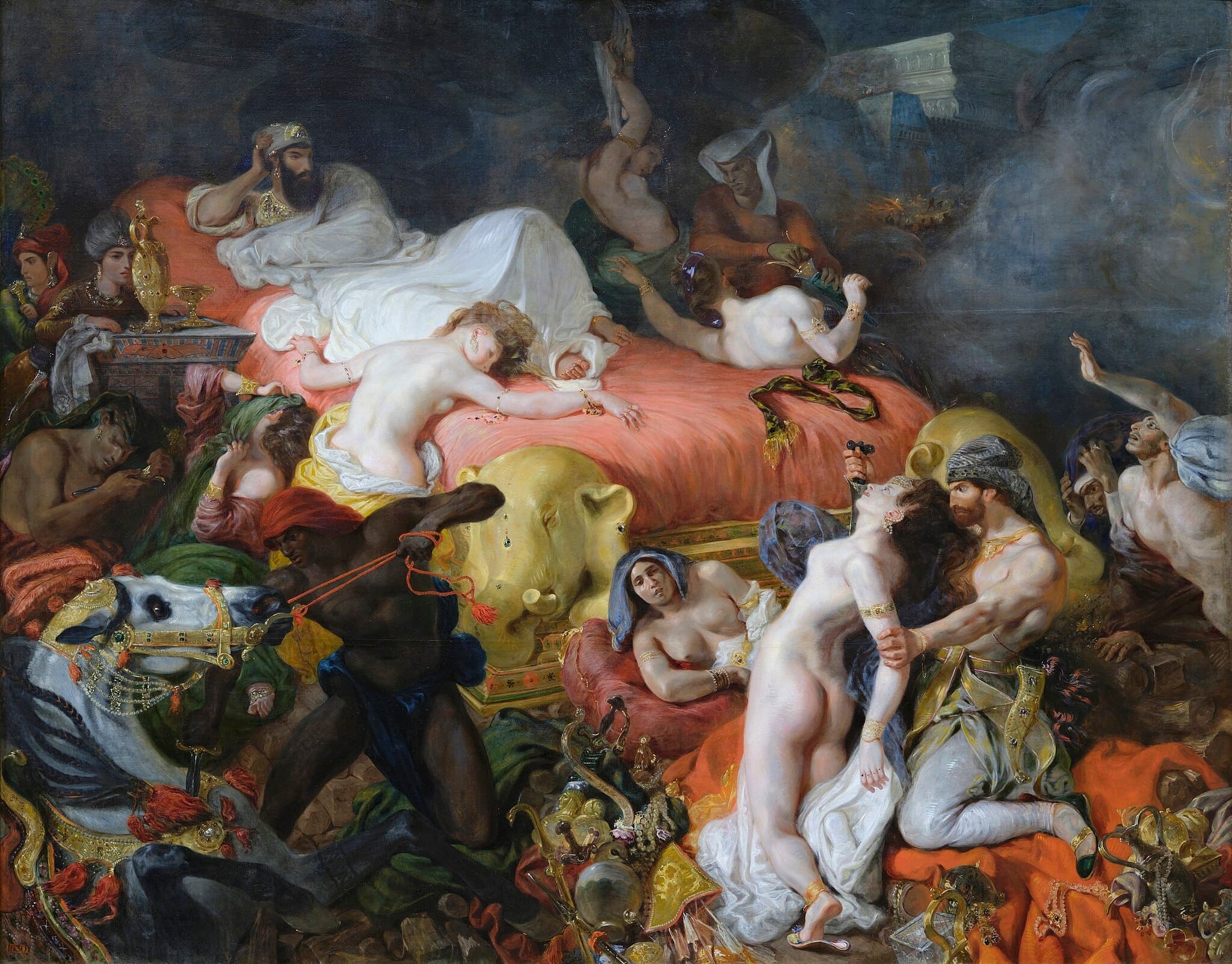
The Death of Sardanapalus (1827) is a canonical, monumental Delacroix held by the Musée du Louvre and effectively off‑market. If hypothetically offered and freely exportable, a defensible market estimate is $100–150 million, reflecting museum provenance, singular art‑historical importance, rarity of supply, and the trophy premium paid for comparable museum‑quality masterworks.
Valuation Analysis
Overview: Eugène Delacroix’s La Mort de Sardanapale (1827/28) is a major Salon painting and a signature work in his oeuvre; the principal canvas is in the permanent collection of the Musée du Louvre and is treated as a museum masterpiece [1]. Because this specific monumental canvas has no modern public‑market sale record, any price is necessarily hypothetical and must be derived by extrapolating from the artist’s auction history, high‑end comparables, and the premiums historically paid for museum‑quality, culturally important masterworks.
How the range was derived: Public comparables for Delacroix show top‑end finished oils reaching the low tens of millions (for example, a notable Rockefeller‑collection Delacroix canvas sold at Christie’s for US$9.875M) and important oil sketches and studies selling in the low‑ to mid‑millions; drawings and small studies commonly trade in the thousands to mid‑six‑figures [2]. Those realized figures set a measurable market baseline for the artist, but they are not directly transferable to a unique, monumental Louvre canvas. To translate those comparables to a market price for a canonical museum masterpiece, standard market practice applies a large “trophy” multiple — driven by scarcity, institutional provenance, and buyer competition among national museums and ultra‑high‑net‑worth collectors — producing a valuation an order of magnitude above ordinary auction comparables.
Key value drivers and risks: The primary upward drivers are the painting’s canonical status, its scale and theatricality, and its uninterrupted, high‑quality museum provenance — all features that motivate premium bidding in the rare event of a sale. Offsetting factors include legal and administrative obstacles (French national patrimony/export protections), the tiny pool of credible buyers capable of acquiring and housing such a work, and practical costs and logistics of deinstallation, transport and conservation. Any final price would also depend on sale mechanics (public auction vs. private sale with guarantees), timing, guarantees, and the presence of competing institutional bidders.
Scenarios: A conservative hypothetical outcome (limited buyer competition, restrictive export/heritage conditions) would place realized value near the lower band of the range (≈ $100M). A fully competitive international sale, with multiple institutional or deep‑pocket private bidders and favorable legal/tax circumstances, could push the price toward or above the upper band (≈ $150M+). These scenarios assume clear title, good condition following professional conservation assessment, and active engagement by a major auction house or a consortium of bidders.
Practical note: If you mean a study, sketch or reduced replica rather than the Louvre canvas, market values fall dramatically (drawings commonly $10k–$1M+, small oil sketches $50k–$2M+, and select finished smaller canvases several million). For a defensible, sale‑ready valuation of any physical object, an in‑person appraisal, full provenance, and a current conservation report are required.
Key Valuation Factors
Art Historical Significance
High ImpactLa Mort de Sardanapale is one of Delacroix’s most discussed and reproduced compositions and a touchstone of French Romanticism. Its dramatic subject, daring composition, and chromatic bravura were focal points in 19th‑century critical debate and remain central in scholarship and exhibitions. Because cultural significance is a primary determinant of collector and institutional demand, works that are canonical within an artist’s oeuvre attract substantially higher premiums. For this painting, being a widely cited, frequently illustrated museum centerpiece elevates its market standing above ordinary artist comparables, justifying a substantial trophy premium in any hypothetical sale.
Rarity & Market Scarcity
High ImpactLarge, museum‑quality Delacroix canvases rarely enter the market. The effective absence of supply at the top end creates intense competition when a marquee piece becomes available, often producing outsized bidding and private‑sale activity. Scarcity is compounded by the fact that most of Delacroix’s canonical oils reside in national collections; therefore, market evidence is thin and the few open‑market comparables tend to understate the price of a true masterpiece. In practice, scarcity drives auction houses and sellers to structure sales with guarantees and private placement strategies aimed at wealthy institutions and single‑buyer deals.
Provenance & Museum Ownership
High ImpactLongstanding museum ownership (Musée du Louvre) provides impeccable provenance, exhibition history, and scholarly documentation — all strong positive value factors. However, museum custody also makes an actual commercial sale highly unlikely and raises legal hurdles (national patrimony and export controls) that limit buyer pools and can either suppress bidding or redirect the sale into negotiated institutional transfers. While superb provenance typically increases price, in this case it importantly implies legal and administrative friction that materially influences the range and structure of any transaction.
Comparables & Auction Evidence
Medium ImpactThe artist’s best public comparables (high‑quality finished oils and important oil sketches) provide baseline market data — for example, Delacroix canvases and sketches have realized low‑to‑mid‑millions to the low tens of millions at major houses. Those realizations are robust reference points but must be adjusted substantially upward to reflect the unique status of a Louvre masterpiece. Comparables therefore inform the lower bound of an extrapolated range but are inadequate alone; an additional trophy premium and scarcity multiplier are necessary to reach the $100–150M band.
Condition, Size & Conservation
Medium ImpactThe painting’s monumental size and any conservation history materially affect market value. Large canvases require specialized transport, preparation and display commitments that reduce the effective buyer pool and increase transaction costs. Conversely, excellent state of preservation and recent professional conservation reports can support the high end of a valuation. Any final price would thus be conditioned on a detailed condition report; significant restoration needs or structural issues could reduce value by tens of percent, while pristine condition reinforces the trophy valuation.
Sale History
The Death of Sardanapalus has never been sold at public auction.
Eugene Delacroix's Market
Eugène Delacroix is a leading figure of 19th‑century French Romanticism; his works are collected by major museums worldwide and by discerning private collectors. Market outcomes are bifurcated: drawings and studies trade relatively frequently at modest to mid‑six‑figure levels, important oil sketches can reach mid‑millions, and finished canvases occasionally achieve low‑to‑mid‑tens of millions at auction. The artist’s top public auction record remains well below the extreme sums paid for the best Impressionist or Old Master masterpieces, but museum‑quality, historically central canvases command a premium when they surface.
Comparable Sales
Tigre jouant avec une tortue (Tiger Playing with a Tortoise)
Eugène Delacroix
Same artist; finished oil by Delacroix sold at a major house and widely cited as the artist's modern auction benchmark — shows top public‑market ceiling for high‑quality Delacroix canvases.
$9.9M
2018, Christie's, New York (The Rockefeller Collection sale)
~$11.8M adjusted
Le 28 juillet — La Liberté guidant le peuple (oil sketch)
Eugène Delacroix
Same artist; important oil sketch for a major Delacroix composition sold at auction — representative of value for significant preparatory/medium‑scale works.
$4.2M
2017, Christie's (14 December 2017)
~$5.3M adjusted
Étude de lions couchés (Study of Reclining Lions)
Eugène Delacroix
Recent regional rediscovery and sale of a small Delacroix oil — illustrates market demand and price band for smaller studies/rediscovered works (mid‑six‑figures).
$495K
2025, Hôtel Drouot, Paris (28 March 2025)
Current Market Trends
Since 2024–2026 the market has shown selective strength for high‑quality historical works as some collectors rotate away from contemporary risk. Supply of top‑tier 19th‑century masterworks remains extremely limited, and sales of such pieces are often structured privately or with guarantees. Rediscoveries and well‑provenanced works continue to attract attention, but the very top end remains cautious and driven by institutional interest and deep‑pocket private buyers.
Sources
- Musée du Louvre collection: La Mort de Sardanapale (Delacroix)
- Christie's: Tigre jouant avec une tortue (Tiger Playing with a Tortoise) — Rockefeller Collection (sale lot)
- Christie's: Eugène Delacroix collecting guide / oil sketch sales
- Philadelphia Museum of Art: reduced/reprise version of Sardanapalus (McIlhenny collection)
- French Ministry of Culture: export procedures and cultural property protections