How Much Is The Execution of the Doge Marino Faliero Worth?
Last updated: May 4, 2026
Quick Facts
- Methodology
- comparable analysis
This autograph, museum‑held large history painting by Eugène Delacroix (Wallace Collection, inv. P282) is museum‑quality and well documented. Were it to come to market in good condition with catalogue‑raisonné confirmation, a reasoned auction range is USD 3,000,000–12,000,000, with the final outcome driven by condition, publication/exhibition history and sale strategy.
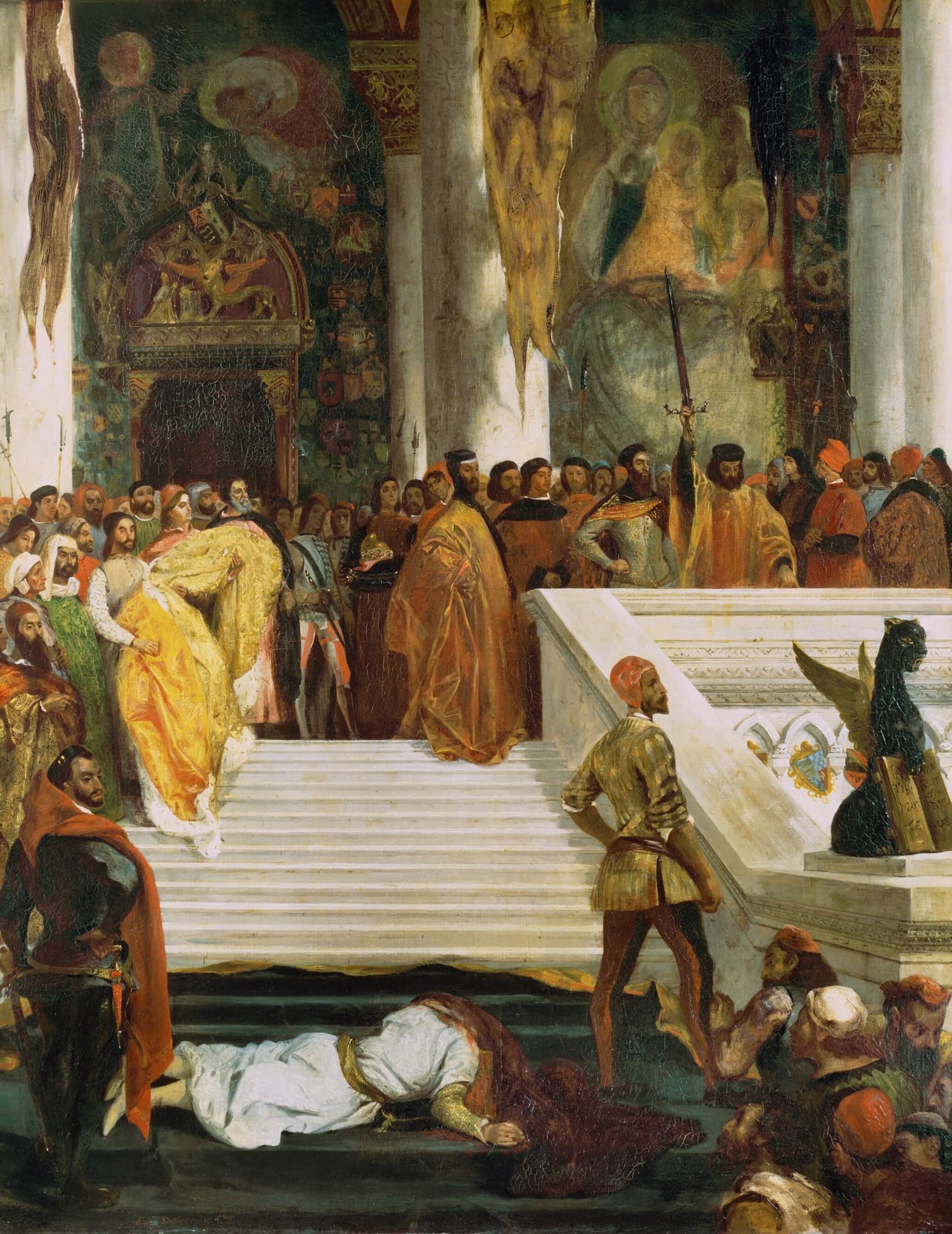
The Execution of the Doge Marino Faliero
Eugene Delacroix • Oil on canvas
View more by Eugene Delacroix →Valuation Analysis
Context and attribution: The Execution of the Doge Marino Faliero in the Wallace Collection (inv. P282) is an autograph, Salon‑exhibited Delacroix history canvas now held in public collection, and therefore carries the premium of institutional ownership and scholarly visibility [1]. Because it is museum‑held there is no recent public sale; the valuation below is a hypothetical market opinion for a well‑provenanced, fully authenticated, and well‑conserved example offered publicly.
Comparable rationale and numeric band: The USD 3,000,000–12,000,000 window is derived by triangulating known Delacroix auction outcomes and the market behaviour for large 19th‑century French history paintings. The modern public ceiling for a high‑quality Delacroix oil is in the single‑digit millions (Christie’s Tiger/Tortoise lot, c. USD 9.875M), which functions as an achievable high‑end benchmark for exceptional, fresh‑to‑market canvases [2]. Mid‑market comparables for smaller museum‑quality oils (for example, Bonhams Paris, 2023, which realised the equivalent of c. USD 849k) illustrate how scale, subject matter and institutional provenance scale values upward; a large, Salon‑exhibited history painting with full documentation therefore sits comfortably in the multi‑million band [3].
Drivers and sensitivities: The strongest positive drivers are: confirmed autograph status and catalogue‑raisonné/committee acceptance; robust provenance and exhibition/publication history (Salon 1827, printed scholarship); and excellent physical condition. Negative drivers that would materially compress value include unresolved attribution questions, significant restoration or poor condition, and gaps in provenance. Absent these negatives, institutional provenance (Wallace Collection) and documented Salon history materially increase buyer confidence and allow estimates at the upper end of the range [4].
Sale strategy implications: To secure prices toward the top of the band, the painting would require major‑house placement (Christie’s or Sotheby’s), a targeted pre‑sale exhibition and catalogue entry, and specialist endorsement (Delacroix scholars/museum curators). Guarantees or underwriting are realistic at the upper end; private‑treaty sale to a museum is a likely alternative if institutional interest exists. Conversely, an offering lacking the above credentials would be exposed to heavy discounts by dealers and cautious bidders.
Conclusion and next steps: Given the painting’s museum ownership, scale and documented Salon provenance, USD 3,000,000–12,000,000 is a reasoned, conservative market window for an authenticated, well‑conditioned autograph canvas. Immediate next steps to firm and market‑ready this valuation are: obtain a full conservator condition report, assemble a complete provenance dossier, and consult leading Delacroix specialists and the Wallace Collection archive to confirm catalogue‑raisonné status and publication history [1][2][3][4].
Key Valuation Factors
Art Historical Significance
High ImpactThe subject is squarely within Delacroix's mature interest in dramatic historical and literary themes, and the Wallace canvas was exhibited at the Paris Salon (1827), which enhances its scholarly importance. Salon exhibition roots and an appearance in standard Delacroix literature place the work in the artist's history‑painting corpus rather than peripheral studio material. Works with established art‑historical relevance command premiums because museums and top private collectors prize narrative scale, documented iconography and connections to the artist's major projects. The painting's standing in the literature and relation to known preparatory drawings therefore exerts a sustained, high positive effect on market value.
Provenance & Exhibition History
High ImpactMuseum ownership and documented exhibition pedigree are decisive. Being in the Wallace Collection (acc. inv. P282) and shown at the Salon reduces buyer risk, facilitates export/loan for exhibition, and supports catalogue‑entry and scholarly attention. Provenance that ties a work to significant collections or to a continuous, demonstrable chain of ownership typically elevates value into the multi‑million range, because it eases committee acceptance, insurability and museum interest. Conversely, gaps in provenance or unclear title history materially reduce competitive bidder confidence and can shave millions off a prospective hammer price.
Condition & Conservation
High ImpactThe physical state of the picture is a primary value lever. Surface varnish, inpainting, previous restorations, relining and structural weaknesses all alter buyer appetite and the required sale condition. Even a superb attribution will be heavily discounted if the canvas has unstable paint, extensive overpainting or recent aggressive restoration. A detailed conservator report will quantify necessary interventions and their cost—and a favourable report can materially raise the reserve/estimate. Condition issues can move a work from the multimillion band down to low six figures in extreme cases, so this factor is high impact.
Market Comparables & Auction Record
High ImpactComparable auction evidence sets realistic ceilings and floors. Delacroix's modern auction high (~USD 9.875M) provides an empirical ceiling for a fresh, museum‑quality canvas, while recent mid‑market sales of smaller oils (e.g., Bonhams 2023, ~EUR 775k ≈ USD 849k) indicate where smaller or less prominent works trade. Because large history canvases by Delacroix are rare in the public market, each sale carries disproportionate signaling power; solid, museum‑quality provenance and pre‑sale exposure can therefore lift a lot well above routine comparables. This makes comparable evidence a high‑impact valuation factor.
Rarity & Freshness to Market
Medium ImpactLarge Salon‑scale Delacroix canvases seldom appear on the open market, and when they do they attract cross‑border museum and wealthy private interest. Freshness to market (first major auction offering in generations) and the absence of recent sales increase competitive tension, but they also require sophisticated marketing and institutional outreach. While rarity can push the price upwards, it also concentrates the buyer pool; therefore the net effect is high upside but also execution‑dependent—hence a medium impact categorisation for planning and reserve setting.
Sale History
The Execution of the Doge Marino Faliero has never been sold at public auction.
Eugene Delacroix's Market
Eugène Delacroix occupies a top tier within 19th‑century French Romanticism: heavily represented in major museums, intensively studied, and collectible by institutions and advanced private buyers. Market activity is intermittent; drawings and small oils trade more frequently in the low‑to‑mid five and six‑figure bands, while large, museum‑quality history paintings are rare and can bring multi‑million prices when authenticated and fresh to market. Provenance, exhibition history and catalogue‑raisonné acceptance are disproportionately important for Delacroix, and they largely determine whether a work trades in the mid‑six‑figure range or in the multimillion ceiling established by high‑profile sales.
Comparable Sales
Tigre jouant avec une tortue
Eugène Delacroix
Same artist; large, high‑quality oil and the artist's modern auction record — useful as the market ceiling for Delacroix paintings and shows demand for fresh, museum‑quality canvases with top‑collector provenance.
$9.9M
2018, Christie's New York (Peggy & David Rockefeller sale)
~$11.8M adjusted
Cheval arabe attaché à un piquet
Eugène Delacroix
Recent, well‑provenanced small oil by Delacroix — a good mid‑market comparable showing realised prices for smaller museum‑quality oils (mid‑six figures).
$849K
2023, Bonhams Paris
~$900K adjusted
Choc de cavaliers Arabes (Arab horsemen charging)
Eugène Delacroix
Reported earlier multimillion public sale for a dramatic Orientalist/military composition by Delacroix — useful historical precedent for high prices on large, dramatic canvases (note: public-source reporting is secondary; archival confirmation recommended).
$3.3M
1998, Historic auction reported 1998 (auction‑house press)
~$6.5M adjusted
Current Market Trends
The market for 19th‑century French painting has been cautious since 2023, with recovery signals into 2025–2026. Collectors are selective: rarity, museum provenance and fresh‑to‑market status drive premiums while condition and unclear provenance suppress results. Top houses favour well‑documented, exhibition‑ready works; accordingly, a Delacroix with institutional pedigree is well positioned to benefit from the current selective demand, although market timing and sale strategy remain critical.
Sources
- Wallace Collection — The Execution of the Doge Marino Faliero (inv. P282) object entry
- Christie’s — Combined Records and Top Tens (includes reference to Delacroix auction benchmark, 2018)
- Bonhams Paris — Eugène Delacroix, Cheval arabe attaché à un piquet (sale 22 June 2023)
- Delacroix scholarship / catalogue references — Metropolitan Museum / Delacroix publication (catalogue/essay material)