How Much Is The Massacre at Chios (Scenes from the Massacres at Chios) Worth?
Last updated: May 4, 2026
Quick Facts
- Methodology
- comparable analysis
Hypothetical open‑market value for Eugène Delacroix’s The Massacre at Chios (1824) is estimated at USD 20,000,000–100,000,000. This is a reasoned, evidence‑anchored band based on scarce public comparables for Delacroix oils, category price re‑discovery events, and the painting’s canonical importance — but note the work is museum‑held and effectively not marketable under normal circumstances.
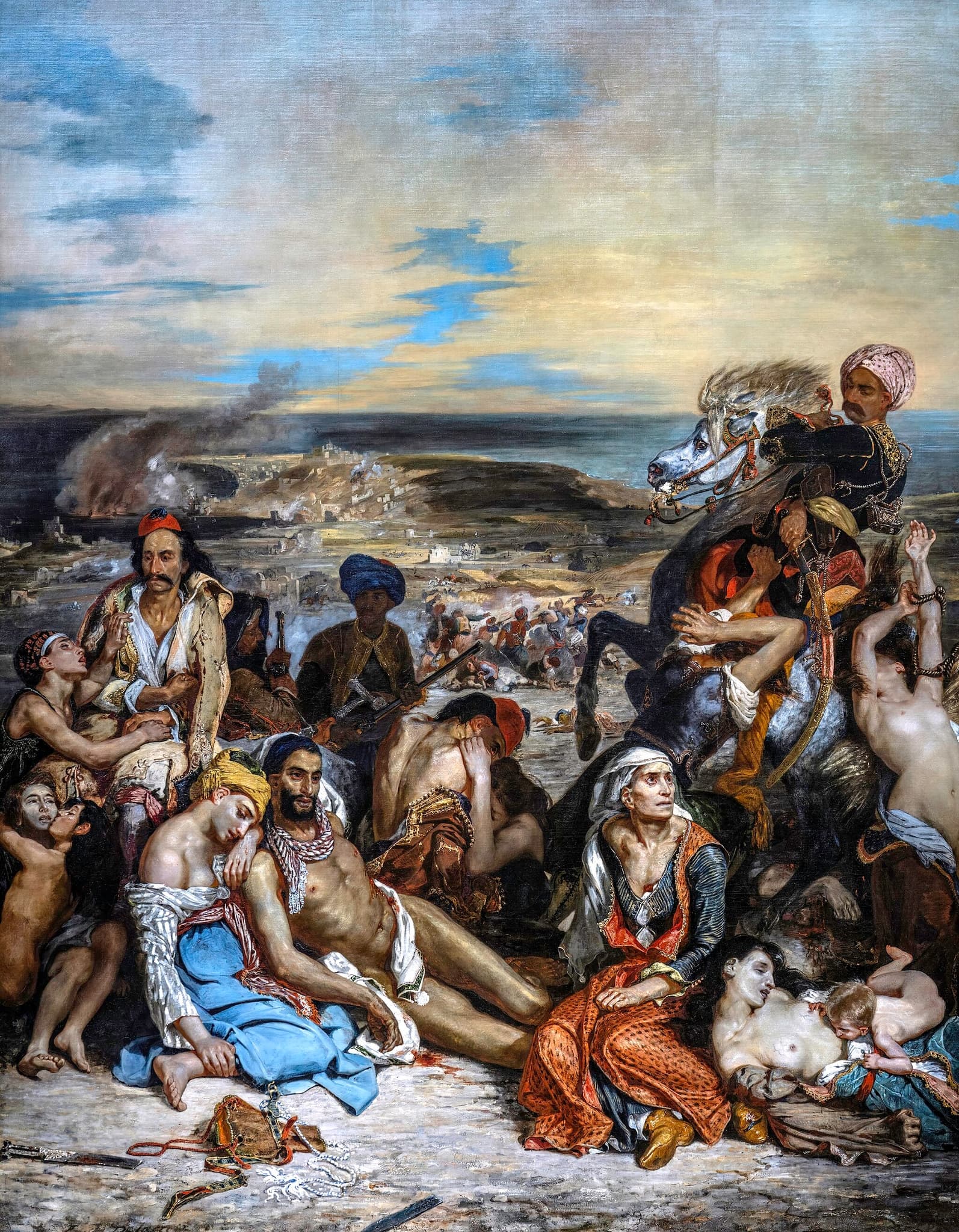
The Massacre at Chios (Scenes from the Massacres at Chios)
Eugene Delacroix, 1824 • Oil on canvas
View more by Eugene Delacroix →Valuation Analysis
Valuation conclusion (hypothetical sale): If The Massacre at Chios (1824) by Eugène Delacroix were offered on the open market under exceptional circumstances, my estimated market valuation is USD 20,000,000–100,000,000. The lower bound reflects realized auction evidence for important Delacroix oils adjusted for significance; the upper bound reflects an extraordinary, highly competitive institutional and ultra‑high‑net‑worth collector bidding scenario for a canonical Salon history painting.
Methodology: This estimate uses a comparable‑analysis approach combining public auction anchors (notably the Christie’s 2018 sale that produced Delacroix’s modern oil record) with market context from large private‑collection dispersals that reset demand in the 19th‑century/Orientalist field [2][3]. Because top Delacroix oils rarely appear on the market, price discovery is uncertain: I extrapolate from the highest‑quality available public comparables and the demonstrated willingness of institutions and specialists to pay premiums for canonical, museum‑quality history canvases.
Lower bound rationale: The modern public auction high for a Delacroix oil is materially below the lower bound of this range (Christie’s, 2018, $9.875M) [2]. However, that lot differs in scale, subject and canonical importance. A museum‑quality Salon history painting typically commands a meaningful premium over animal studies or small works. Given the sparsity of directly comparable sales and reasonable conservatism for condition/market risk, USD 20M is a defensible floor for a major Delacroix history canvas offered in good condition.
Upper bound rationale and caveats: The $100M upper bound represents an exceptional scenario: coordinated institutional interest, a small pool of eligible buyers, intense publicity, and a sale that overcomes legal/patrimony barriers. Comparable category events (large Orientalist dispersals such as the Najd sales) demonstrate that concentrated demand can generate outsized results across the genre, though not necessarily for Delacroix specifically [3]. Practically, such an outcome is improbable given market depth for nineteenth‑century Romantic masters relative to Impressionist/Modern blue‑chips, so the higher figure is reserved for rare, competitive situations.
Legal and custodial reality: The painting was purchased by the French state in 1824 and is in the Louvre inventory; it is effectively inalienable for practical purposes and therefore not marketable under normal circumstances [1]. That custodial status both increases hypothetical cultural value and renders any market estimate academic: a real‑world transfer would require exceptional legal and political conditions, which materially suppress realistic liquidity even if theoretical prices can be high.
Refinements required: A precise monetized appraisal would require the Louvre’s accession and provenance files, a full condition and conservation report, and consultation with leading 19th‑century specialists and auction‑house departments. With those inputs the band could be narrowed and a probabilistic hammer/price‑realised projection provided; absent them the USD 20M–100M band is a reasoned, evidence‑anchored hypothetical valuation.
Key Valuation Factors
Art Historical Significance
High ImpactThe Massacre at Chios is a major Salon history painting and a formative masterpiece in Delacroix’s oeuvre and 19th‑century French Romanticism. Its subject, scale, and early public purchase by the French state place it among the artist’s most consequential works. Canonical status elevates institutional demand and collector desirability: museums and top collectors prize works that are pivotal in an artist’s career and in broader art‑historical narratives. That premium for canonical status is the single strongest upward driver of hypothetical market value for this canvas.
Provenance & Legal Status
High ImpactPurchased by the French state in 1824 and long held in the national collection (Louvre inventory), the painting’s provenance is impeccable but also creates near‑absolute legal and patrimony constraints. French inalienability and export restrictions mean the work is effectively off‑market; any hypothetical sale would require exceptional legislative or political steps. Those legal realities both increase theoretical scarcity value (cultural premium) and sharply reduce real‑world liquidity — a critical factor that keeps this valuation speculative rather than transactional.
Market Comparables & Scarcity
High ImpactPublic auction comparables for Delacroix oils are sparse: the modern auction benchmark is Christie’s 2018 sale (Delacroix oil, $9.875M) and earlier Paris sales provide historical context. Large private‑collection dispersals in the Orientalist/19th‑century field (e.g., the Najd sales) show concentrated demand can lift category prices. Because top Delacroix oils seldom appear, scarcity drives wide valuation bands and uncertainty; comparables anchor the lower bound but cannot tightly predict exceptional sale outcomes, so extrapolation to the tens of millions is required.
Condition & Conservation
Medium ImpactCondition materially affects market value for large historic canvases. Treatments, relinings, overpaint or unstable supports can reduce competitive buyer interest and therefore price; conversely, well‑documented, expertly conserved works preserve or enhance value. For this painting the public catalogue notes and museum conservation records are needed to confirm structural and surface state. Without those reports, a conservatively wider valuation band must be used to allow for condition risk and restoration history.
Exhibition & Publication History
Medium ImpactExtensive display, scholarly citation and inclusion in major catalogues raisonnés or thematic exhibitions strengthens market confidence and supports higher hypothetical pricing. The Massacre at Chios has a robust exhibition and literature profile, which reassures institutions and collectors about attribution and importance. Well‑publicized loans and major catalogue essays often precede or accompany premium sales; this painting’s museum prominence is therefore a positive valuation factor even though it contributes to its inalienability.
Sale History
The Massacre at Chios (Scenes from the Massacres at Chios) has never been sold at public auction.
Eugene Delacroix's Market
Eugène Delacroix (1798–1863) is a cornerstone figure of 19th‑century French Romantic painting. The secondary market for Delacroix is active but constrained: major oils are overwhelmingly museum‑held and infrequently offered, while works on paper and small studies trade more regularly. The artist’s public auction record for an oil (Christie’s, 2018) sits below the rarefied tens‑of‑millions band occupied by top Impressionist/Modern names, meaning Delacroix’s headline prices are lower even though his canonical importance is high.
Comparable Sales
Tigre jouant avec une tortue (Tiger Playing with a Tortoise)
Eugène Delacroix
Same artist and medium; this is the headline public auction result for a Delacroix oil in the modern record and therefore a primary market anchor for top‑tier Delacroix oils, even though the subject (animal scene) and scale are less closely matched to a large Salon history painting.
$9.9M
2018, Christie's, New York — The Collection of Peggy & David Rockefeller (Evening Sale)
~$13.1M adjusted
Choc de cavaliers arabes (reported)
Eugène Delacroix
Same artist; large‑scale 19th‑century sale in Paris that has been cited historically as an earlier high for Delacroix oils — useful as an historic Paris‑market benchmark and for showing long‑term price trajectory.
$7.8M
1998, Piasa, Paris (reported)
~$15.8M adjusted
Najd Collection dispersal (representative benchmark for Orientalist/19th‑century demand)
Various (Najd Collection)
Large private‑collection dispersal that re‑established appetite and price benchmarks for high‑quality Orientalist and 19th‑century academic paintings (Gérôme, Deutsch, etc.). Useful as a market‑context comparable for buyer interest and what a focussed sale of top works in this genre can realise.
$43.3M
2019, Sotheby's — The Najd Collection (Orientalist paintings), London (sale total reported)
~$56.3M adjusted
Current Market Trends
Current market conditions (post‑2022) feature cooler global auction turnover and greater buyer selectivity, but renewed interest in high‑quality 19th‑century and Orientalist paintings persists, supported by targeted private dispersals and museum programming. Supply scarcity of top museum‑quality Delacroix oils keeps price discovery episodic: when the right works appear, competitive institutional and private bidding can lift results substantially, though such occurrences are rare.
Sources
- Musée du Louvre Collections — Scènes des massacres de Scio (The Massacre at Chios), inv. INV 3823
- Christie’s — The Collection of Peggy & David Rockefeller: 19th & 20th Century Art (Evening Sale), 8 May 2018 (Delacroix record result)
- Sotheby’s Press — The Najd Collection dispersal (Orientalist paintings) and related market impact, 2019