How Much Is The Massacre at Chios Worth?
Last updated: June 5, 2026
Quick Facts
- Methodology
- comparable analysis
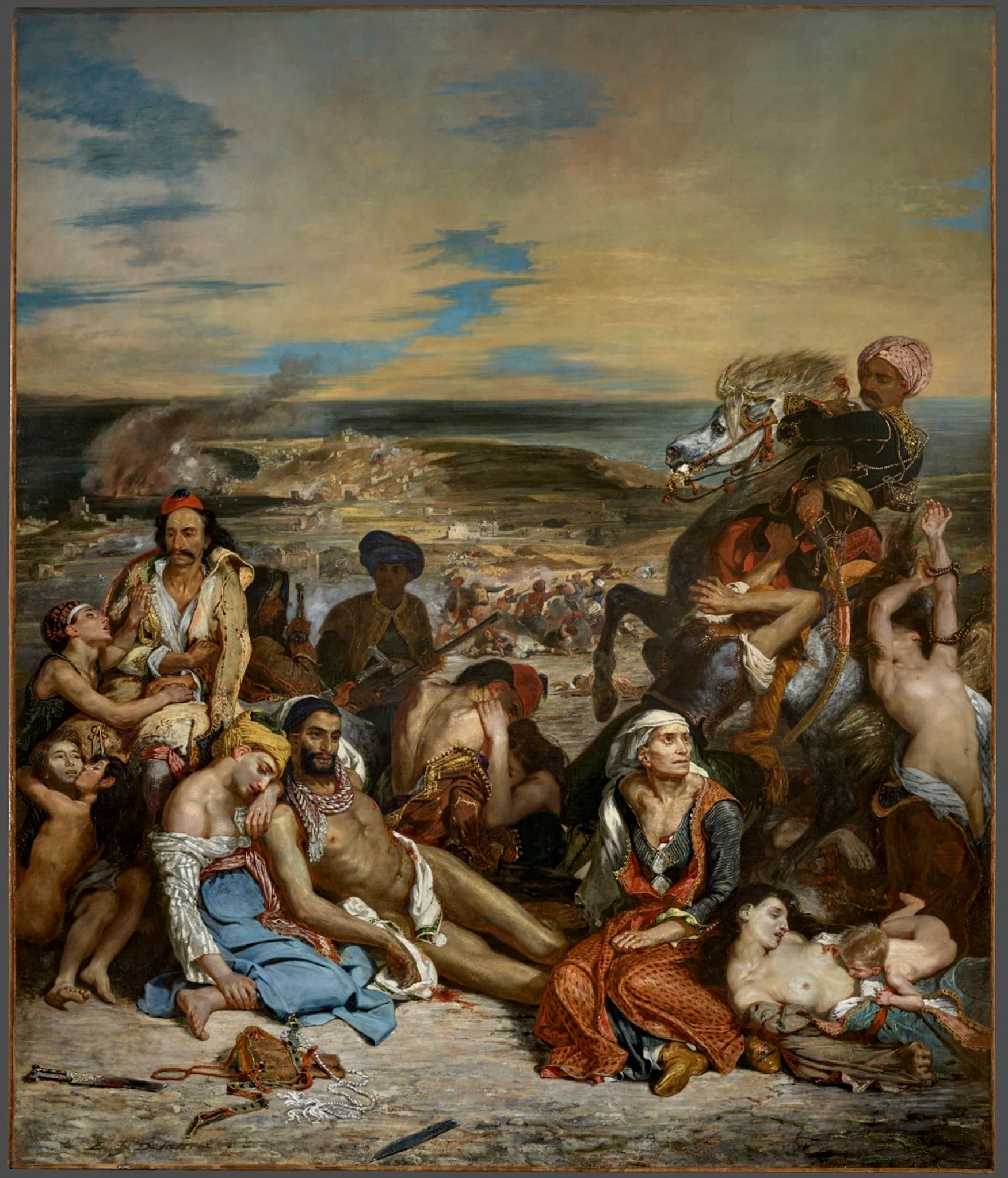
Eugène Delacroix’s The Massacre at Chios is an inalienable Louvre masterpiece and one of the defining monuments of French Romanticism. In a hypothetical, unencumbered sale today, we estimate $300–500 million, derived from cross-artist trophy benchmarks and the work’s singular place in art history. This is a theoretical valuation; the painting is not commercially available.
Valuation Analysis
Work and status. Delacroix’s The Massacre at Chios (1824; oil on canvas, c. 419 × 354 cm) is held by the Musée du Louvre (inv. 3823), acquired from the artist by the French state in September 1824; the museum’s record details its provenance and movements within the national collections [1]. As part of France’s public collections, it is legally inalienable—works in the “domaine public” cannot be sold under the Code du patrimoine, Article L451‑5 [2].
Method. Because the painting has never traded in the modern market, there is no direct sale history to anchor price. Delacroix’s highest auction price—$9,875,000 for Tiger Playing with a Tortoise in 2018—reflects the caliber of works available at auction, not the value of his canonical monuments [3]. Rational pricing therefore requires cross‑artist trophy analysis at the very top of the market, where value is driven by art‑historical rank and global recognition. Public benchmarks include Leonardo’s Salvator Mundi at $450.3 million [4], Gustav Klimt’s Portrait of Elisabeth Lederer at $236.4 million in 2025 [5], and Picasso’s Les femmes d’Alger (Version O) at $179.4 million [6].
Positioning. Within this framework, The Massacre at Chios sits among the most consequential 19th‑century canvases in existence—one of Delacroix’s two or three defining masterpieces and a cornerstone of Romantic history painting. Its fame, scholarship, and Louvre provenance confer maximum institutional prestige; the monumental scale slightly narrows the private‑buyer pool but heightens its status as a civic and cultural trophy. At the ultra‑trophy tier, demand is led by major museums (often via patrons), sovereign entities, and a handful of UHNW collectors; pricing at this level decouples from artist‑specific auction records and aligns instead to cultural primacy and global scarcity.
Estimate. Balancing these factors, an unencumbered open‑market estimate is $300–500 million. The lower bound is consistent with recent trophy outcomes for uniquely important pictures; the upper bound remains below the inflation‑adjusted Leonardo apex yet reflects this work’s singular stature and anticipated sovereign/UHNW competition [4][5]. This figure is strictly hypothetical: the painting is not commercially available, and French law and export controls would ordinarily preclude any transaction [2].
Key Valuation Factors
Art Historical Significance
High ImpactThe Massacre at Chios is a cornerstone of French Romanticism and one of Delacroix’s defining canvases, on par with Liberty Leading the People. It marked a decisive break from Neoclassicism toward expressive color, dynamic composition, and modern history painting, and it shaped the trajectory of 19th‑century European art. Its subject—the atrocities of the Greek War of Independence—embodies Romantic engagement with contemporary political struggle and humanitarian tragedy. The painting’s immense scholarly footprint, ubiquity in art‑historical literature, and central placement within the Louvre cement its canonical status. At the top of the market, this level of cultural primacy commands a premium that is only loosely tethered to the artist’s auction record, positioning the work among the most important pictures of its century.
Rarity and Supply
High ImpactMonumental, museum‑grade Delacroix oils are effectively unavailable: the vast majority reside in European institutions and do not circulate. Unlike categories where artist records routinely reset, Delacroix’s public auction ceiling is constrained by the absence of masterpieces on the market, not by demand. A picture of this rank would represent a once‑in‑a‑generation (or longer) opportunity, drawing competition from a tiny set of sovereign buyers, institutions (via patrons), and UHNW collectors seeking cultural trophies rather than decorative acquisitions. Extreme rarity exerts powerful upward pressure on price at this tier, with cross‑artist precedents showing that buyers prioritize art‑historical stature and global recognition when true icons surface, even if the artist’s auction record is modest relative to peers in Modern or Post‑War categories.
Provenance, Scale, and Visibility
High ImpactUnassailable provenance—the French State and the Louvre—maximizes confidence and prestige, eliminating typical concerns around attribution, title, or condition disclosure. The painting’s monumental scale (c. 419 × 354 cm) intensifies visual impact and institutional presence, aligning it with civic and museum contexts where grand history paintings confer identity and status. While size narrows the pool of private residential buyers, it enhances trophy appeal for public venues, foundations, and state‑backed collections that can accommodate large works. Visibility—permanent display, scholarship, and reproduction—further amplifies brand equity. At the ultra‑trophy level, these attributes are price‑positive, supporting a valuation that exceeds what smaller easel pictures by the same artist could achieve, even at the top of the auction market.
Trophy Benchmarks and Demand
High ImpactPricing at the apex is set by a small number of public benchmarks and comparable cultural trophies. Leonardo’s Salvator Mundi at $450.3 million established the modern auction apex; more recently, Klimt’s Portrait of Elisabeth Lederer achieved $236.4 million, and Picasso’s Les femmes d’Alger realized $179.4 million. These outcomes illustrate willingness to pay for universally recognized, museum‑caliber icons. Although Delacroix’s auction record is far lower due to supply limitations, Massacre at Chios operates in this trophy arena: it is globally famous, academically foundational, and institutionally celebrated. In such cases, pricing decouples from the artist’s own auction comps and tracks to historical rank, visibility, and scarcity, supporting a $300–500 million range in a fully open, unencumbered sale.
Legal Status and Marketability
Medium ImpactAs part of France’s national collections, the painting is inalienable under the Code du patrimoine. Practically, this removes it from the commercial market and means any valuation is hypothetical, useful for context, insurance discussions on loans, or risk management scenarios. While legal inalienability reduces real liquidity (and thus immediate market price discovery), it does not diminish the painting’s cultural or theoretical market value; if anything, it enhances desirability by underscoring its institutional stature and impossibility to acquire. For the purpose of a market estimate premised on an unconstrained sale, legal barriers are set aside; however, any real‑world transaction would require exceptional statutory changes and would likely trigger pre‑emption or export controls that complicate execution and timing.
Sale History
Ministère de la Maison du Roi (French State)
Purchased from the artist for 6,000 French francs following the 1824 Salon; entered and remained in the French national collections (Versailles, Musée du Luxembourg, Louvre). USD equivalent not applicable.
Eugene Delacroix's Market
Delacroix is a blue‑chip 19th‑century master whose major oils overwhelmingly reside in museums, suppressing headline auction prices relative to his historical stature. His public auction record for an oil is $9,875,000 (Christie’s New York, 2018; Tiger Playing with a Tortoise), a figure limited by supply rather than demand. The majority of market activity is in drawings and smaller oils, with strong subjects—animal studies, Moroccan/orientalist scenes, or sheets tied to major compositions—trading from the mid‑five to low‑six figures and occasionally higher. When fresh, high‑quality oils appear, they attract significant attention but are rare. Consequently, any valuation of a canonical Delacroix masterpiece must extrapolate from cross‑artist trophy benchmarks rather than rely on the artist’s own auction record.
Current Market Trends
Old Masters and 19th‑century European categories have shown resilient demand for best‑in‑class, museum‑grade works amid selective buying at the ultra‑premium tier. Supply is the dominant constraint: masterpieces are largely institutionalized, while activity concentrates in mid‑market drawings and smaller oils. In recent marquee cycles, sovereign and UHNW buyers have demonstrated readiness to pay for globally recognized cultural trophies, with public benchmarks (Leonardo, Klimt, Picasso) reaffirming the ceiling for singular works. Paris continues to consolidate its role for historical European material post‑Brexit, supporting liquidity in Delacroix’s works on paper. Against this backdrop, a museum‑caliber Romantic history painting of iconic status would command intense competition and price discovery near the top of the global trophy range—were it tradable.
Sources
- Musée du Louvre collection entry: The Massacre at Chios (INV. 3823)
- Code du patrimoine (France), Article L451-5: Inalienability of public collections
- Christie’s: Rockefeller Evening Sale report (Delacroix auction record)
- Guinness World Records: Most expensive painting sold at auction (Leonardo da Vinci, Salvator Mundi)
- Axios: Klimt portrait sells for $236.4 million at Sotheby’s New York
- TIME: Picasso’s Les femmes d’Alger sets auction record at Christie’s