How Much Is Tiger Playing with a Tortoise (Tigre jouant avec une tortue) Worth?
Last updated: May 4, 2026
Quick Facts
- Last Sale
- $9.9M (2018, Christie's New York — The Collection of Peggy & David Rockefeller, Evening Sale (Lot 3))
- Methodology
- recent sale
This opinion is anchored to the identical painting that sold at Christie’s New York (The Collection of Peggy & David Rockefeller) on 8 May 2018 for $9,875,000. Given that benchmark, current market conditions and comparable evidence, a fair market range today for the same object in comparable condition and provenance is approximately $7,000,000–$14,000,000 (central expectation ≈ $9–11M).
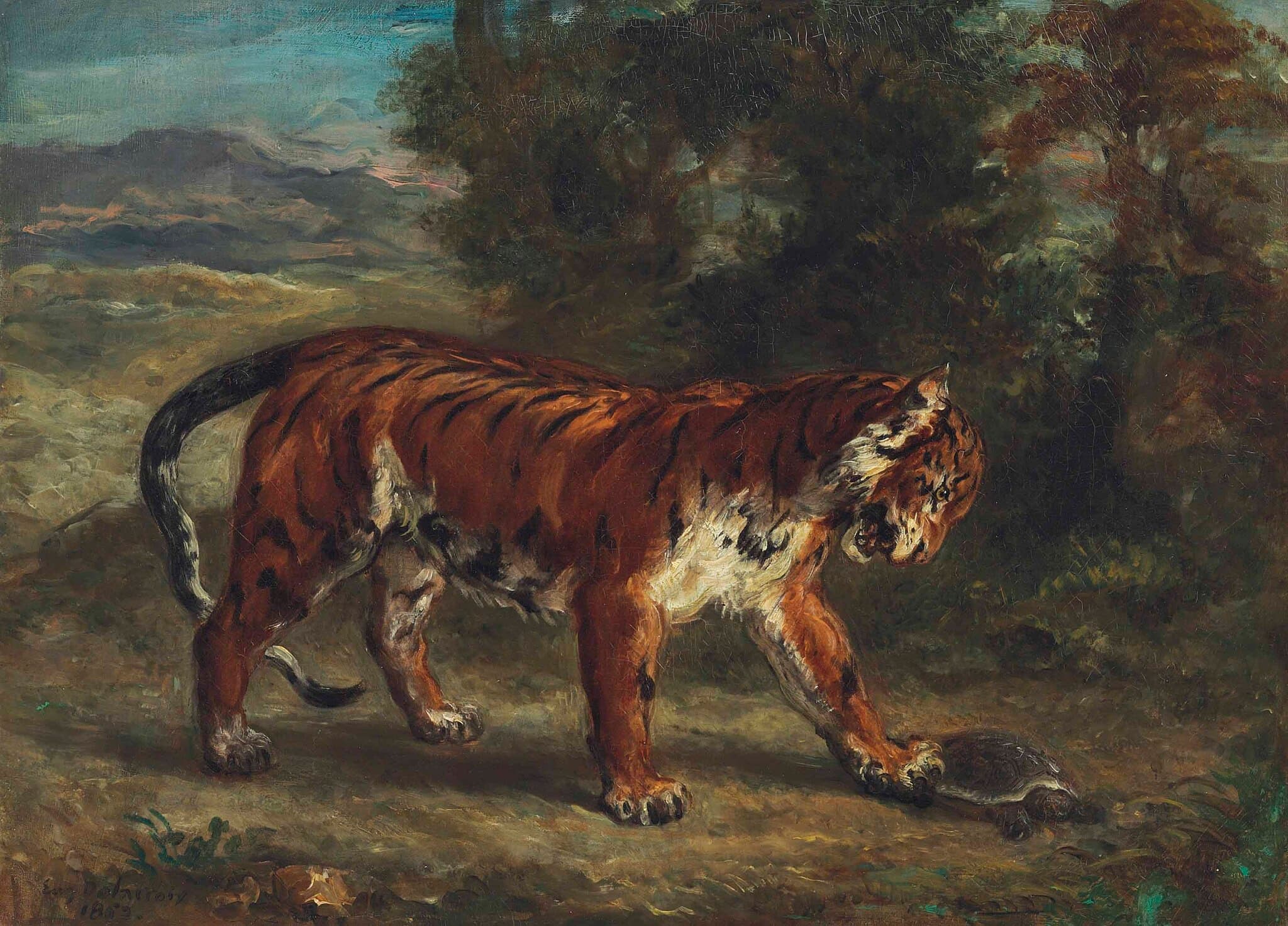
Tiger Playing with a Tortoise (Tigre jouant avec une tortue)
Eugene Delacroix, 1862 • Oil on canvas
View more by Eugene Delacroix →Valuation Analysis
Anchor and provenance: This valuation is anchored to the exact work that appeared as "Tigre jouant avec une tortue" and realized $9,875,000 at Christie’s New York (8 May 2018). The lot carried high‑quality provenance (Rockefeller collection) and catalogue/literature citations that materially enhanced buyer confidence and liquidity in the 2018 sale [1]. That published result is the primary market benchmark for this specific object.
Work character and relative significance: The painting is a late, animal‑subject canvas and—in intrinsic art‑historical hierarchy—would normally rank as a minor to mid‑level Delacroix picture. Nevertheless, the combination of clear attribution, catalogue raisonné entries and top‑tier provenance elevates it above the mid‑market cluster of small studies and rediscoveries; it attracts both private collectors and institutional interest because of those factors.
Method and comparable evidence: Using the 2018 sale as the principal anchor, I adjust for market movement, liquidity and comparable auctions since 2018. Recent evidence shows a tiered market: well‑provenanced Delacroix oils remain scarce and command strong prices, while smaller rediscovered canvases and studies commonly trade in the mid‑six‑figure to low‑seven‑figure bands [2]. The 2018 Rockefeller result therefore sits at the top of the public ladder for this composition and guides the present estimate.
Valuation range rationale: The proposed market range of $7,000,000–$14,000,000 reflects realistic scenarios. The lower bound assumes a softer international auction climate, the discovery of significant conservation or title issues, or constrained promotion; the upper bound assumes museum interest or highly competitive international bidding (or that a private sale achieves premium museum or collector demand). The most probable outcome in a normal, well‑managed offering is centered near $9–11M.
Sale mechanics and caveats: Christie’s disclosed a direct financial guarantee on the lot in 2018; guaranteed or underwritten lots can affect bidding dynamics and must be considered when interpreting the realized price. A full condition report, confirmation of all provenance documents and any conservation history are required to move from this market opinion to a liability‑grade appraisal.
Next steps: Obtain an up‑to‑date technical/condition report, high‑resolution imagery, and the full provenance file; solicit written pre‑sale opinions from major houses if consignment is contemplated. With those inputs the range can be narrowed to a single point estimate or converted to a formal insured/replacement valuation [1][2].
Key Valuation Factors
Art Historical Significance
Medium ImpactEugène Delacroix is a central figure in 19th‑century French Romanticism, but this painting’s subject — a late animal study — does not rank among his canonical, history‑painting masterpieces. That said, the work demonstrates Delacroix’s late painterly vocabulary and interest in exotic/animal subjects; for collectors of the artist and of Romantic animalier motifs it has clear appeal. Because the piece is an authentic Delacroix with catalogue references, its art‑historical value is meaningful but not at the top tier reserved for large history or iconic narrative works. This places its significance at a solid, collectible level rather than at the apex of Delacroix scholarship.
Provenance & Exhibition/Literature
High ImpactProvenance is the single strongest positive for this painting. The Rockefeller provenance (Peggy & David Rockefeller collection) plus earlier ownership and listing in standard Delacroix literature / catalogue raisonné entries significantly increases buyer confidence and institutional interest. Works with that provenance attract museum consideration, encourage aggressive bidding and reduce attribution risk. Inclusion in established catalogues (Robaut/Chesneau, Bortolatto, Johnson, as cited in the Christie’s entry) materially uplifts marketability and typically translates to a substantial premium versus comparable works lacking such documentation.
Condition & Technical State
Medium ImpactA precise valuation hinges on a current conservation and technical report. Typical condition issues for 19th‑century canvases (varnish discoloration, retouching, relining, craquelure or unstable ground) can reduce market value materially; conversely, mature, sympathetically conserved surfaces preserve value. Without a detailed dossier I allow a margin for condition‑related adjustment in the range. A clean technical report will support pricing toward the high end; significant interventions or undocumented restorations could justify discounts in the tens of percentage points.
Market Comparables & Liquidity
High ImpactThe direct comparable — the 2018 Christie’s Rockefeller sale — is the primary market anchor and underpins this valuation. Adjacent comparables (mid‑six‑figure sales of smaller rediscovered Delacroix canvases and robust mid‑market results for good canvases at major houses) demonstrate that while many Delacroix works trade well below major‑work levels, well‑provenanced oils maintain strong liquidity. The buyer pool includes Blue‑chip private collectors and institutions; that depth of demand makes the lot saleable within the quoted range in an active market.
Size, Medium & Rarity
Medium ImpactAt roughly 45.1 x 62.2 cm (approx. 17¾ x 24½ in), the painting is a small‑to‑medium oil on canvas — a size that broadens its private‑collector appeal and increases the prospective bidder pool compared with very large history canvases. Late Delacroix oils in good condition and with solid provenance are relatively uncommon, which supports pricing above studies and works on paper. The combination of medium, date (1862) and rarity contributes positively to marketability, though it also places the work outside the very largest price brackets for Delacroix.
Sale History
Christie's New York — The Collection of Peggy & David Rockefeller, Evening Sale (Lot 3)
Eugene Delacroix's Market
Eugène Delacroix (1798–1863) occupies a blue‑chip position in the 19th‑century market. His major history paintings and important Orientalist canvases achieve the highest prices and attract institutional buyers; studies, small oils and works on paper form an active mid‑market. Scarcity of top‑quality oils combined with strong curatorial interest keeps prices resilient. Provenance and catalogue‑raisonné documentation markedly increase value; rediscoveries and targeted museum interest can push well‑provenanced works into competitive seven‑figure outcomes.
Comparable Sales
Tigre jouant avec une tortue (Tiger Playing with a Tortoise)
Eugène Delacroix
Exact same painting — world‑auction record for Delacroix; identical provenance (Rockefeller collection) and primary market benchmark.
$9.9M
2018, Christie's New York — The Collection of Peggy & David Rockefeller, Evening Sale (Lot 3)
~$12.0M adjusted
Arab Horse Tied to a Stake
Eugène Delacroix
Oil canvas by Delacroix with an animal/Orientalist subject — a mid‑market result that illustrates demand for good canvases in the high‑six‑figure range.
$849K
2023, Bonhams Paris (Alain Delon sale, June 2023)
~$908K adjusted
Study of Reclining Lions
Eugène Delacroix
Rediscovered Delacroix study with animal subject — sold in mid‑six figures and shows how smaller/study works by Delacroix trade well below museum‑quality oils.
$529K
2025, Hôtel Drouot / Malo de Lussac (Drouot sale, 2025)
Aquatint / work on paper by Eugène Delacroix (Christie's NY)
Eugène Delacroix
Work on paper/print — not directly comparable by medium but helpful to show strong collector/institutional interest in Delacroix material across media; indicates active market for drawings/prints even when top‑end oils are scarce.
$9K
2023, Christie's New York (prints/drawings sale, Jan 2023)
~$9K adjusted
Current Market Trends
The Delacroix market is selective and tiered: top, well‑provenanced oils remain scarce and command strong prices, while rediscovered small canvases and works on paper trade actively in the mid‑market. Institutional interest and exhibitions periodically lift demand for specific categories. Macroeconomic volatility can affect buyer risk appetite, but museum‑quality, well‑documented works retain resilience and liquidity.
Sources
- Christie's — Tigre jouant avec une tortue, The Collection of Peggy & David Rockefeller (Lot 3), 8 May 2018
- Artnet News — coverage of recent Delacroix rediscoveries and mid‑market sales (illustrative market context)
- Christie's Press — Combined Records and Top Tens (report referencing Rockefeller sale results)
- Artnet News — Bonhams/Alain Delon sale coverage (comparable mid‑market example)