How Much Is Women of Algiers in their Apartment Worth?
Last updated: June 5, 2026
Quick Facts
- Methodology
- extrapolation
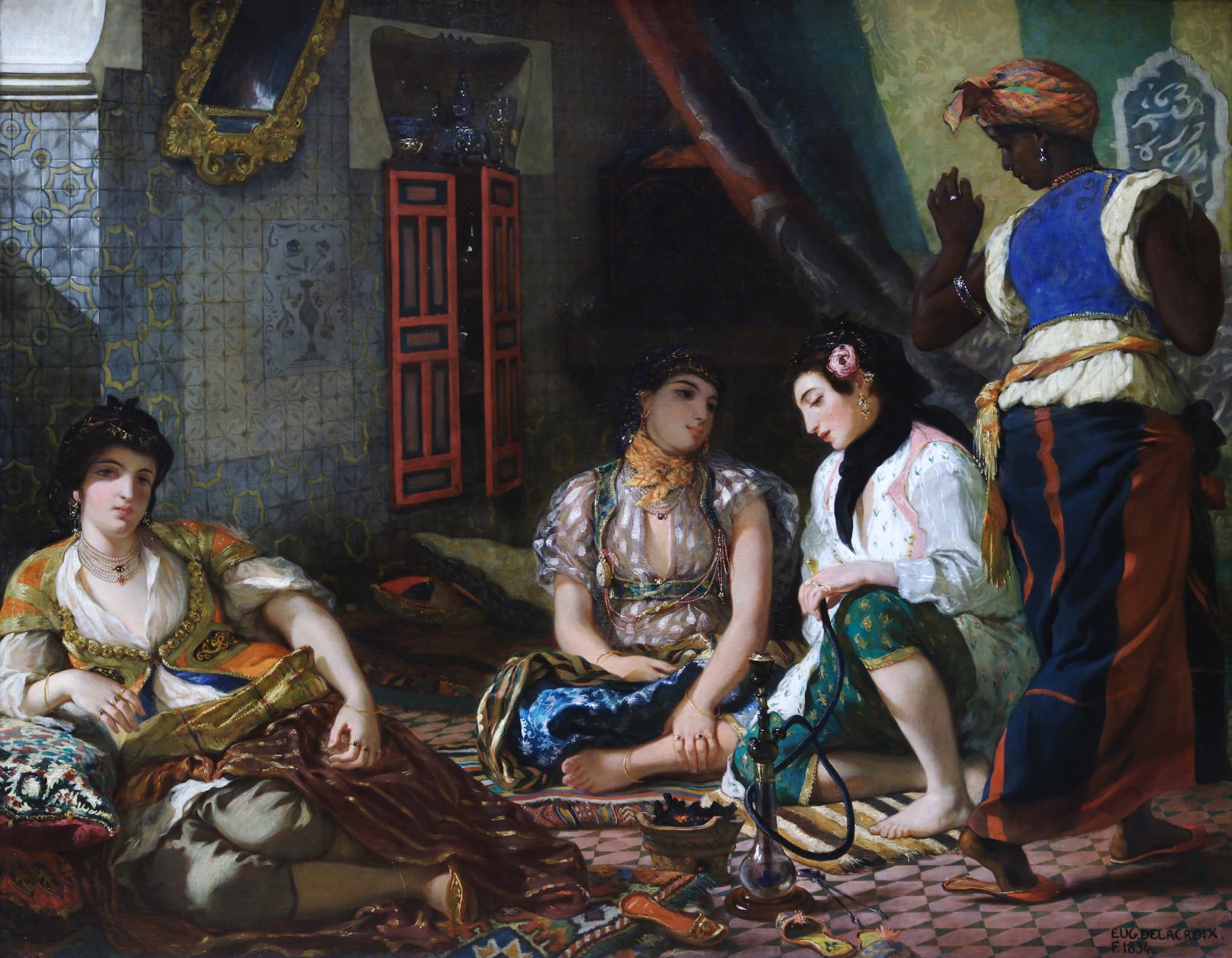
The canonical 1834 Women of Algiers in their Apartment by Eugène Delacroix is an inalienable masterpiece in the Louvre; it has never been sold. On a hypothetical indemnity or open‑market basis, we value it at $200–300 million, reflecting its singular art‑historical importance, scale, condition, and cross‑category trophy demand.
Valuation Analysis
Object and status. Women of Algiers in their Apartment (1834) is among Delacroix’s most celebrated canvases, a cornerstone of French Romanticism and Orientalism. The prime, large-format oil (approximately 180 × 229 cm) is owned by the French State and held by the Musée du Louvre; it was acquired from the 1834 Salon and has never entered the market [1]. The painting underwent a high-profile conservation in 2021–2022 and is again on view, underscoring its excellent presentation and ongoing scholarly visibility [2]. Under French law, works in public museum collections are inalienable and not market-eligible [3].
Method and estimate. Because no direct price precedent exists for this exact work, the valuation relies on upward extrapolation from the artist’s auction benchmarks and cross-category trophy pricing. We assign a hypothetical value of $200–300 million. This range reflects the painting’s canonical status within Delacroix’s oeuvre; its scale, finish, and publication history; its centrality to 19th‑century art; and its extremely limited substitutability at any price point.
Market anchors. Delacroix’s auction record stands at $9.875 million for Tiger Playing with a Tortoise (Christie’s, Rockefeller sale, 2018) [4]. That result, while strong, pertains to a markedly less pivotal work. Canon-defining masterpieces command a rarity and cultural‑significance premium that lifts them well beyond an artist’s ordinary ceiling. The enduring resonance of this subject is evidenced by Picasso’s Women of Algiers (Version O) achieving $179.365 million in 2015, a record at the time, directly acknowledging Delacroix’s composition and its place in the canon [5]. In today’s selective but still trophy‑driven historical market, nine‑figure valuations for museum‑grade icons remain defensible despite generally cautious bidding for lesser material [6][7].
Condition and visibility. The Louvre’s recent conservation and technical review affirm the work’s stability and legibility, factors that materially support a top‑tier valuation [2]. Continuous display in one of the world’s most visited museums further cements its global recognition and scholarly importance, both of which amplify demand in any hypothetical sale or indemnity setting.
Legal context. As a work in a French national collection, the painting is not for sale under the Code du patrimoine [3]. The stated figure therefore functions as an indemnity/insurance proxy and open‑market analogue for a cross‑category trophy. Taken together—peerless art‑historical stature, unique provenance, exceptional scale and finish, pristine visibility, and the demonstrated willingness of the market to pay nine figures for canonical images—these considerations justify the $200–300 million range.
Key Valuation Factors
Art Historical Significance
High ImpactThis is one of Delacroix’s defining masterpieces and a keystone of French Romantic Orientalism. Its influence radiates across the 19th and 20th centuries, shaping the visualization of the harem interior and inspiring major successors, most famously Picasso’s 1954–55 Les Femmes d’Alger series. The work is extensively published, taught, and exhibited, positioning it among the most recognizable images in 19th‑century painting. Such centrality confers a cultural‑significance premium that substantially exceeds typical artist benchmarks and supports a nine‑figure valuation.
Rarity and Substitutability
High ImpactThere is no realistic substitute for the prime 1834 Louvre canvas. Autograph variants of comparable scale and finish are not known on the market, and major Delacroix oils of any iconic subject appear only sporadically at auction. This extreme scarcity, coupled with global demand from institutions and top‑tier private collectors for canonical images, drives a substantial rarity premium. The painting’s unique combination of scale, finish, and subject makes supply effectively zero, a key driver of the $200–300 million range.
Condition and Conservation
Medium ImpactA recent high‑level conservation (2021–2022) and technical review by the Louvre’s conservation teams returned the painting to optimal visual impact and secured its long‑term stability. Clear legibility of color, surface, and facture enhances both scholarly and market standing. For an artwork of this stature, strong condition acts as a multiplier on already significant art‑historical value, helping support a top‑decile valuation within the proposed range.
Market Benchmarks and Trophy Pricing
High ImpactWhile Delacroix’s auction record is $9.875 million (Christie’s, 2018), canonical, cross‑category trophies transact on a different curve. Picasso’s Women of Algiers (Version O), explicitly dialoguing with Delacroix’s composition, realized $179.365 million in 2015, highlighting the subject’s magnetism among the world’s leading collectors. In a selective market where middle‑tier Old Master and 19th‑century works can be price‑sensitive, globally recognized icons still command intense competition and nine‑figure outcomes, justifying an extrapolated $200–300 million valuation for this painting.
Provenance and Legal Status
Medium ImpactThe painting’s impeccable provenance—state purchase in 1834 and continuous Louvre ownership—confers unparalleled institutional prestige. French cultural‑property law renders it inalienable, so the valuation functions as a hypothetical indemnity/open‑market proxy rather than a sale forecast. In practice, such legal status underscores the work’s museum‑defining importance, which in turn elevates its theoretical market value relative to any privately held Delacroix.
Sale History
Women of Algiers in their Apartment has never been sold at public auction.
Eugene Delacroix's Market
Eugène Delacroix is a blue‑chip name in 19th‑century art, with a deep but supply‑constrained market. His auction record is $9.875 million for an 1862 oil sold in the 2018 Rockefeller collection at Christie’s, and strong autograph oils typically trade from high six to low eight figures when fresh, well‑provenanced, and of desirable subjects. Works on paper—especially Moroccan subjects and animal studies—are liquid in Paris around Salon du Dessin, often achieving mid‑five to low‑six figures. However, truly canonical, large‑scale oils seldom appear; when they do, pricing is highly selective and depends on subject quality, condition, and provenance. Against this backdrop, the Louvre’s Women of Algiers stands far above normal market comparables and requires upward extrapolation.
Comparable Sales
Tiger Playing with a Tortoise (Tigre jouant avec une tortue)
Eugène Delacroix
Artist-identical, major autograph oil painting; market-record benchmark for Delacroix oils. While an animal subject (not a harem interior), it sets the modern ceiling for top-tier Delacroix at auction.
$9.9M
2018, Christie's New York
~$12.5M adjusted
Cheval arabe attaché à un piquet (Arab Horse Tethered to a Peg)
Eugène Delacroix
Autograph oil with a Moroccan/Orientalist subject—directly relevant to Delacroix’s North African corpus that informs Women of Algiers. Confirms healthy demand for Orientalist oils.
$851K
2023, Bonhams Cornette de Saint Cyr, Paris
~$888K adjusted
Études de lions couchés (Studies of Reclining Lions)
Eugène Delacroix
Fresh rediscovery; oil on canvas by Delacroix. Not an interior figure scene, but an in-demand Romantic/animal subject showing current Paris bidding for quality oils by the artist.
$495K
2025, Daguerre at Hôtel Drouot, Paris
Le Taleb, savant marocain écrivant (Moroccan scholar writing)
Eugène Delacroix
Work on paper from Delacroix’s Moroccan subject-matter—the same trip and ethnographic interest that underpins Women of Algiers. Indicates robust liquidity for high-quality North African studies.
$72K
2025, Artcurial, Paris (Dessins anciens & XIXe)
Étude pour le sultan du Maroc Abd-Er-Rahman sortant de son palais de Meknès
Eugène Delacroix
Moroccan royal subject tied to Delacroix’s 1832 expedition; while a drawing, it aligns closely in geography, date-range research, and Orientalist content relevant to valuing major North African themes.
$14K
2025, Artcurial, Paris (Dessins anciens & XIXe)
Current Market Trends
The historical segment has been selective since 2024, with overall global art sales contracting that year and stabilizing thereafter. Old Master and 19th‑century evening sales in London were described as muted, reflecting cautious bidding for non‑trophy material, while top‑quality works continue to find committed buyers. Paris remains a strong venue for 19th‑century drawings and rediscoveries, supporting liquidity at the works‑on‑paper level. Within this context, demand for museum‑grade, canon‑defining masterpieces continues to transcend category softness, sustaining nine‑figure valuations for cross‑category trophies.
Sources
- Musée du Louvre Collections: Eugène Delacroix, Women of Algiers in their Apartment
- Musée du Louvre: The conservation treatment of Women of Algiers in their Apartment
- Code du patrimoine (France): Inalienability of public museum collections
- Christie’s: Auction Report — Rockefeller 19th & 20th Century Art Evening Sale (Delacroix record)
- TIME: Picasso’s Women of Algiers Sells for Record $179 Million
- The Art Newspaper: Muted Old Master evening sales in London
- The Art Newspaper (FR): Art Basel/UBS report — Global art sales fell 12% in 2024