How Much Is The Sicilian Vespers (I vespri siciliani) Worth?
Last updated: May 18, 2026
Quick Facts
- Methodology
- comparable analysis
If the work is the documented, large 1846 canvas in the Galleria Nazionale d’Arte Moderna (GNAM, Rome) it is not market‑available; for a marketable autograph Hayez I vespri siciliani of museum quality I estimate a value range of $300,000–$1,900,000. The wide bracket reflects major sensitivity to provenance, condition, size and whether the work is fresh to market or already in institutional collections.
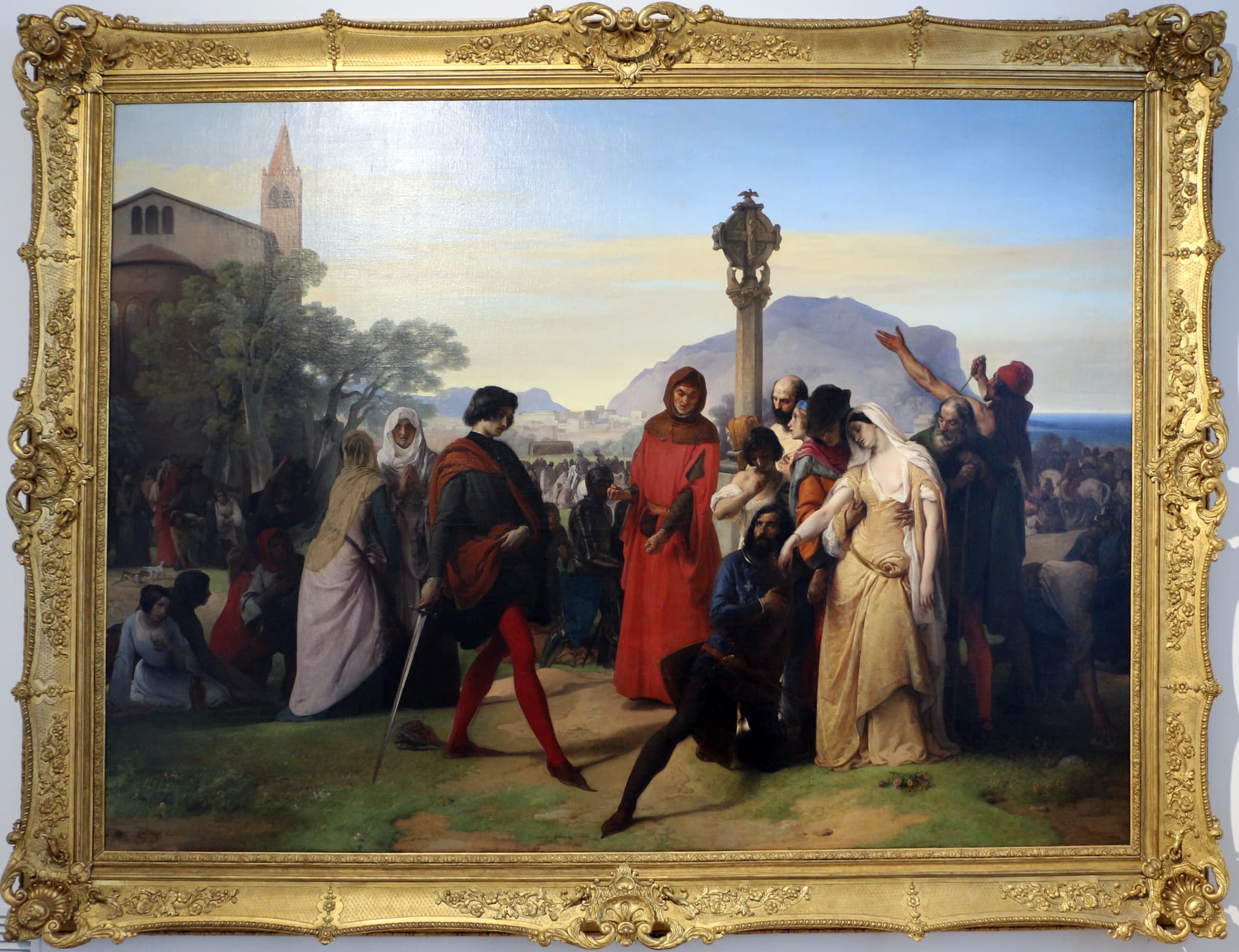
The Sicilian Vespers (I vespri siciliani)
Francesco Hayez • Oil on canvas
View more by Francesco Hayez →Valuation Analysis
Scope and headline. This valuation is for a hypothetical market transaction of an autograph Francesco Hayez painting titled "I vespri siciliani" (noting that the best‑known large autograph version, dated c.1846, is in the Galleria Nazionale d'Arte Moderna e Contemporanea, Rome, and therefore not available on the market) [1]. Based on recent high‑quality Hayez sales and gallery trades, a marketable, museum‑quality I vespri siciliani would reasonably sit in the range $300,000 - $1,900,000 depending on provenance, condition, scale and literature/exhibition history.
Comparables and market ceiling. The top end of this range is informed by recent trophy results for Hayez: Christie’s London’s 2024 sale of Bathsheba established a public auction ceiling near $1.9M and demonstrates institutional and private demand for large, well‑provenanced Hayez history/mythological canvases [2]. Earlier high results for autograph variants of Il Bacio (Christie’s 2016 and Sotheby’s 2008) corroborate a sustained willingness among collectors and institutions to place seven‑figure sums on rare, museum‑quality Hayez canvases.
Why the range is wide. Hayez’s market is bifurcated: small portraits and studio works commonly trade in the low tens of thousands, while fresh, large, documented history paintings can command mid‑six to low‑seven figures. Key value drivers are (1) secure attribution and technical authenticity, (2) continuous, documented provenance and exhibition/literature history, (3) condition and any conservation intervention, and (4) whether the work is offered fresh to market or deaccessioned from an institutional context. Absence or weakness in any of these typically reduces realizations by an order of magnitude.
Practical advice and next steps. To refine the estimate into a saleable reserve or insurance figure you should: provide high‑resolution images (full, detail, reverse, stretcher/labels); supply provenance and exhibition/literature citations; obtain a condition/conservation report; and commission technical imaging/pigment analysis if attribution is uncertain. If the canvas proves to be the GNAM 1846 original it is functionally off‑market and valuation becomes an insurance/appraisal exercise rather than a sales estimate [1]. If you wish, I can prepare a formal comparables packet referencing specific lots and house‑by‑house price histories to support a consignment strategy.
Key Valuation Factors
Art Historical Significance
High ImpactFrancesco Hayez is a central figure of 19th‑century Italian Romanticism and a leading practitioner of history painting associated with Risorgimento themes. I vespri siciliani is a subject with obvious national and historical resonance; if the painting is an autograph large history canvas (especially from Hayez’s mature 1840s output) its art‑historical importance materially increases institutional interest and value. Works with confirmed placement in Hayez’s major thematic cycle and presence in exhibitions or catalogues raisonné are treated as museum‑quality and command a strong premium versus workshop pieces or later copies. This factor is therefore a primary driver of top‑end pricing.
Provenance & Exhibition History
High ImpactProvenance is the single greatest multiplier for a Hayez history painting. Continuous ownership records, especially links to notable private collections, dealers, or institutional exhibitions and cataloguing, substantially reduce buyer risk and attract institutional bidders. Conversely, gaps in provenance, undocumented changes of ownership, or provenance that begins only in the mid‑20th century will depress market confidence and price. Exhibition inclusion, published illustrations, and catalogue‑raisonné entries convert a good painting into a market trophy; absence of these elements will typically relegate a work to the mid or lower tiers of the market.
Condition & Technical Authenticity
High ImpactCondition and technical authenticity determine what a buyer will actually bid. Issues such as heavy overpainting, relining, major restorations, paint loss, or unstable canvases materially reduce realizations even when authorship is secure. Technical imaging (X‑ray, IR reflectography), pigment analysis and a modern conservation report can confirm autograph hand and help quantify restoration needs—information which directly impacts whether the work will be offered through a top house or on the regional market. Buyers and institutions insist on thorough technical documentation for six‑figure purchases.
Size, Composition & Freshness to Market
Medium ImpactLarge format, fully composed history paintings are more commercially attractive than small studies or fragments; scale often signals ambition and rarity. 'Freshness'—meaning a work that has not been on the market recently, especially one coming from a private collection or a dealer rather than being deaccessioned—tends to increase competitive bidding. However, very large canvases may be less liquid (fewer buyers can collect or display them), so size is a mixed influence: it raises potential ceiling but can narrow buyer pool.
Comparable Sales & Market Demand
High ImpactRecent high‑quality Hayez sales (notably Christie’s London 2024 Bathsheba) set a public ceiling near the $1.8–1.9M mark and confirm institutional willingness to pay for rare museum‑grade works. Mid‑six‑figure gallery trades and regional auction results for smaller authenticated Hayez canvases establish practical mid‑range comparables. Market demand is selective: strong for freshly authenticated history paintings with provenance and weaker for studio/attributed works. Comparable sales therefore justify the upper limit of this range and explain the steep drop to the lower bound when attribution or condition is doubtful.
Sale History
The Sicilian Vespers (I vespri siciliani) has never been sold at public auction.
Francesco Hayez's Market
Francesco Hayez (1791–1882) is among the most important and collectible 19th‑century Italian painters. His market is characterized by a sharp separation between trophy, museum‑quality canvases (which have produced high six‑figure and low seven‑figure auction results in recent years) and a broad base of smaller portraits, studies and workshop pieces that sell in the low‑to‑mid five‑figure range. Institutional acquisitions and high‑profile fair trades have tightened the market for top examples, increasing the premium for works with robust provenance and fresh scholarly validation.
Comparable Sales
Bathsheba
Francesco Hayez
Large, museum-quality Hayez history/mythological canvas; recent auction record for the artist and directly relevant as a top-market benchmark for a large Hayez history painting.
$1.9M
2024, Christie's, London
~$1.9M adjusted
Il Bacio (version)
Francesco Hayez
Artist's most iconic composition; high-end public-sale result for an autograph/variant Il Bacio provides an upper-market comparator for important, fresh-to-market Hayez canvases.
$1.9M
2016, Christie's, New York
~$2.5M adjusted
Il Bacio (version)
Francesco Hayez
Earlier high-value sale of an Il Bacio version at a major house; shows long-term demand for top Hayez works and provides a multi-year benchmark.
$1.2M
2008, Sotheby's, London
~$1.7M adjusted
Interior of a Harem
Francesco Hayez
Dealer/gallery sale at TEFAF 2025 for a sizeable Hayez Romantic/orientalist interior (reported €600–700k); represents mid-six-figure pricing for quality Hayez canvases sold through the fair/gallery channel.
$755K
2025, TEFAF / Antonacci Lapiccirella (gallery sale)
Portrait of a Man
Francesco Hayez
Example of a smaller-scale Hayez portrait at an Italian house; illustrates the lower end of the market for securely-attributed non-trophy works and the wide price spread within the artist's market.
$28K
2019, Finarte (Rome) auction
~$34K adjusted
Current Market Trends
The Old Masters and 19th‑century market is selective: demand has firmed for high‑quality, fresh‑to‑market works with documentation, while mid/lower tier material remains price‑sensitive. Recent trophy sales and institutional purchases for Hayez have supported higher ceilings, but outcomes still hinge on provenance, condition and academic validation. Sellers should expect best results when works are offered with full technical and provenance dossiers.