How Much Is The Sleeping Venus Worth?
Last updated: February 17, 2026
Quick Facts
- Methodology
- comparable analysis
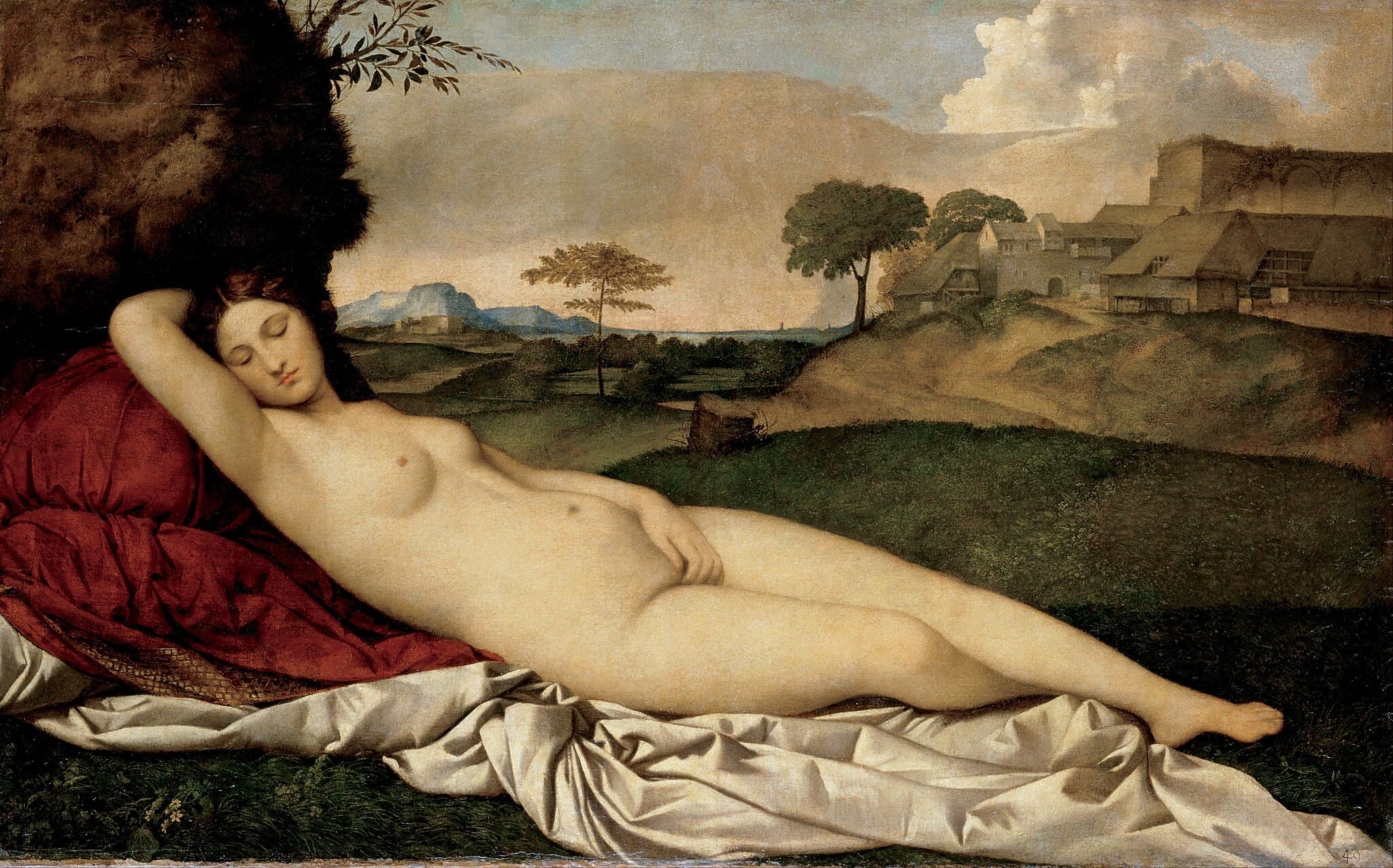
On a hypothetical open market, Giorgione’s The Sleeping Venus would command approximately $400–600 million. This estimate reflects its canonical status as the prototype of the reclining nude, extreme rarity within Giorgione’s microscopic oeuvre, and alignment with apex Old Master benchmarks led by Leonardo’s $450.3 million Salvator Mundi.
Valuation Analysis
Conclusion and range. We estimate a hypothetical open‑market value of $400–600 million for Giorgione’s The Sleeping Venus. Painted circa 1508–1510 and completed in parts by the young Titian, the work is universally recognized as the foundational prototype of the reclining nude and a cornerstone of Venetian Renaissance painting [1][2]. Its art‑historical centrality, coupled with the near‑nonexistence of secure autograph Giorgiones in private hands, places it among the most valuable Old Master paintings that could conceivably come to market.
Why comparable analysis. There is no modern auction benchmark for an uncontested Giorgione painting; the autograph corpus is vanishingly small and held almost entirely by museums [1][2]. Price discovery therefore relies on apex Old Master comparables and a scarcity premium. At the top of the category, Leonardo’s Salvator Mundi realized $450.3 million at Christie’s New York (2017), establishing the modern ceiling for a canonical Renaissance trophy [4]. National‑level institutional acquisitions underscore depth of demand: Rembrandt’s The Standard Bearer sold to the Dutch state for approximately $198 million equivalent (2022) [5]. Within the Italian Renaissance, a Botticelli portrait made $92.2 million at Sotheby’s (2021) [6]. Closest school/subject proxies—Titian’s poesie—traded by private treaty to UK museums for £50 million (2009) and £45 million (2012) [3], while a Titian painting set a public auction record at approximately $22.1 million in 2024 [7].
Positioning the Dresden Venus. Against these anchors, The Sleeping Venus prices materially above the Titian and Rembrandt benchmarks and within striking distance of the Leonardo result. Its art‑historical primacy (the prototype of the reclining nude), extreme rarity (virtually no supply), and dual authorship nexus (Giorgione’s conception and figure; Titian’s landscape/finish) sustain demand from both cross‑category trophy buyers and the world’s top institutions. A $400–600 million bracket captures that balance—well above recent Old Master benchmarks but still acknowledging Leonardo’s broader popular recognition.
Condition, authorship, and risk. Technical studies confirm a Cupid originally at Venus’s feet, overpainted in the 19th century after damage; the landscape is widely accepted as completed by Titian [1][2][8]. These factors are fully embedded in scholarly consensus and do not diminish the work’s blue‑chip status. Rather, they enhance its art‑historical resonance across both Giorgione and Titian scholarship.
Practical note on saleability. The painting is held by the Gemäldegalerie Alte Meister, Dresden (Staatliche Kunstsammlungen Dresden). German state museums typically rely on state indemnity and do not deaccession such keystones; any valuation is therefore theoretical (insurance/indemnity or notional market context) [9]. If exposed to genuine market competition, the picture would attract intense global bidding and private‑treaty interest consistent with the stated range.
Key Valuation Factors
Art Historical Significance
High ImpactThe Sleeping Venus is widely cited as the prototype of the reclining female nude in Western art, a schema that shaped Titian, the Venetian school, and later European painting. Its compositional synthesis of sensuality and landscape is central to the trajectory from High Renaissance ideals to the poetic mode of Venetian colorito. The work’s primacy ensures universal recognition among curators, scholars, and cross‑category collectors. Institutional demand is implicit: any realistic opportunity to acquire or endow such a piece would be treated as a once‑in‑a‑century event. This centrality justifies pricing at the summit of Old Master valuations and supports the upper half of the range.
Extreme Scarcity and Attribution
High ImpactSecurely attributed Giorgione paintings are extraordinarily few and overwhelmingly museum‑held; there is no modern auction record for an uncontested autograph painting. This structural illiquidity forces price discovery through cross‑artist proxies and drives a scarcity premium well beyond typical Old Masters. The accepted model—Giorgione’s design and figure with Titian completing the landscape—strengthens rather than weakens the case, anchoring the work in two blue‑chip oeuvres. In a market that rewards uniqueness and cultural capital, this scarcity profile materially lifts the valuation above even stellar Venetian comparables by Titian alone.
Comparable Benchmarks and Demand
High ImpactApex Old Master pricing is defined by a small cluster of results: Leonardo’s Salvator Mundi at $450.3m (2017), Rembrandt’s The Standard Bearer at roughly $198m equivalent (2022), Botticelli’s $92.2m portrait (2021), and institution-grade Titians at £45–50m. On art-historical weight and rarity, The Sleeping Venus sits above the Titian and Rembrandt anchors and within reach of the Leonardo ceiling. The subject’s universal appeal (Venus), cross-collector resonance, and trophy scarcity suggest intense competition in any hypothetical sale—supporting a $400–600m bracket.
Condition and Conservation History
Medium ImpactA Cupid at Venus’s feet—documented historically—was overpainted in 1837 after damage; its presence has been confirmed by technical imaging. The landscape is generally credited to Titian posthumously. Neither factor undermines the work’s standing: Giorgione’s hand in the figure remains the scholarly core, and the Titian finish adds historical depth. While any future conservation decisions (e.g., treating the overpainted Cupid) would be carefully debated, the painting’s current condition and presentation are consistent with its long status as a museum keystone, with no known issues that would materially depress value.
Institutional Ownership and Legal Context
Medium ImpactHeld by the Gemäldegalerie Alte Meister (Staatliche Kunstsammlungen Dresden), the painting is effectively non-saleable under prevailing museum norms and cultural-heritage protections. German public museums typically rely on state indemnity rather than commercial insurance, and deaccession of such a canonical work is not contemplated. While this constrains actual market testing, it simultaneously cements the work’s perceived ‘priceless’ status. The valuation here is therefore geared to insurance/indemnity and a counterfactual market scenario, not an imminent transaction, but remains anchored in robust global trophy demand.
Sale History
The Sleeping Venus has never been sold at public auction.
Giorgione's Market
Giorgione occupies a uniquely rarefied position in the Old Masters market. Very few securely attributed paintings survive, and they are almost entirely in museums, which means there is effectively no modern auction record for an uncontested autograph painting. The best-documented public sale under the Giorgione name in recent decades is a drawing (2005, under $300,000), underscoring how little true supply exists. Consequently, price discovery for Giorgione is indirect and occurs through closely related Venetian masters—foremost Titian—as well as apex Renaissance trophies across Italy and the North. In any realistic scenario where an autograph Giorgione of canonical stature appeared, competition from top collectors and institutions would be intense, with pricing at the summit of the Old Masters field.
Comparable Sales
Salvator Mundi
Leonardo da Vinci
Apex Renaissance trophy sale establishing the modern ceiling for canonical 16th‑century Old Masters; benchmarks scarcity, global demand, and trophy pricing for museum‑caliber works.
$450.3M
2017, Christie's New York
~$582.0M adjusted
Diana and Actaeon
Titian
Closest school/subject proxy: prime Venetian myth with female nude, institutional acquisition at the highest level; directly tied to the Giorgione–Titian tradition.
$72.0M
2009, Private treaty (National Gallery, London / National Galleries of Scotland)
~$106.0M adjusted
Diana and Callisto
Titian
Companion to Diana and Actaeon; prime Venetian mythological nude, institution‑grade; strong subject and authorship proximity to Sleeping Venus.
$71.0M
2012, Private treaty (National Gallery, London / National Galleries of Scotland)
~$97.3M adjusted
Portrait of a Young Man Holding a Roundel
Sandro Botticelli
Top recent result for an Early Italian Renaissance masterpiece; calibrates demand for canonical pre‑Modern names at auction (though a portrait, not a mythological nude).
$92.2M
2021, Sotheby's New York
~$107.0M adjusted
The Standard Bearer
Rembrandt van Rijn
Museum‑caliber Old Master painting acquired by a national institution; benchmarks state‑backed pricing for culturally defining works.
$198.0M
2022, Private sale to the Dutch State / Rijksmuseum
~$214.0M adjusted
The Massacre of the Innocents
Peter Paul Rubens
Record‑level Baroque Old Master at auction; illustrates the upper bound achieved for museum‑quality historical painting in the public market.
$76.7M
2002, Sotheby's London
~$134.2M adjusted
Current Market Trends
The Old Masters market is highly bifurcated: mid-market material is liquid and selective, while supply at the very top remains extremely thin. Since 2021, trophy results have reaffirmed appetite for canonical Renaissance names (Botticelli at $92.2m; a Rembrandt acquired by the Dutch state for ~€175m), even as 2024 saw softer volumes. By 2025–2026, the category showed renewed strength, with record-level results for drawings and fresh benchmarks for Venetian painting, signaling robust demand for historically validated works. In this environment, an iconic, museum-caliber Renaissance masterpiece—especially one with virtually no private-market substitutes—would command aggressive, globally competitive pricing.
Study print
Study this painting as a print
Pair the full artwork with a museum-style study sheet focused on one meaningful detail.
Sources
- Encyclopaedia Britannica – "Sleeping Venus"
- Wikipedia – "Sleeping Venus (Giorgione)"
- National Gallery (London) – Press release: "Diana and Actaeon secured for the nation" (2009)
- Wikipedia – "Salvator Mundi (Leonardo)"
- Rijksmuseum – Press: The Netherlands acquires Rembrandt’s The Standard Bearer (2022)
- DW – Rare Botticelli portrait sold for record $92 million (2021)
- Artnet News – Titian painting sells for a record $22 million at Christie’s (2024)
- Sächsische Zeitung – On the overpainted Cupid in the Dresden Venus (German)
- Versicherungswirtschaft Heute – German public museums rely on state indemnity (2019)