How Much Is Daughters of Revolution Worth?
Last updated: July 9, 2026
Quick Facts
- Methodology
- comparable analysis
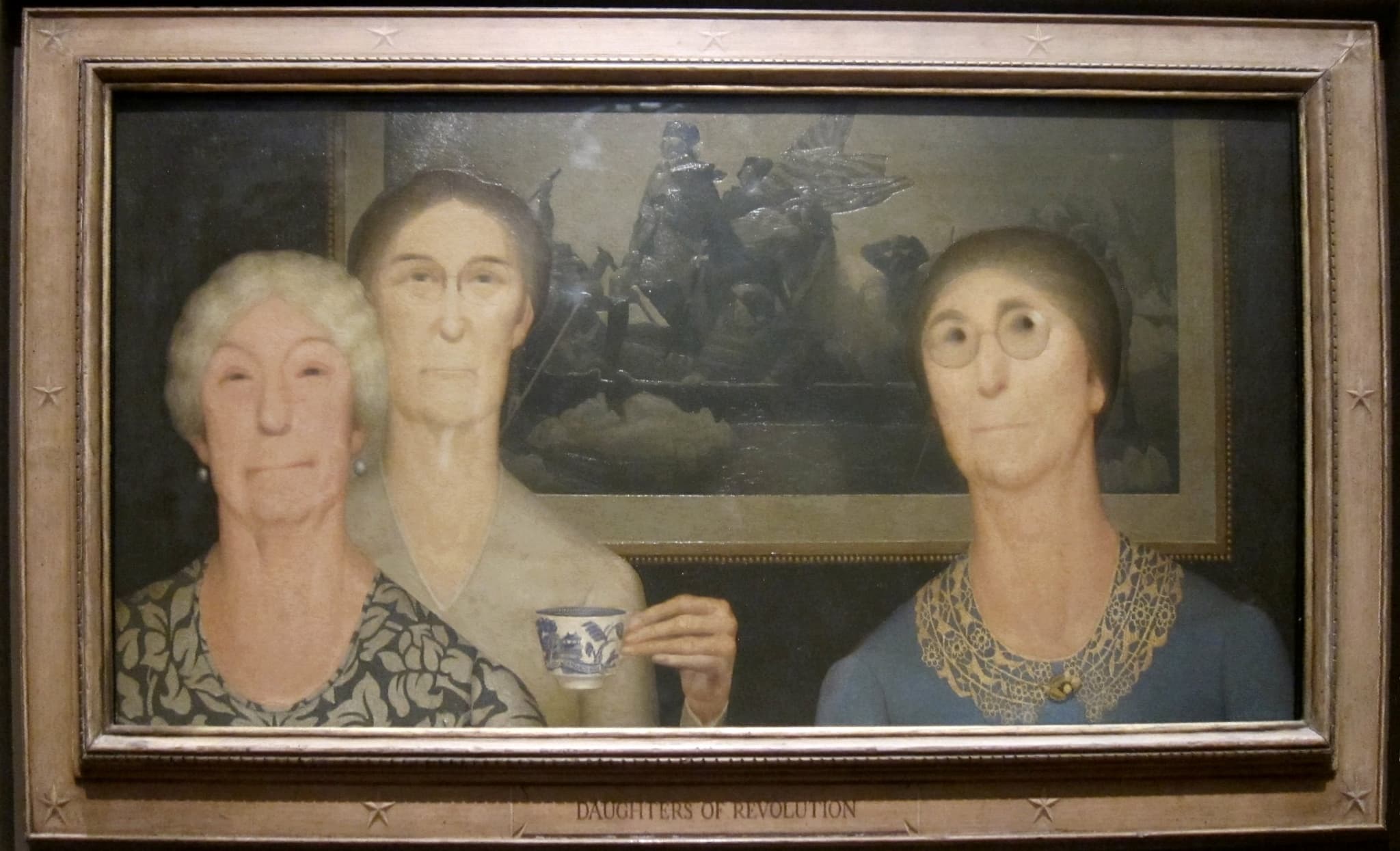
Assuming the Cincinnati Art Museum’s autograph oil were deaccessioned and offered openly, fair market value is $12–25 million. The range is built from Grant Wood’s best public benchmarks, the work’s textbook status, and the scarcity that would spur institutional and top-tier private competition.
Valuation Analysis
Conclusion: We place a hypothetical fair market value of $12–25 million on Grant Wood’s Daughters of Revolution (1932) if the Cincinnati Art Museum’s original were ever offered for sale. This estimate is derived by comparable analysis anchored to Wood’s best public benchmarks and adjusted upward for the painting’s exceptional art-historical stature, name recognition, and the extreme scarcity of top-tier Grant Wood oils in private hands [2].
Object and significance: Daughters of Revolution is a canonical, widely reproduced satire within Wood’s oeuvre—central to discussions of American identity, nationalism, and cultural politics between the wars. The Cincinnati Art Museum’s object records and conservation materials affirm authorship, medium, and long institutional stewardship, underscoring the work’s prominence and scholarship/loan history [1][5]. Among Wood’s best-known images after American Gothic, it is a mainstay of American art surveys and would command masterpiece-level attention if available.
Comparables and pricing logic: The clearest hard benchmark for a prime Wood oil remains Spring Plowing (1932), sold at Sotheby’s in 2005 for $6.96 million, a figure widely cited in the press [2]. While no recent public sale exists for a comparably important Wood painting, sustained demand for top imagery is evident in significant works on paper—notably the 2026 result for Study for American Gothic at $584,200 [3], and earlier strong prices such as Study for Dinner for Threshers at $1.565 million in 2014 [6]. Given Daughters of Revolution’s higher fame, its textbook status, and the paucity of blue-chip Wood oils outside museums, a new auction record would be expected. Our $12–25 million corridor reflects an uplift over the historical painting record, scaled to current market conditions and the composition’s outsized cultural resonance.
Category context and demand: The broader American Modern/Regionalist segment continues to show healthy competition for fresh, high-quality works, with headline results and record-setting momentum reported in curated American art sales (e.g., Christie’s 2024 Modern American Art sale totaling $13.29 million and Benton leading at $2.23 million) [4]. In this supply-constrained niche, institutional interest is a key driver; a masterpiece-level Wood—with distinguished provenance and deep literature/exhibition history—would trigger bidding from museums, patrons, and major private collectors of American art.
Positioning and assumptions: This valuation assumes the painting is the museum-held, autograph oil in very good condition, with clean title and comprehensive documentation [1][5]. It reflects fair market value in an open, competitive setting (public auction or brokered private treaty with multiple bidders). The low end ($12 million) aligns with a conservative uplift over the last painting record; the high end ($25 million) recognizes the work’s iconic status within Wood’s oeuvre and the likely intensity of institutional and private demand in a rare opportunity to acquire a textbook Grant Wood [2][3][4].
Key Valuation Factors
Art Historical Significance
High ImpactDaughters of Revolution is one of Grant Wood’s most discussed and reproduced paintings, a sharp satirical statement on American identity that appears in surveys of American art and in Wood scholarship. Its cultural resonance places it immediately behind American Gothic in public recognition, giving it a premium within the artist’s canon. This qualitative importance matters commercially: collectors and institutions pay up for works that define an artist’s contribution to art history, especially those repeatedly illustrated, taught, and lent. In the Wood corpus, this painting functions as a key narrative touchstone, ensuring that, if offered, it would be pursued as a once-in-a-generation opportunity. That level of significance is central to justifying an eight-figure result.
Rarity and Supply Constraints
High ImpactTop-tier Grant Wood oils very rarely come to market; the majority of masterpieces are long held by museums. The thin supply of comparable paintings, particularly from the early 1930s at full finish, creates a scarcity premium. When supply is constrained and demand is spread across institutions, foundations, and seasoned private collectors, price discovery can move rapidly. In this context, the absence of recent public trades does not imply weak demand—rather, it underscores how unusual the offering would be. Scarcity also weakens the weight of lower-magnitude comparables (e.g., prints), making the few major oil benchmarks and the work’s intrinsic importance more decisive in setting value.
Market Benchmarks and Price Positioning
High ImpactThe principal hard benchmark is Spring Plowing (Sotheby’s 2005) at $6.96 million, with later years showing robust bidding for high-profile works on paper tied to Wood’s most famous imagery. While not a direct substitute, these results signal persistent demand when prime works emerge. Positioning Daughters of Revolution above the historical painting record is justified by its textbook status, broader cultural recognition, and the long interval since a comparable painting was available. Our $12–25 million range scales from the 2005 benchmark, incorporates inflation and category growth, and embeds a premium for name recognition and likely institutional competition, consistent with observed dynamics in Modern American Art.
Provenance, Condition, and Exhibition/Literature
High ImpactInstitutional ownership by the Cincinnati Art Museum, with conservation and object materials publicly referenced, supports strong confidence in authorship, condition stewardship, and scholarly profile. Works with dense exhibition and literature histories are more liquid and can command step-up pricing, as they present fewer due-diligence risks and offer museum-ready narrative value. Our estimate assumes the painting remains in very good condition with no material structural issues and unencumbered title. Any documented conservation of a routine nature would not be value-negative; however, the discovery of significant condition problems or restrictive covenants would be the primary downward risks to the valuation corridor.
Sale History
Daughters of Revolution has never been sold at public auction.
Grant Wood's Market
Grant Wood is a cornerstone of American Regionalism, alongside Thomas Hart Benton and John Steuart Curry. His market is unusually supply-constrained: most masterpiece oils reside in museums, and only a handful of major paintings have traded publicly in recent decades. The auction record for a Wood painting remains Spring Plowing (Sotheby’s, 2005) at $6.96 million, while strong results for important drawings tied to major compositions demonstrate continued depth of demand when paintings are unavailable. Prints constitute the most active segment but are not price-setting for top oils. Given Wood’s cultural prominence—anchored by American Gothic—collectors and institutions are prepared to compete aggressively for any museum-caliber painting that surfaces, making new records plausible for truly iconic works.
Comparable Sales
Spring Plowing
Grant Wood
Best hard benchmark for a prime Wood oil; same year (1932), closely comparable medium/finish, blue‑chip subject within American Regionalism.
$7.0M
2005, Sotheby's New York
~$11.2M adjusted
Study for Dinner for Threshers
Grant Wood
High‑finish 1930s study for a celebrated composition; evidences depth of demand for top narrative imagery by Wood when paintings are unavailable.
$1.6M
2014, Christie's New York
~$2.1M adjusted
Study for American Gothic
Grant Wood
Iconic subject, strong museum‑level interest; while a drawing (not an oil), it signals robust competition for prime Wood imagery in the current market.
$584K
2026, Christie's New York
~$574K adjusted
White Horse
Thomas Hart Benton
Closest cohort benchmark: a leading American Regionalist masterwork with strong 2024 result, framing top‑tier pricing for the movement’s prime oils.
$2.2M
2024, Christie's New York
~$2.3M adjusted
Current Market Trends
Modern American Art and American Regionalism have shown resilient demand for fresh, high-quality material despite broader market cyclicality. Curated American art sales continue to post solid totals and competitive bidding for category leaders, with museum-quality works outperforming estimates. The segment benefits from institutional programming and anniversaries that re-center narratives of American identity, sustaining visibility for Regionalist imagery. Against this backdrop, masterpiece-caliber paintings by Wood carry a scarcity premium: limited supply, deep institutional interest, and renewed scholarly attention combine to support eight-figure outcomes when a top example appears.
Sources
- Cincinnati Art Museum – Behind the Scenes in Conservation: Daughters of Revolution
- Sun Journal – Grant Wood landscape sells for $6.96 million (2005 Sotheby’s result)
- Fine Books & Collections – Rufus King Constitution Draft Tops Christie’s ‘We the People’ Sale (notes Wood ‘Study for American Gothic’ result)
- Christie’s Press – Modern American Art totals $13,286,378 (category context; Benton lead lot)
- Google Arts & Culture – Grant Wood, Daughters of Revolution (object details)
- Artnet News – Was Christie’s $46 Million American Art Auction a Flop? (notes 2014 Wood drawing result)