How Much Is Dinner for the Threshers Worth?
Last updated: April 24, 2026
Quick Facts
- Methodology
- comparable analysis
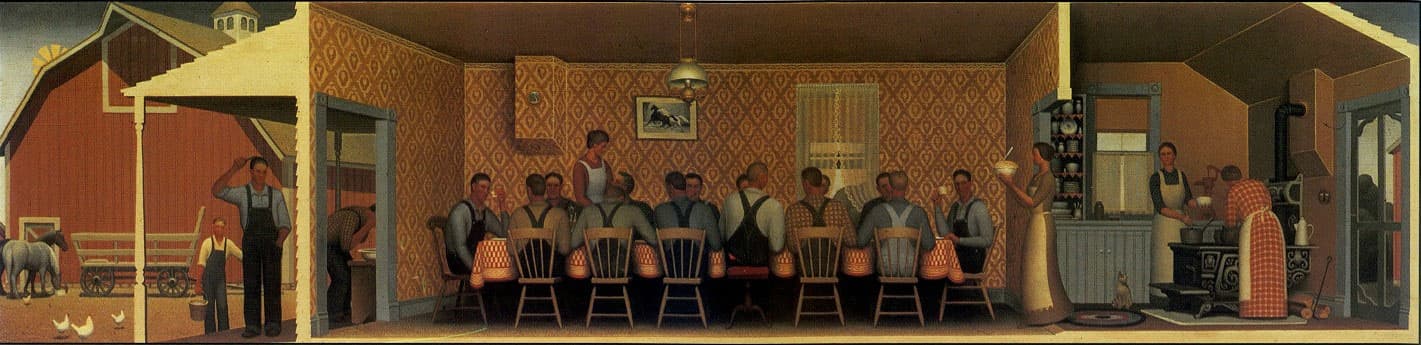
Dinner for the Threshers (1934) by Grant Wood is accessioned in the Fine Arts Museums of San Francisco (de Young) and therefore has no public auction sale record. Based on museum ownership and auction comparables—the Christie’s 2014 Study for Dinner for Threshers (USD 1,565,000) and the historic oil benchmark Spring Plowing (Sotheby’s, 2005, USD 6.96M)—a defensible market range for a hypothetical deaccession is US$300,000–$3,000,000, with the final outcome driven by provenance, condition, scale, and exhibition/publication history.
Valuation Analysis
Overview: Dinner for the Threshers (1934) is an accessioned work in the Fine Arts Museums of San Francisco (M.H. de Young), accession no. 1979.7.105; it therefore has no public auction sale history to establish a market price by sale [1]. For a defensible market estimate I rely on a comparable‑analysis approach that weights directly related auction results, the artist's public auction ceiling, and qualitative condition/provenance factors.
Comparable anchors: A directly related comparable is Christie’s sale (19 Nov 2014) of a finished study for Dinner for Threshers, which realized USD 1,565,000—demonstrating serious collector demand for material tied to this composition [2]. The public auction high for a Grant Wood oil remains Spring Plowing (Sotheby’s, 2005, USD 6.96M), which functions as a practical upper market benchmark for prime oils by the artist [3]. More recently, a high‑visibility sale of a Study for American Gothic in 2026 underscored how thematic sales and anniversaries can materially lift realized prices for Regionalist studies [4].
Range justification: Synthesizing these data points I place a prudent market range for Dinner for the Threshers at US$300,000–$3,000,000. The lower bound anticipates outcomes where the work is judged secondary (smaller scale, poor or uncertain provenance, or notable condition issues) and therefore attracts a narrower buyer pool. The midpoint reflects a museum‑quality mature oil with acceptable condition and basic provenance but limited exhibition/literature history. The upper bound assumes a prime presentation—excellent conserved condition, stout provenance/documentation, documented exhibition and publication history, and sale in a targeted major‑house sale or to an institutional buyer; under those circumstances an oil tied to this composition can reasonably enter the multi‑million dollar band [2][3].
Key value drivers: Provenance and institutional ownership materially raise perceived importance but reduce market liquidity (deaccession would be required to monetize) [1]. Condition and conservation history will materially alter estimates—museum conservation records are crucial. Exhibition and publication record (catalogue raisonné inclusion) are strong multipliers; timing and sale venue (thematic sale, major house) also affect realized outcomes [2][4][5].
Recommendations: To refine this estimate into a formal appraisal: obtain the de Young accession and provenance file, request a condition and conservation report, confirm catalog‑raisonné status, and solicit written estimates from specialist appraisers or the valuation departments at major auction houses. This analysis is directional and market‑based; a formal, defensible valuation requires inspection, full provenance documentation and current market checks with auction houses and dealers [1][2][3][4][5].
Key Valuation Factors
Art Historical Significance
High ImpactDinner for the Threshers dates to Grant Wood's mature period (1930s) and exemplifies his rural genre focus and formal clarity. While not the singularly iconic composition that American Gothic represents, the painting nevertheless has meaningful art‑historical value as an example of Wood’s thematic and stylistic concerns during a pivotal decade. Institutional acquisition by the de Young indicates curatorial recognition, which increases scholarly interest and market desirability. This significance supports a premium over run‑of‑the‑mill regionalist works, particularly among institutional buyers and collectors who prioritize documented, museum‑quality pieces; however it does not guarantee the same universal bidding breadth commanded by Wood’s most iconic works.
Provenance & Ownership
High ImpactProvenance is a major value amplifier. The de Young accession provides an authoritative institutional chain that enhances credibility and buyer confidence—assuming the museum’s acquisition record is clean and continuous. Institutional ownership typically suggests rigorous documentation and conservation, both positive for valuation. Conversely, museum ownership reduces immediate market liquidity because sale would require deaccession procedures, potential donor restrictions, and institutional approval. If provenance shows gaps prior to museum acquisition, or if donor terms restrict sale, those factors could materially depress a market estimate. Clear, museum‑level provenance normally supports a higher estimate within the valuation range.
Condition & Conservation
High ImpactCondition is decisive for price realization. Stable, original surfaces with documented conservation treatments and little inpainting support premium estimates; conversely, structural problems (panel/hardboard instability, flaking, heavy overpainting) require discounts and may preclude sale at top houses. Museums generally retain conservation records, so obtaining the de Young’s treatment reports is essential. Technical analysis (X‑ray, infrared imaging, pigment testing) can also confirm original material and alter attribution confidence. The presence or absence of such documentation will materially affect both marketability and the likely selling venue (private treaty vs. major auction).
Comparables & Price History
High ImpactDirect comparables are limited because key oils often remain in institutional collections. Nevertheless, Christie’s 2014 sale of a finished Study for Dinner for Threshers realized US$1.565M—a strong signal of collector interest in works tied to this composition [2]. The 2005 Sotheby’s sale of Spring Plowing (US$6.96M) remains the practical ceiling for Grant Wood oils and frames an upper bound [3]. Recent thematic, high‑visibility sales (e.g., 2026 American Gothic study) demonstrate that curated sale contexts can substantially raise realized prices. These price anchors justify a multi‑scenario approach (weak/typical/strong) when estimating a hypothetical market outcome.
Market Demand & Liquidity
Medium ImpactGrant Wood’s market is niche and geographically concentrated in the U.S. Prints and editions provide the most frequent liquidity at low‑thousand price levels, while unique oils and important studies are illiquid and produce episodic spikes when offered. Demand is driven mainly by museums, regional collectors and Americana specialists; international participation is limited compared with blue‑chip moderns. Market catalysts—anniversaries, museum exhibitions, thematic sales—can generate outsized interest and uplift prices, so timing and sale strategy are important considerations for achieving top market outcomes.
Sale History
Christie's, New York
Sotheby's, New York
Christie's, New York
Grant Wood's Market
Grant Wood is a central figure of American Regionalism whose limited supply of prime oils and the visibility of a few canonical images create a bifurcated market. Reproductions and lithographs trade frequently and affordably, but original drawings, studies and especially oils surface only sporadically and can achieve mid‑six to low‑seven figure results when provenance, condition and iconography align. The artist’s public auction record (Spring Plowing, 2005) highlights scarcity rather than steady, broad‑based growth; value is driven primarily by museum interest, provenance and ties to known compositions.
Comparable Sales
Study for Dinner for Threshers
Grant Wood
Direct preparatory/finished work on paper for the same composition (Dinner for Threshers). Same artist and subject; shows market willingness to pay seven-figure sums for a high-quality study tied to this painting.
$1.6M
2014, Christie's, New York
~$2.1M adjusted
Study for American Gothic
Grant Wood
Preparatory drawing for Wood's most iconic composition; recent high‑visibility sale (thematic Americana sale) demonstrating strong demand for studies/works on paper by Wood and the price uplift possible when provenance/exhibition context aligns.
$584K
2026, Christie's, New York
~$576K adjusted
Spring Plowing
Grant Wood
The auction record and market ceiling for a Grant Wood oil (major finished oil sale). Similar medium (oil) and represents the scarcity premium for museum-quality oils by the artist—useful as an upper bound comparator.
$7.0M
2005, Sotheby's, New York
~$11.3M adjusted
Current Market Trends
The current market for Grant Wood is stable but episodic: prints remain the most liquid category while unique works command concentrated institutional and specialist interest. Recent anniversary‑ and theme‑driven sales (notably in 2025–2026) have shown that curatorial packaging and timing can produce outsized results for preparatory works. Overall supply of prime oils remains constrained, supporting the potential for high outcomes when the right work is presented in the right venue.
Sources
- Fine Arts Museums of San Francisco (de Young) accession record via Smithsonian SIRIS — Dinner for the Threshers, 1934
- Christie's, New York — Study for Dinner for Threshers (lot, 19 Nov 2014)
- Press coverage of Sotheby's sale — Spring Plowing (2005) auction record
- Christie's, New York — Study for American Gothic (We the People: America at 250 sale, 23 Jan 2026)
- MutualArt — Grant Wood auction profile and market activity summary