How Much Is Parson Weems' Fable Worth?
Last updated: April 24, 2026
Quick Facts
- Methodology
- comparable analysis
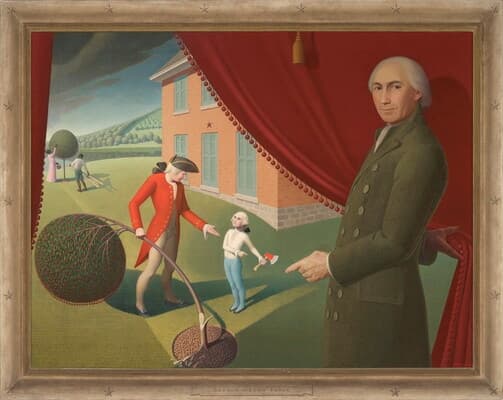
Parson Weems' Fable (1939) is accessioned in the Amon Carter Museum (1970.43) and therefore off‑market. If hypothetically offered today as a well‑provenanced, museum‑quality Grant Wood oil, a realistic fair‑market range is approximately $750,000 to $3,000,000, with final placement dependent on condition, scholarly status, and sale context.
Valuation Analysis
Parson Weems' Fable (1939) by Grant Wood is accessioned in the Amon Carter Museum of American Art (accession 1970.43) and therefore not a work circulating on the open market; the estimate below represents a hypothetical fair‑market range if the painting were to be offered publicly or in a private institutional sale. The museum record documents a signed, dated oil with stretcher inscriptions noting an owner ('Mrs John P. Marquand') and a Whitney 1940 Annual label, which materially strengthens its pedigree and market interest [1]. Based on those attributes, a plausible market range today is approximately $750,000 to $3,000,000.
The valuation is anchored by a comparable‑analysis approach that blends the artist's auction ceiling and recent realized results for works of related significance. Grant Wood's auction record (Spring Plowing) sold at Sotheby's in 2005 for roughly $6.96 million and establishes the upper bound for trophy oils by Wood [2]. At the other end, recent sales of drawings/studies and prints show strong activity for works tied to American Gothic and steady, lower pricing for multiples; for example, a Study for American Gothic exceeded pre‑sale expectations at Christie’s in January 2026, demonstrating concentrated bidder interest for material closely tied to Wood's signature image [3].
Putting Parson Weems' Fable into this frame: it is a mature, large, signed oil with documented exhibition history and early provenance, which positions it well above print and study pricing but below the very top tier represented by the artist’s occasional trophy landscapes and iconic compositions. The painting's exact placement inside the $750k–$3M range will hinge on condition (including any restorations), the degree to which the work is regarded as 'major' in scholarship and catalogues, and the sale context (institutional/private sale versus open auction). A clean condition report, published exhibition history, and inclusion in the catalogue raisonné would all push value toward the high end; heavy restoration or uncertain attribution would push it toward the low end.
Institutional ownership both increases pedigree and reduces market availability. Because the painting is museum‑held, there are no recent public sale comparables for this exact object; hypothetical market value must therefore be derived from related, publicly realized sales and comparative judgement [2][3]. Private institutional transfers or structured deaccession sales often attract institutional buyers and can result in realized prices that differ materially from general‑market auction outcomes. To convert this hypothetical range into a definitive fair‑market or insurance value, obtain a formal condition report, full provenance documentation from Amon Carter, and a written appraisal from an ASA/ISA appraiser; consult the University of Iowa Grant Wood catalogue raisonné project for final cataloguing [4].
In short: strong institutional provenance and exhibition history place Parson Weems' Fable comfortably above print/study pricing, but its secondary status relative to 'American Gothic' and the lack of a direct market sale make a $750,000–$3,000,000 hypothetical range the most supportable market estimate at present.
Key Valuation Factors
Art Historical Significance
High ImpactParson Weems' Fable dates to 1939, placing it in Grant Wood's mature period when he explored narrative allegory and Americana. The subject engages the Parson Weems/George Washington fable, a theme that feeds directly into Wood's broader interest in American identity and myth-making. The painting's size, oil medium, and signed/dated status increase its art‑historical weight. Its documented exhibition (Whitney 1940 label) and museum acquisition further strengthen its scholarly visibility and desirability among institutions and collectors focused on American Regionalism.
Condition & Conservation
Medium ImpactCondition is a primary determinant of market value for an oil of this scale. Museum stewardship typically suggests good conservation practices, but specific factors—canvas tension, previous restorations, varnish discoloration, and any structural issues—can materially affect price. A clean, original surface will favor the high end of the estimate; extensive restoration or structural problems will depress value. A formal, up‑to‑date condition report from a conservation professional is essential to refine valuation and to advise potential buyers on conservation costs.
Provenance & Exhibition History
High ImpactRecorded stretcher inscriptions noting an early owner ('Mrs John P. Marquand') and a Whitney 1940 Annual label are meaningful provenance markers that elevate market confidence. The painting's accession into the Amon Carter Museum (1970.43) provides institutional validation. Such provenance and exhibition history are value multipliers because they reduce attribution risk, enhance publishability, and attract institutional buyers. Strong documented provenance will push a hypothetical market result above median comparables for non‑provenanced works.
Rarity & Market Scarcity
High ImpactMajor Grant Wood oils are scarce on the open market—many reside in museum collections—so when high‑quality oils appear they can attract intense competition and premium pricing. This scarcity creates episodic, rather than continuous, market behavior: top examples can outperform expectations, but supply constraints mean comparables are few. Because Parson Weems' Fable is museum‑held, the hypothetical sale would be unusual and likely draw specialized institutional or private collectors, amplifying the scarcity premium if condition and scholarship are favorable.
Market Demand & Comparables
Medium ImpactComparable sales show a bifurcated market: a 2005 Sotheby's sale (Spring Plowing) set a multi‑million ceiling for trophy oils, while prints and studies typically trade in the low thousands to low hundreds of thousands. Recent high‑interest results for works connected to American Gothic demonstrate that subject and provenance can substantially uplift value. Given that Parson Weems' Fable is not American Gothic but is a well‑documented large oil, demand should place it above print/study levels but below trophy‑work maxima; this dynamic informs the $750k–$3M range.
Sale History
Parson Weems' Fable has never been sold at public auction.
Grant Wood's Market
Grant Wood is a major figure in 20th‑century American Regionalism. His most iconic picture, American Gothic, anchors institutional and market interest, and a small number of large oils by Wood have realized mid‑seven‑figure prices when they reach the market. However, much of the market activity for Wood in recent years has been concentrated in prints, lithographs, drawings, and studies that trade at substantially lower price points. Institutional holdings of the best oils constrain supply, producing episodic high‑value outcomes when a museum‑quality painting becomes available.
Comparable Sales
Spring Plowing
Grant Wood
Same artist; large, museum-quality oil and the artist's auction record — establishes the ceiling for top-tier Wood oils.
$7.0M
2005, Sotheby's New York
~$11.4M adjusted
Study for American Gothic (pencil on paper)
Grant Wood
Same artist and directly connected to his signature image; demonstrates strong bidder interest for works tied to American Gothic, though medium/scale differ from a large oil.
$584K
2026, Christie's New York
~$567K adjusted
Seed Time and Harvest (lithograph, Cole 2)
Grant Wood
Same artist but a print — useful to show market liquidity and pricing for multiples (low‑thousands range), not directly comparable to an original oil.
$6K
2022, Bonhams Los Angeles (Prints & Multiples)
~$6K adjusted
Lithograph (January 1938, ed. 250)
Grant Wood
Recent small-sale example for a Grant Wood lithograph — indicates the active lower end of the market for the artist's printed work.
$3K
2023, Brunk Auctions / Bidsquare
~$3K adjusted
Current Market Trends
The market for American Regionalism is supply‑constrained at the top and benefits from episodic institutional interest. Post‑pandemic auction rebounds and anniversaries or Americana programming can amplify demand for well‑provenanced works. Recent strong outcomes for studies tied to American Gothic show healthy bidder appetite for works closely connected to iconic subjects, while most other Wood works continue to trade at lower price brackets.
Sources
- Amon Carter Museum of American Art — object page: Parson Weems' Fable, Grant Wood (accession 1970.43)
- Sun Journal / press coverage — Grant Wood 'Spring Plowing' sale (Sotheby's, Nov 30, 2005) reported at approximately $6.96M
- Christie's press release — Study for American Gothic sale outcome (Jan 23, 2026)
- Grant Wood Catalogue Raisonné Project — University of Iowa