How Much Is A Burial at Ornans Worth?
Last updated: May 22, 2026
Quick Facts
- Methodology
- extrapolation
A Burial at Ornans (1849–50) is a canonical, museum‑held Courbet and effectively not for sale under normal circumstances. If, under exceptional and legally permitted circumstances, it reached the open market a reasoned hypothetical valuation range is $40–$120 million — the lower bound anchored to Courbet’s secondary‑market performance and the upper bound modelling an extraordinary, competitive institutional/private bidding scenario.
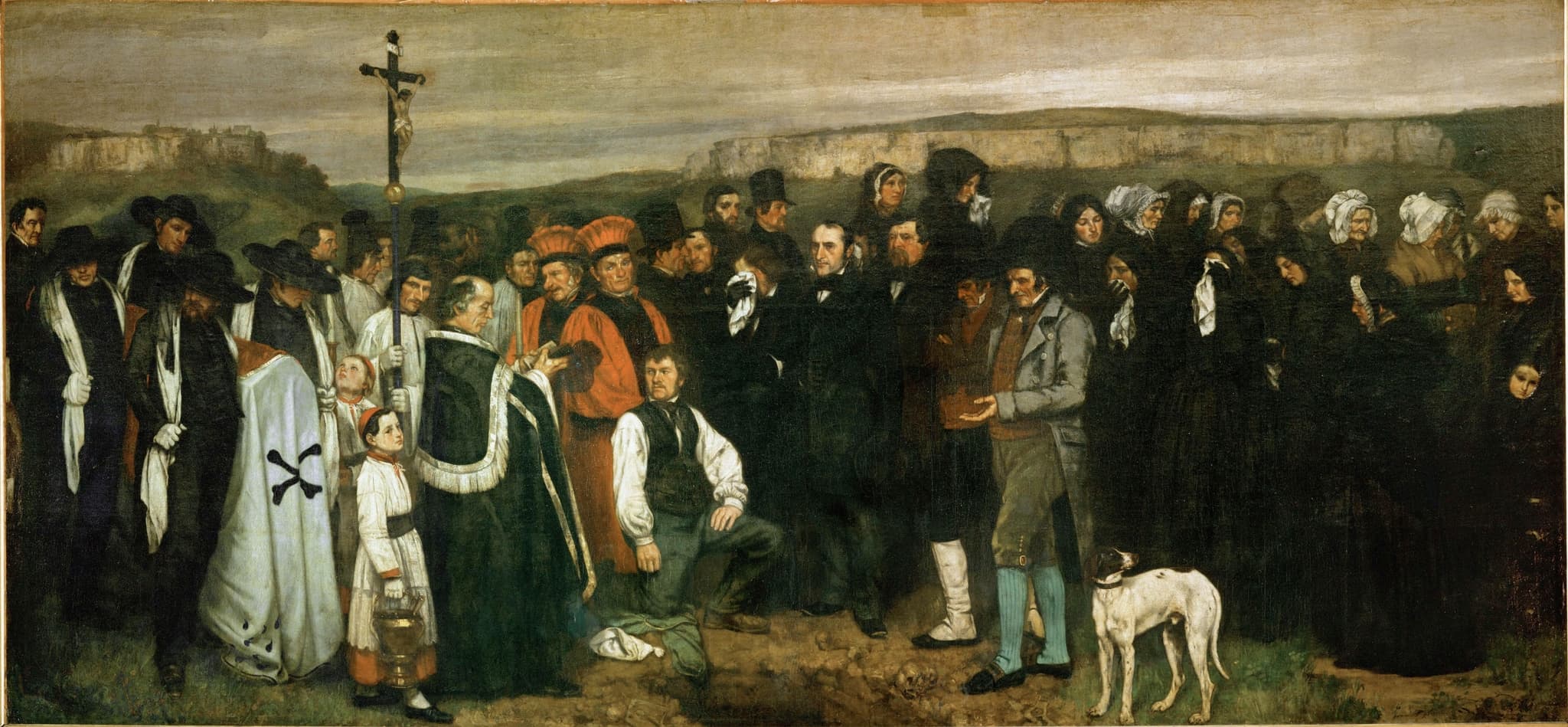
A Burial at Ornans
Gustave Courbet, 1849–1850 • Oil on canvas
Read full analysis of A Burial at Ornans →Valuation Analysis
Final hypothetical market valuation: A Burial at Ornans (1849–50) is one of Courbet’s most consequential works and is part of the French national collection at the Musée d’Orsay. If extremely rare legal circumstances enabled a sale, a defensible market window is $40–$120 million. This estimate is hypothetical, predicated on high institutional interest, aggressive private bidding, and precedent for museum‑calibre nineteenth‑century canvases achieving significant premiums. [1][2]
Rationale and anchor points: The painting has no modern auction history and so the valuation is an extrapolation from the artist's secondary‑market behaviour and from precedent for museum‑grade nineteenth‑century canvases. Courbet's public auction record is the Christie’s sale of Femme nue couchée (2015) at about $15.3M, which establishes a documented market ceiling for Courbet in freely traded sales; more routine Courbet lots frequently realise in the low‑to‑mid six‑figure band with occasional single‑lot seven‑figure outcomes (for example La Pauvresse de village, c.2022, sold in Paris at approximately €1.7M) [2][4]. These outcomes justify a low bound in the tens of millions when scaled to a canvas of national, canonical importance.
Upper‑end mechanics and justification: The $120M upper bound models an exceptional sale dynamic: competing national institutions, major cultural foundations and private collectors converge on a single canonical painting. When museum masterpieces do appear, the market can pay substantial uplift—driven by scarcity of supply, institutional pressure to preserve national patrimony, and the painting's exhibition and scholarship history. A Burial at Ornans' monumental scale, centrality to the Realist movement and iconic status would command a unique premium versus run‑of‑the‑mill Courbets. At the same time Courbet's historical market ceiling is lower than those of top Impressionist or modern masters, which tempers probability and the expected realised price in most scenarios.
Constraints and caveats: French patrimony law and the Musée d'Orsay's custodial status significantly reduce the probability and change the mechanics of any sale: declassification, formal governmental approval and export licence processes would be required, and such processes are rare and politically sensitive [3]. Condition, conservation history, catalogue‑raisinée inclusion and clear title also materially influence final value. If any of these variables were adverse, the realised number could fall materially below the lower bound; conversely, perfect condition plus extraordinary competitive pressure could push final price above the upper bound.
Recommendation: Treat $40–$120M as a reasoned, conditional market band. For a formal, transaction‑grade valuation commission a leading house appraisal (Sotheby’s/Christie’s), obtain legal guidance on French patrimony constraints, and secure a conservation report and complete provenance dossier to refine and, if necessary, narrow the estimate.
Key Valuation Factors
Art Historical Significance
High ImpactA Burial at Ornans is a foundational Realist painting whose monumental scale, depiction of provincial life and placement at the apex of Courbet’s career make it a reference work in scholarship and museum programming. As a canonical piece its cultural and scholarly value far exceeds that of a routine market lot and translates into buyer willingness to pay a significant premium when the object becomes hypothetically tradable. Museums prioritize such works for exhibition, loans and prestige; private collectors seeking canonical nineteenth‑century holdings likewise prize them. This depth of recognition and exhibition history supports a strong upward effect on any market valuation.
Rarity / Museum Ownership
High ImpactThe painting is held by the Musée d’Orsay and is effectively unique in the open market: there is no regular supply of canonical Courbets of the same scale, provenance and exhibition pedigree. Absolute scarcity elevates competitive pressure and headline valuations when comparable works become available. At the same time, museum custody brings procedural hurdles — deaccession policy, national review and export permissions — which affect liquidity and which bidders will price into offers. Scarcity therefore increases theoretical ceiling while reducing practical transactional probability.
Artist Market Dynamics
Medium ImpactCourbet’s secondary‑market profile is solid but historically below the highest Impressionist and modern names. The artist’s auction record (~$15.3M, Christie’s 2015) sets an empirical high; many other works trade in the low‑to‑mid six‑figure band and only occasionally in the low single‑digit millions. This distribution provides both a floor and a calibration point for hypothetical valuations: canonical museum works will command multiples of routine outcomes, but the probability of routinely reaching triple‑digit millions is lower than for top Impressionists or modern masters.
Legal / Cultural Restraints
High ImpactFrench patrimony law and the inalienability of national museum collections are decisive. Any sale would require formal declassification, ministerial approval and likely export licences; these processes are rare and politically sensitive and therefore materially reduce transaction probability. Prospective purchasers would factor legal, reputational and logistical risk into bids. When the legal pathway is constrained, the effective bidder pool narrows (often to domestic institutions), which alters competitive dynamics and can depress realised prices relative to an otherwise identical freely tradable painting.
Comparable Sales & Market Volatility
Medium ImpactComparable auctions illustrate a bifurcated market: many Courbet lots achieve hundreds of thousands, a minority reach low‑seven figures, and the artist’s public record has a documented high in the mid‑teens of millions. By contrast, canonical museum works by top Impressionist or modern painters have reached tens to hundreds of millions, showing precedent for high ceilings in exceptional institutional sales. Macro volatility, philanthropic capital and museum budgets drive episodic high‑end results, so modelling both conservative and exceptional scenarios is required to capture a realistic value band.
Sale History
A Burial at Ornans has never been sold at public auction.
Gustave Courbet's Market
Gustave Courbet is a preeminent figure in 19th‑century Realism with steady museum representation and scholarly attention. His secondary‑market performance is concentrated: the public auction record is approximately $15.3M (Christie’s, 2015), while most offerings trade in the hundreds of thousands and only a few museum‑quality canvases realise higher single‑digit millions. Collectors and institutions view Courbet as a reference name within nineteenth‑century collecting, but he has not consistently entered the $50–100M bracket that characterizes the very top Impressionist/modern artists. Market appetite is therefore selective and prize is driven by rarity, condition and provenance.
Comparable Sales
Femme nue couchée
Gustave Courbet
Same artist and the artist's public-auction record — useful as a market-ceiling benchmark for Courbet in the secondary market, though subject/scale differ from the monumental Burial at Ornans.
$15.3M
2015, Christie's, New York
~$20.5M adjusted
La Pauvresse de village
Gustave Courbet
Same artist, same period (1860s) and rural/genre subject — a recent Paris sale that illustrates market demand for well‑provenanced mid‑size Courbets.
$1.9M
2022, Sotheby's, Paris
~$2.1M adjusted
Le Ruisseau de Puits Noir
Gustave Courbet
Recent sale in London of a small/medium Courbet landscape — indicates baseline liquidity and typical realized prices for non‑monumental works.
$105K
2024, Christie's, London
~$108K adjusted
La Trombe
Gustave Courbet
Very recent U.S. sale showing continued demand in the sub‑million/low‑seven‑figure band for certain Courbet works; useful to gauge near‑term market activity.
$965K
2025, Sotheby's, New York
Current Market Trends
Current market conditions for nineteenth‑century French painting are ‘selectively buoyant’: demand concentrates on museum‑quality works with strong provenance and exhibition histories, while ordinary material faces price pressure. Retrospectives and renewed scholarship have increased visibility for Courbet, but macroeconomic uncertainty and variable philanthropic budgets keep top‑end bids episodic. Scarcity of canonical Courbet canvases supports high potential ceilings, but realised prices remain sensitive to timing, buyer competition and legal constraints.
Study print
Study this painting as a print
Pair the full artwork with a museum-style study sheet focused on one meaningful detail.