How Much Is The Stone Breakers Worth?
Last updated: May 22, 2026
Quick Facts
- Methodology
- comparable analysis
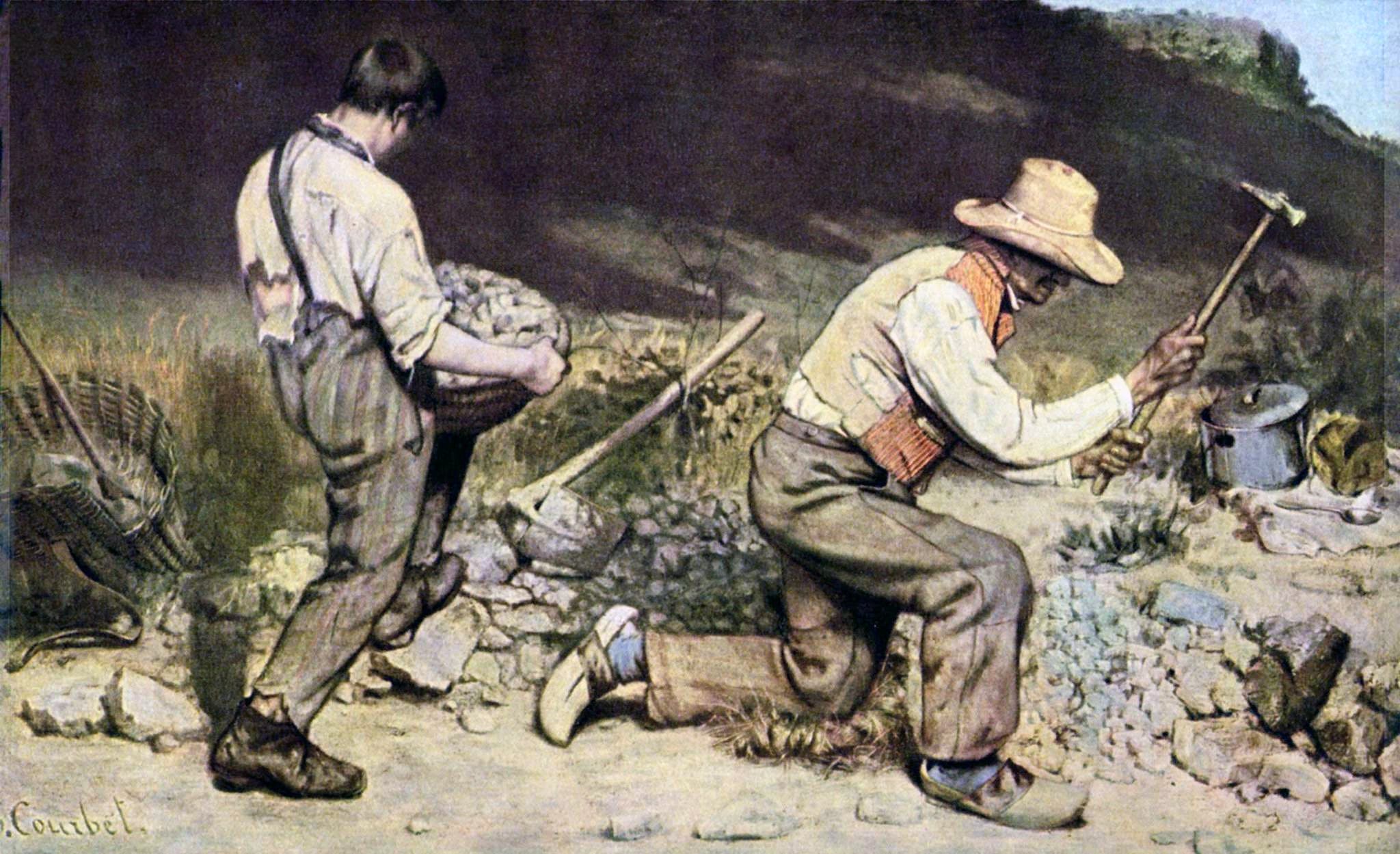
If The Stone Breakers still existed and were legally tradable, we estimate a value of $80–120 million. This range extrapolates from Courbet’s auction record and recent market signals, with a premium for the work’s singular, canonical status in 19th‑century Realism. Legal reality: as a WWII war loss from a public museum, it would be non‑marketable, so this is a hypothetical market/insurance indication.
Valuation Analysis
Conclusion: We estimate Gustave Courbet’s The Stone Breakers (1849) at $80–120 million on a hypothetical, legally tradable basis. The painting is among the two or three most important works of Courbet’s career and a cornerstone of 19th‑century Realism. Its canonical status justifies a multiple of any price achieved by the artist at auction, while remaining below the very top Impressionist/Post‑Impressionist brands.
How the estimate was derived: The starting point is Courbet’s auction record: Femme nue couchée realized $15,285,000 at Christie’s New York in 2015, establishing the modern price ceiling for the artist at public sale [1]. We then apply a qualitative premium for Stone Breakers’ art‑historical primacy, scale, and cultural resonance—attributes that position it closer to era‑defining “trophy” pictures that trade in the high eight to nine figures. Recent Courbet sales confirm a selective but steady market: strong, well‑documented works (e.g., La Trombe at $965,200 in 2025) sell on their merits, while secondary material can underperform or be bought‑in [3][4]. Together, these data points support a large upward adjustment from the artist’s record for a once‑in‑a‑generation masterpiece.
Key factors and positioning: The Stone Breakers is a textbook image of Realism—frequently reproduced, academically central, and historically provocative. Its subject (back‑breaking labor) is less decorative than nudes or luminous landscapes, which narrows broad private appeal. However, the sheer canonical importance and rarity of a museum‑grade Courbet figure composition would galvanize institutional and connoisseur demand, sustaining nine‑figure potential. The work’s large scale (c. 159 × 259 cm in pre‑war records) further amplifies impact and value.
Legal and practical reality: The Dresden original is a recorded WWII war loss from a German state museum (SKD/Galerie Neue Meister, inv. 2522; “Kriegsverlust/destroyed”) [2]. Any reappearance would face immediate restitution/return claims, rendering a commercial sale impracticable. Accordingly, this valuation functions as a reasoned market/insurance proxy, not a prediction of a real transaction.
Why $80–120 million now: Since 2015, buyers have rewarded art‑historically resonant trophies across classic categories, while remaining price‑sensitive for mid‑tier works. Courbet’s traded market (mostly landscapes/marines in the low‑six to low‑seven figures; select works around $1–2m; record at $15.3m) demonstrates durable liquidity but a limited brand ceiling relative to Monet/Manet. The Stone Breakers overcomes that ceiling by virtue of singular importance, positioning it in the lower band of recent “trophy” outcomes for the era—hence an $80–120m range. This band captures robust institutional interest and private connoisseur competition, while acknowledging Courbet’s historically narrower collector base compared with the very top 19th‑century brands [1][3][4].
Key Valuation Factors
Art Historical Significance
High ImpactThe Stone Breakers is universally ranked among Courbet’s defining statements—alongside A Burial at Ornans and The Painter’s Studio—as a foundational image of 19th‑century Realism. Its frank depiction of labor, anti‑heroic composition, and monumental scale crystallize the artist’s break with academic history painting and his advocacy for contemporary, unidealized subjects. This is the Courbet that appears in textbooks, surveys, and major exhibitions as the shorthand for the Realist revolution. Works with this level of canonical status command premiums that transcend the artist’s ordinary market ceiling, because they are not just “best of artist” but “best of era” touchstones. That universality materially increases pricing power in any realistic market or insurance context.
Rarity and Supply
High ImpactMasterpiece‑level Courbet figure compositions of the late 1840s–1850s are effectively off the market, with the crucial examples long held by museums. The Stone Breakers was unique in subject and ambition; it was held by the Galerie Neue Meister and is recorded as a WWII war loss. Even aside from the legal reality, practical supply of anything comparable is near zero. In a world where the best traded Courbets are typically marines, hunting scenes, and landscapes, a re‑emergent Stone Breakers would represent a once‑in‑a‑generation opportunity. This absolute scarcity—and lack of viable substitutes—supports a step‑change in value relative to the artist’s existing auction record and mid‑market liquidity.
Subject and Aesthetic Appeal
Medium ImpactThe painting’s subject—physically grueling, humble labor—lacks the decorative and hedonistic appeal of Courbet’s nudes or luminous landscapes, which typically draw broader private‑collector demand. Historically, this can compress bidder pools and exert downward pressure on purely aesthetic pricing. However, for The Stone Breakers, the same subject is the source of its art‑historical power and modern relevance. Museums, academically minded collectors, and patrons seeking culturally resonant pictures are likely to prioritize significance over decorativeness. In effect, narrower “decorative” appeal is offset by the work’s iconic status, scholarship, and exhibition potential, neutralizing the usual discount attached to social‑realist themes.
Provenance and Legal/Restitution Constraints
High ImpactThe Dresden original is a documented WWII war loss from a German state museum (SKD/Galerie Neue Meister). If it resurfaced, legal and ethical norms would dictate restitution/return; a commercial sale would be untenable. For valuation purposes, that reality shifts emphasis from cash‑market liquidity to notional replacement/insurance value for an irreplaceable cultural asset. Such frameworks can exceed what a typical auction might realize, particularly for singular icons. Our $80–120m range therefore reads as a practical synthesis: it acknowledges non‑marketability while anchoring to real, recent price data and cross‑category trophy demand, yielding a credible order‑of‑magnitude indication rather than a prediction of an actual sale outcome.
Sale History
The Stone Breakers has never been sold at public auction.
Gustave Courbet's Market
Gustave Courbet is a blue‑chip 19th‑century master with a durable but selective auction market. His world auction record stands at $15.285 million for Femme nue couchée (Christie’s New York, 2015) [1]. Most traded material consists of authenticated landscapes, marines, and hunting scenes, which cluster from the low six figures to low seven figures; superior examples can approach or exceed $1 million (e.g., La Trombe at $965,200 in 2025) [3]. Social‑realist subjects and top‑tier figure compositions are exceptionally scarce at auction, with many key works held by institutions. As a result, Courbet’s brand typically prices below Manet/Monet, but best‑of‑oeuvre works would command a significant premium over the artist’s existing record due to rarity and art‑historical importance.
Comparable Sales
Femme nue couchée
Gustave Courbet
Same artist; benchmark auction record and best publicly traded Courbet. While a different subject (nude, 1862) and smaller than Stone Breakers, it sets the brand ceiling for the artist at auction.
$15.3M
2015, Christie's New York
~$20.9M adjusted
La Pauvresse de village
Gustave Courbet
Same artist; close in period (1866) and subject matter of social realism/poverty, aligning thematically with Stone Breakers’ depiction of labor and hardship.
$1.9M
2022, Sotheby's Paris
~$2.1M adjusted
La Trombe
Gustave Courbet
Same artist; strong-quality 1867 marine showing current market appetite for prime, authenticated Courbets at the upper mid-tier; useful for liquidity and estimate sensitivity.
$965K
2025, Sotheby's New York
Le Ruisseau de Puits Noir
Gustave Courbet
Same artist; representative landscape result that anchors the lower bound of market depth for typical Courbet subjects and condition levels.
$105K
2024, Christie's London
~$108K adjusted
Le Printemps (Spring / Jeanne Demarsy)
Édouard Manet
Cross-artist, same era ‘trophy’ by a higher-profile 19th‑century master. Calibrates what iconic, museum-grade 19th‑century pictures can fetch at auction and frames an upper bound relative to Courbet’s brand.
$65.1M
2014, Christie's New York
~$88.6M adjusted
Laboureur dans un champ (Ploughman in the Field)
Vincent van Gogh
Cross-artist benchmark with a rural labor theme that echoes Stone Breakers’ subject. Van Gogh’s stronger brand shows how a canonical 19th‑century image of work can command high‑eight to nine figures.
$81.3M
2017, Christie's New York
~$105.7M adjusted
Current Market Trends
The 19th‑century French/Realist segment remains quality‑driven and estimate‑sensitive: well‑documented, fresh works sell strongly, while middling material can be bought‑in. Recent results for Courbet reflect this selectivity, with prime works clearing at healthy levels and secondary examples underperforming [3][4]. At the very top, cross‑category demand for museum‑grade “trophies” has stayed resilient through 2025–2026, supporting high eight‑ to nine‑figure outcomes when art‑historical significance, provenance, and condition align. Against this backdrop, a canonical Courbet such as The Stone Breakers—if tradable—would logically price far above the artist’s current record while remaining below the absolute peaks achieved by the most brand‑elite names of the era.
Study print
Study this painting as a print
Pair the full artwork with a museum-style study sheet focused on one meaningful detail.
Sources
- Christie’s – World auction record for Gustave Courbet (Femme nue couchée, 2015)
- Deutsche Digitale Bibliothek – Courbet, Les casseurs de pierres (SKD/Galerie Neue Meister, inv. 2522) – war loss record
- HENI – Gustave Courbet, La Trombe, Sotheby’s New York (May 14, 2025) $965,200
- Le Journal des Arts – Courbet market notes incl. €1.7m La Pauvresse de village; selectivity and buy‑ins