The Stone Breakers

by Gustave Courbet

In The Stone Breakers, Gustave Courbet monumentalizes the backbreaking labor that underpins modern life. Two workers—youth and age—turn their faces away as patched clothes, wooden clogs, a wicker basket, and a dented kettle state a stark economy. The low horizon and compressed space forge a mood of claustrophobic realism that resists heroism [1][2][3].

Study Print Studio

Create a personal study print

Build a companion study sheet around the part of this painting that speaks to you most. Choose a detail, shape an interpretation, and walk away with something personal and display-worthy.

Fast Facts

Year
1849
Medium
Oil on canvas
Dimensions
165 x 257 cm
Location
Destroyed/lost; formerly Gemäldegalerie Neue Meister (Staatliche Kunstsammlungen Dresden), Dresden
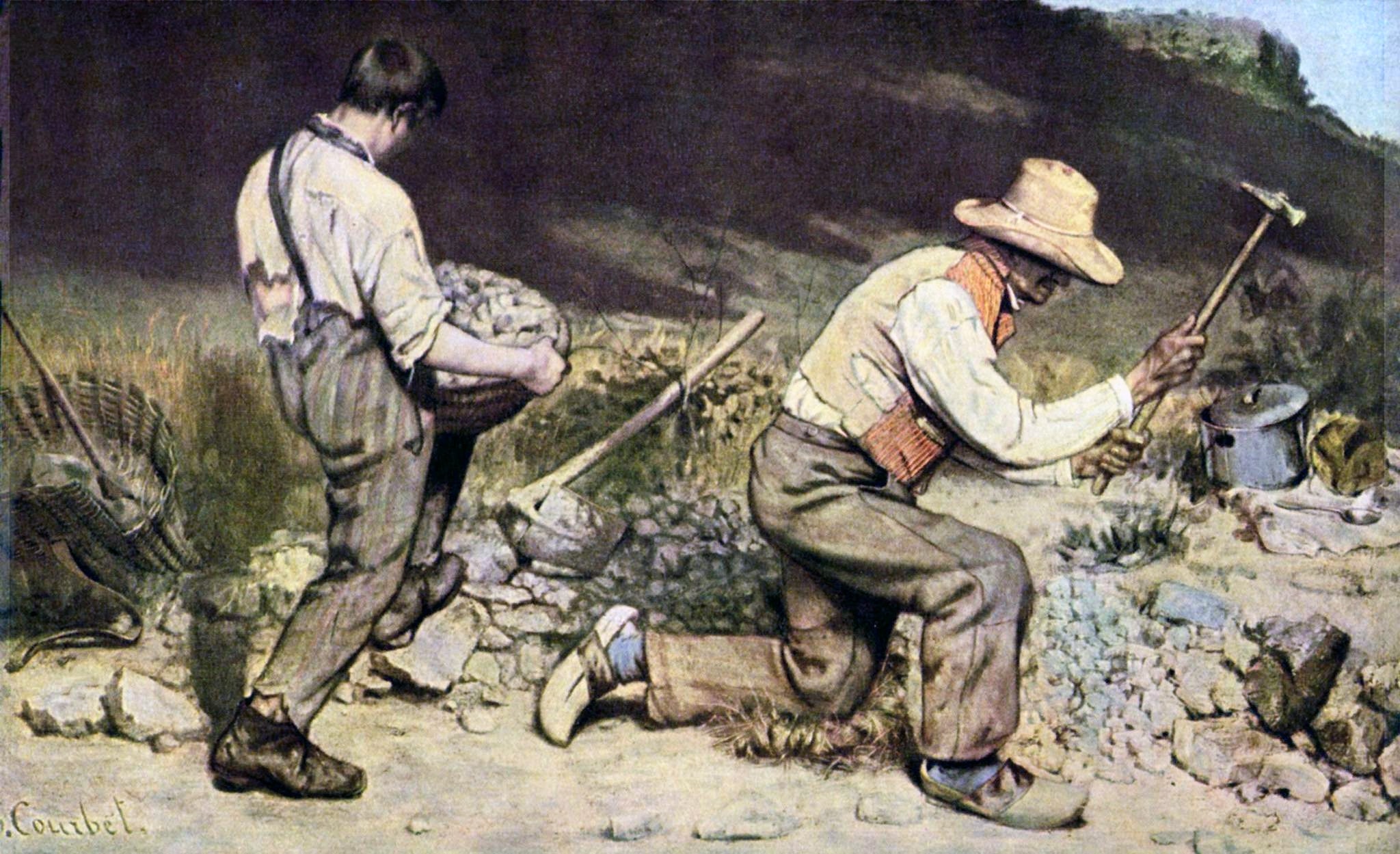
The Stone Breakers by Gustave Courbet (1849) featuring Footwear contrast (wooden clogs vs. worn leather shoes), Hammer and shattered stones, Wicker basket of rocks, Patched clothing and sagging suspenders

Click on any numbered symbol to learn more about its meaning

Meaning & Symbolism

Courbet stages labor as destiny rather than episode. The elderly breaker, kneeling with hammer raised, and the adolescent straining under a wicker basket form a dyad of youth and age that reads as a closed loop—work begun early and ending late, with no evident exit. Their faces turn from us, a pointed refusal of anecdote that transforms them into emblems of class, not portraits. The clothes—ripped cuffs, patched knees, sagging suspenders—and the rough footwear—leather shoes for the boy, heavy wooden clogs for the man—broadcast poverty as a condition, not a passing hardship. On the ground, a metal kettle with a spoon, a heel of dark bread, and a sack show that nourishment is meager and taken on-site, collapsing the line between life and labor. The brushwork is dense and unvarnished, a tactile analogue to quarry grit; Courbet’s earthy browns, grays, and dull greens bind bodies to the slope so tightly that the men seem geologically related to the roadbed they build. With the hillside closing the horizon and the shallow foreground crowded by stones and tools, the composition denies the escape of distance; the world is work, and work is close. This deliberate claustrophobia strips away the picturesque and replaces it with presence 123. That presence carries a polemical charge. Painted in 1849 and shown at the Salon of 1850–51, the canvas extends Courbet’s campaign to elevate the contemporary and the common to a scale once exclusive to myth and state history. Its very size—historically recorded as a large exhibition piece—asserts that the making of roads by anonymous hands is as consequential to modern France as any battlefield or coronation 12. Courbet himself traced the image to a real roadside encounter with two stone breakers, signaling his insistence on the here-and-now as valid subject matter and on eyewitness truth against academic idealization 4. Where earlier rural scenes could sentimentalize peasants or frame toil within a consoling landscape, Courbet refuses consolation: no distant vista, no narrative uplift, only repetitive exertion paced by hammer blows and basket loads. In doing so, he articulates a realist ethics—art as an index of social fact—and a political stance legible in the wake of 1848: attention to laboring classes as the ground of the modern nation 13. The painting’s afterlife reinforces its thesis. Though destroyed or lost amid the wartime catastrophe that befell Dresden’s collections, The Stone Breakers survives through photographs, a related smaller version, and reproductive prints, continuing to structure how we see labor in art 567. Its visual logic—monumental scale, anonymized figures, material exactitude, compressed space—became a toolkit for later realism and social documentary. By aligning rough facture with rough work, and by denying viewers the comfort of narrative heroism, Courbet fixes our gaze on the brute facts of making the modern world—and on the people usually omitted from its official portraits 123.

Explore Deeper with AI

Ask questions about The Stone Breakers

Popular questions:

Powered by AI • Get instant insights about this artwork

💬 Ask questions about this artwork!

Interpretations

Social-Historical Lens (1848 and the Politics of Scale)

Painted immediately after 1848, The Stone Breakers weaponizes scale to claim public visibility for laboring bodies once excluded from history painting. At the Salon of 1850–51, this was read as a challenge to academic hierarchies and a republican recoding of who counts in the nation’s image economy. Courbet’s own account of an eyewitness encounter underlines a politics of presence: the here-and-now as valid, even urgent, subject matter. Rather than allegorize work, Courbet insists on its material centrality to modern France, an argument that sympathetic critics saw as ethically and politically charged. The painting’s monumental size and anti-heroic facture thus function like a civic proposition in paint: the builders of roads are builders of the polity, and their representation belongs at the very center of public culture 124.

Source: The Metropolitan Museum of Art (Galitz); Britannica; Petra ten-Doesschate Chu (Courbet correspondence)

Formal/Material Analysis (Facture as Labor Analogue)

Courbet’s dense, unvarnished facture behaves like a tactile proxy for quarry grit—an aesthetics of resistance to the Academy’s glossy finish. The heavy impasto and earthy chromatic register (browns, dull greens, ash grays) bind figures to the slope, performing a kind of material mimesis wherein paint embodies the weight and abrasion of toil. This refusal of finish is not stylistic rebellion alone; it is an ethical claim that a truthful surface must retain the drag of matter and process—akin to labor itself. In this reading, brushwork is not mere technique but an index of class: a coarse surface for coarse work, rejecting the polite illusionism that would detach viewers from the brute conditions of making modern infrastructure 38.

Source: Smarthistory/Khan Academy; Encyclopedia.com (Realism synthesis)

Anti-Pastoral Landscape (Enclosure vs. Vista)

Where mid‑century rural painting often staged consolation through horizon and light, Courbet engineers an anti-pastoral. The hillside closes the horizon; the shallow foreground crowds with stones and tools; no sky relieves the eye. This compositional claustrophobia abolishes the distance that typically aestheticizes peasant labor. Compared with Millet’s gleaners—framed by an expansive field—Courbet’s workers are pressed against earth like geological extensions of their task. Space itself becomes an instrument of critique: by suppressing the picturesque, Courbet denies spectators any pastoral alibi, forcing an encounter with proximity, repetition, and bodily strain as the conditions of modernity’s ground-level construction 3.

Source: Smarthistory/Khan Academy

Reproduction, Loss, and the Afterlife of Realism

Although the Dresden canvas is lost, the work persists through prewar photographs, a smaller related version in Winterthur, and a 19th‑century reproductive print by Firmin Gillot. These surrogates sustain the painting’s documentary authority, enabling its compositional logic—monumental scale, anonymized figures, compressed space—to seed later realism and social photography. The afterlife emphasizes how indexical claims can outlive originals, with reproductive media diffusing Courbet’s realist program into broader visual culture. The wartime disappearance, paradoxically, sharpens the painting’s thesis: modernity is built by vulnerable, often vanishing hands, yet reproducibility keeps their image in circulation, a reminder that representation is also a form of social endurance 1567.

Source: National Gallery of Art (Gillot print); Staatliche Kunstsammlungen Dresden; Oskar Reinhart Collection (Winterthur); The Met (context)

Temporal Ethics (Work as Life Course and Memento Mori)

The dyad of adolescent and elderly figures stages time-as-labor: a life begun under burden and concluding under the same. Details like the kettle, spoon, and dark bread on-site collapse respite into the workflow, marking a subsistence temporality with no narrative exit. Read through a memento mori lens, the painting converts productivity into depletion—each hammer blow an incremental expenditure of life. Courbet’s refusal of anecdotal faces generalizes this temporal fate beyond individuals to a class, rendering wear and attrition the common denominator of the rural poor. In this sense, the painting is less a scene than a calendar of erosion, where the only measurable progress is the road’s extension and the body’s corresponding decline 23.

Source: Britannica; Smarthistory/Khan Academy

Related Themes

About Gustave Courbet

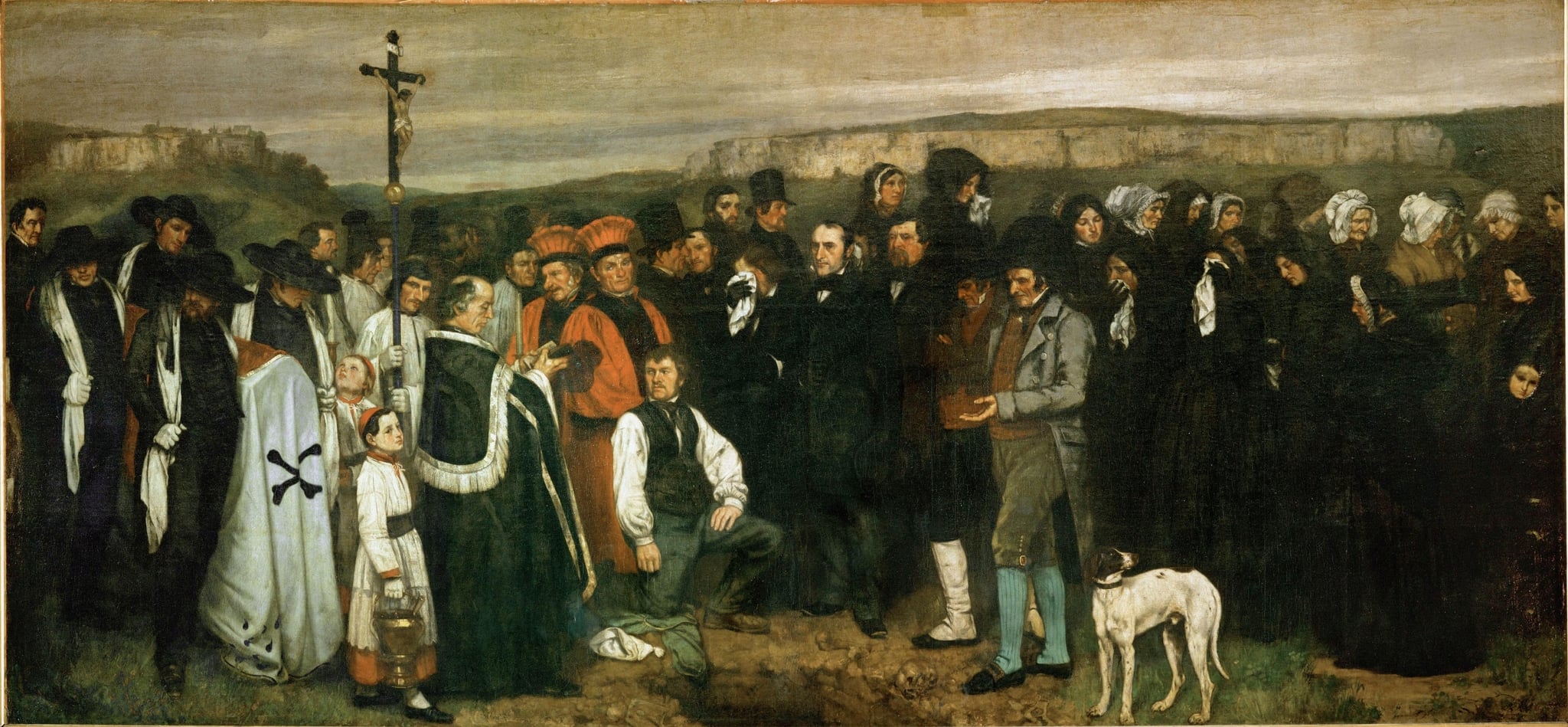
Gustave Courbet (1819–1877) led French **Realism**, rejecting academic idealization to paint contemporary life at monumental scale. After shocking the Salon of 1850–51 with works like The Stone Breakers and A Burial at Ornans, he continued to challenge institutions, shaping the path to modern art [1][2].
View all works by Gustave Courbet