How Much Is The Ambassadors Worth?
Last updated: February 23, 2026
Quick Facts
- Methodology
- comparable analysis
The Ambassadors is a canonical Holbein and one of the National Gallery, London’s signature paintings. Based on top-tier Old Master benchmarks and the 2011 private sale of Holbein’s Darmstadt Madonna, a prudent fair-market indication for a hypothetical offering is $120–180 million, with competition likely at the upper end.
Valuation Analysis
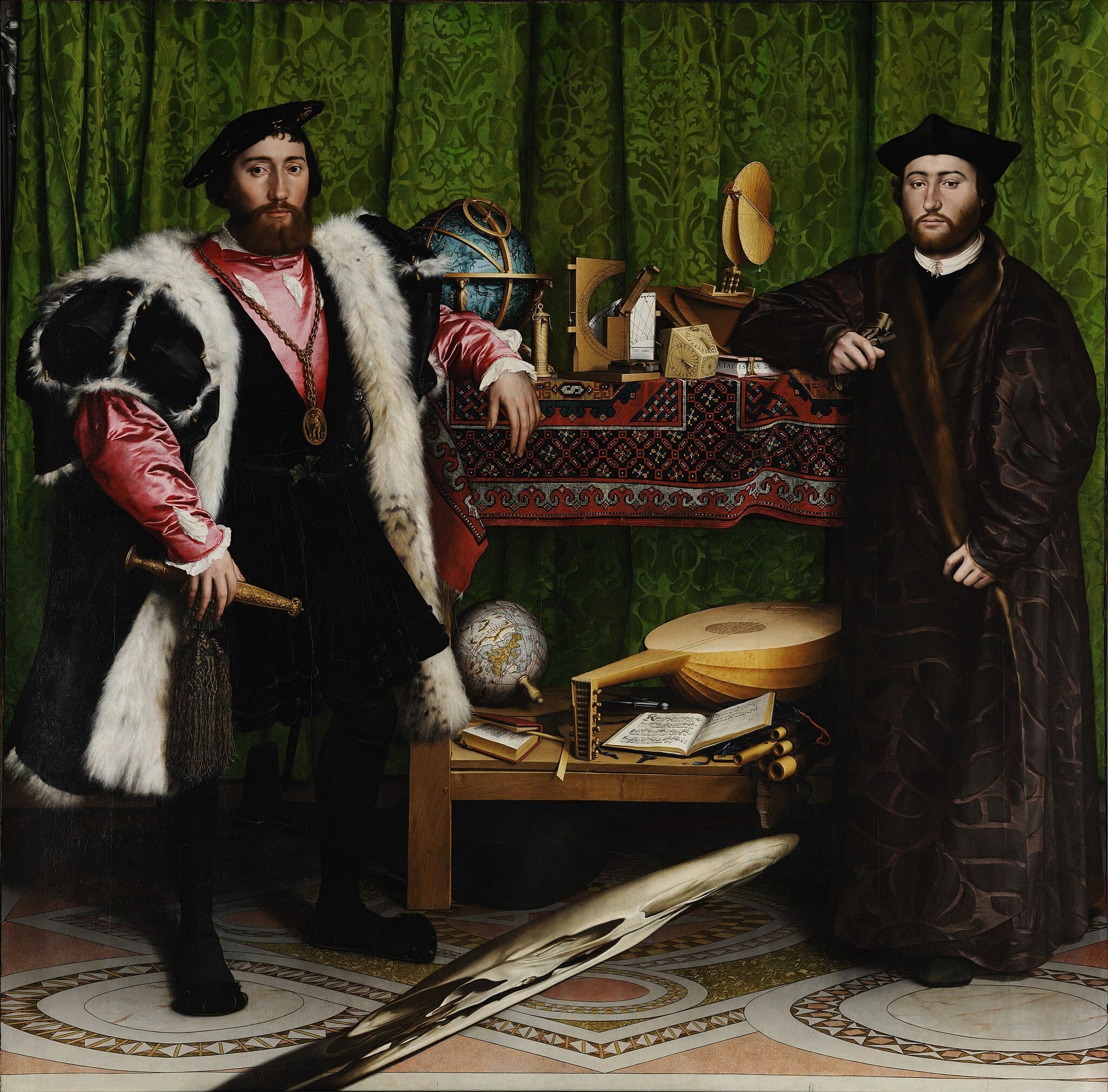
Value conclusion: $120–180 million (hypothetical fair market value, assuming global exposure and no deaccession/export constraints). This range reflects the painting’s universally acknowledged masterpiece status within Hans Holbein the Younger’s oeuvre, its extraordinary rarity, its cultural renown (not least the famous anamorphic skull), and its unimpeachable provenance and stewardship at the National Gallery, London [1].
Primary anchor: direct Holbein benchmark. The closest modern datapoint for a prime autograph Holbein is the 2011 private-treaty sale of the Darmstadt (Meyer) Madonna for more than €50 million (c.$70 million at the time), with informed commentary that an exportable example could have exceeded €100 million. Inflated to today, that sale implies roughly mid–high eight figures to c.$100 million as a single-artist baseline [2]. Given The Ambassadors’ greater scale, complexity, art-historical fame and broader cultural recognition, an upward adjustment into low nine figures is justified.
Cross-artist comparables: Old Master trophies. The most relevant public benchmarks for pre-1600 masterpieces include Botticelli’s Portrait of a Young Man Holding a Roundel at $92.2 million (2021) [3] and the Dutch State’s €175 million (≈$198 million) 2022 acquisition of Rembrandt’s The Standard Bearer [4]. Rubens’s Massacre of the Innocents achieved £49.5 million (~$76.7 million in 2002; ≈$130+ million in today’s dollars), showing depth for monumental, museum-caliber pictures at auction [5]. These datapoints define a band from about $100 million to around $200 million for uniquely important Old Masters, consistent with the range concluded here.
Scarcity and demand. Fully autograph Holbein oils are vanishingly rare on the open market; the artist’s auction record is artificially low because top works simply do not appear. The Ambassadors is widely taught, reproduced, and instantly recognizable, which expands the potential buyer base to include leading museums, foundations, and sovereign or UHNW collectors who compete for era-defining pictures. In such contests, pricing often steps beyond artist-specific auction precedents and is set by cross-category trophy dynamics—precisely the rationale for a nine-figure indication here.
Practical considerations. As a core UK national-collection picture, a real-world sale is improbable and would face policy and export scrutiny. This estimate therefore functions as an intrinsic fair-market indication or insurance-style valuation. Within that construct, the $120–180 million range situates The Ambassadors appropriately among the few Old Master works capable of commanding modern blue-chip prices while acknowledging Holbein’s relative scarcity of public-market comparables.
Key Valuation Factors
Art Historical Significance
High ImpactThe Ambassadors (1533) is one of Holbein’s supreme achievements and a cornerstone of Northern Renaissance painting. It synthesizes dazzling surface realism with intellectual depth, from the meticulously rendered textiles and scientific instruments to the famed anamorphic skull that encodes a memento mori. The sitters—Jean de Dinteville and Georges de Selve—anchor the work in European diplomacy and humanist culture. Within Holbein’s oeuvre, it stands alongside his greatest portraits and religious works as a definitive statement of ambition and virtuosity. Canonical status translates directly into market power because it attracts both connoisseurs and institutional or sovereign buyers seeking emblematic, public-facing masterpieces.
Rarity and Market Scarcity
High ImpactFully autograph Holbein oils of major scale and undisputed authorship are extraordinarily scarce on the market. The paucity of supply depresses auction records relative to the artist’s true cultural standing, creating a disconnect that only resolves when a top-tier example becomes tradable and pricing is set by cross-category trophy dynamics. The last marquee autograph Holbein to transact publicly or semi-publicly at scale was the Darmstadt Madonna (2011, private treaty), confirming deep latent demand at the highest levels. Against this backdrop, The Ambassadors—arguably Holbein’s most celebrated secular painting—would command a substantial scarcity premium if hypothetically available.
Provenance and Ownership
High ImpactProvenance is long, stable, and illustrious: 18th-century French ownership, then Longford Castle (Earls of Radnor), followed by the National Gallery, London, since 1890. Continuous stewardship within a top-tier museum ensures exceptional scholarly documentation, exhibition history, and public familiarity—key elements that underpin liquidity for trophy works. While national-collection status makes an actual sale improbable, it also enhances intrinsic value because it signals institutional consensus on importance and quality. If ever deaccessioned or subject to an indemnified transaction, this pedigree would rank among the most secure in the Old Master field and be a significant driver of price confidence.
Market Benchmarks and Demand
Medium ImpactRelevant cross-artist benchmarks demonstrate today’s pricing for uniquely important Old Masters: Botticelli’s $92.2m portrait (2021), Rubens’s monumental canvas (~$76.7m in 2002, ≈$130m+ in current dollars), and the Dutch State’s ~$198m purchase of Rembrandt’s The Standard Bearer (2022). Holbein’s own Darmstadt Madonna surpassed €50m in 2011, with credible indications that an exportable example could exceed €100m. These datapoints place The Ambassadors credibly within a $100–200m band. Given its iconic status, the $120–180m range balances demonstrated market appetite for trophies with the narrower collector base and episodic liquidity of the Old Master category.
Sale History
Private sale (William Buchanan to Jacob Pleydell-Bouverie, 2nd Earl of Radnor)
Recorded as 1,000 guineas in Longford Castle accounts; date approximate. USD based on late-19th-century gold-parity conversion.
Private treaty to the National Gallery, London
Group purchase of three pictures for £55,000; USD shown at c.$4.87/£ gold-parity. No individual allocation recorded in Board Minutes.
Hans Holbein the Younger's Market
Hans Holbein the Younger ranks among the greatest Northern Renaissance painters, with an outsized cultural footprint relative to recent public auction records. The scarcity of secure autograph oils has kept his headline auction prices modest; the current auction record is for a Holbein and Workshop portrait at ~$1.37m. Private or state-linked transactions provide a truer read on valuation: the Darmstadt (Meyer) Madonna sold privately in 2011 for more than €50m, evidencing deep demand for top Holbein works. Collectors and institutions prize Holbein for psychological acuity, courtly associations, and technical brilliance; when prime works surface, competition is intense and prices detach from routine Old Master averages.
Comparable Sales
Madonna of Jakob Meyer zum Hasen ("Darmstadt Madonna")
Hans Holbein the Younger
Same artist; prime autograph oil and acknowledged masterpiece. Rarity and stature closely mirror The Ambassadors, offering the most direct benchmark for Holbein at the top end.
$70.0M
2011, Private treaty (Germany)
~$97.0M adjusted
Portrait of a Young Man Holding a Roundel
Sandro Botticelli
Canonical Renaissance portrait; headline Old Master result in the modern market. Serves as a strong cross-artist benchmark for trophy pre‑1600 paintings.
$92.2M
2021, Sotheby's New York
~$106.0M adjusted
Massacre of the Innocents
Peter Paul Rubens
Record‑level Baroque Old Master auction result; evidences depth of demand for monumental, museum‑quality Old Masters at public sale.
$76.7M
2002, Sotheby's London
~$133.0M adjusted
Salvator Mundi
Leonardo da Vinci
Top of the Old Master market; sets an outer bound for masterpiece pricing. While attribution debates exist, it shows the ceiling for globally iconic Renaissance works.
$450.3M
2017, Christie's New York
~$572.0M adjusted
The Standard Bearer
Rembrandt van Rijn
Northern European masterpiece acquired as a national treasure; demonstrates current institutional/sovereign willingness to pay for era‑defining portraits.
$198.0M
2022, Private treaty (Dutch State/Rijksmuseum)
~$210.5M adjusted
Diana and Actaeon
Titian
Joint institutional acquisition of a Renaissance icon; anchors pricing for museum‑caliber Italian 16th‑century paintings.
$71.0M
2009, Private treaty (National Gallery, London & National Galleries of Scotland)
~$103.0M adjusted
Current Market Trends
The Old Master market remains selective but robust at the top, with fewer trophy pictures coming to market and pricing concentrated in canonical, museum-quality works. After a softer 2024, demand for best-in-class objects rebounded in 2025–26, aided by strong institutional and sovereign participation. Cross-artist comparables show that pre-1600 icons can achieve nine figures, while mid-market lots face estimate discipline. For Northern Renaissance masterworks with ironclad provenance and broad cultural recognition, buyer pools expand beyond traditional connoisseurs to include museums, foundations, and UHNW collectors—conditions that support the $120–180 million indication for The Ambassadors under a hypothetical sale scenario.
Study print
Study this painting as a print
Pair the full artwork with a museum-style study sheet focused on one meaningful detail.

Sources
- National Gallery, London – Holbein, The Ambassadors
- Deutsche Welle – Sale of Holbein's 'Darmstadt Madonna' tops €50m
- Sotheby’s – Botticelli portrait sells for $92.2m (press release)
- Rijksmuseum – Rembrandt’s The Standard Bearer acquired by the Netherlands
- Forbes – Rubens ‘Massacre of the Innocents’ sells for £49.5m (2002)