How Much Is Adoration of the Magi (triptych, Prado) Worth?
Last updated: April 29, 2026
Quick Facts
- Methodology
- extrapolation
Assuming an accepted autograph attribution and commercial saleability, the Prado Triptych of the Adoration of the Magi would command a hypothetical market range of approximately $120–300 million. If downgraded to workshop/follower status or if major condition/restoration issues are documented, a realistic market range falls to roughly $20–80 million; note that an actual sale is extremely unlikely because the work is museum‑held and protected under Spanish heritage rules.
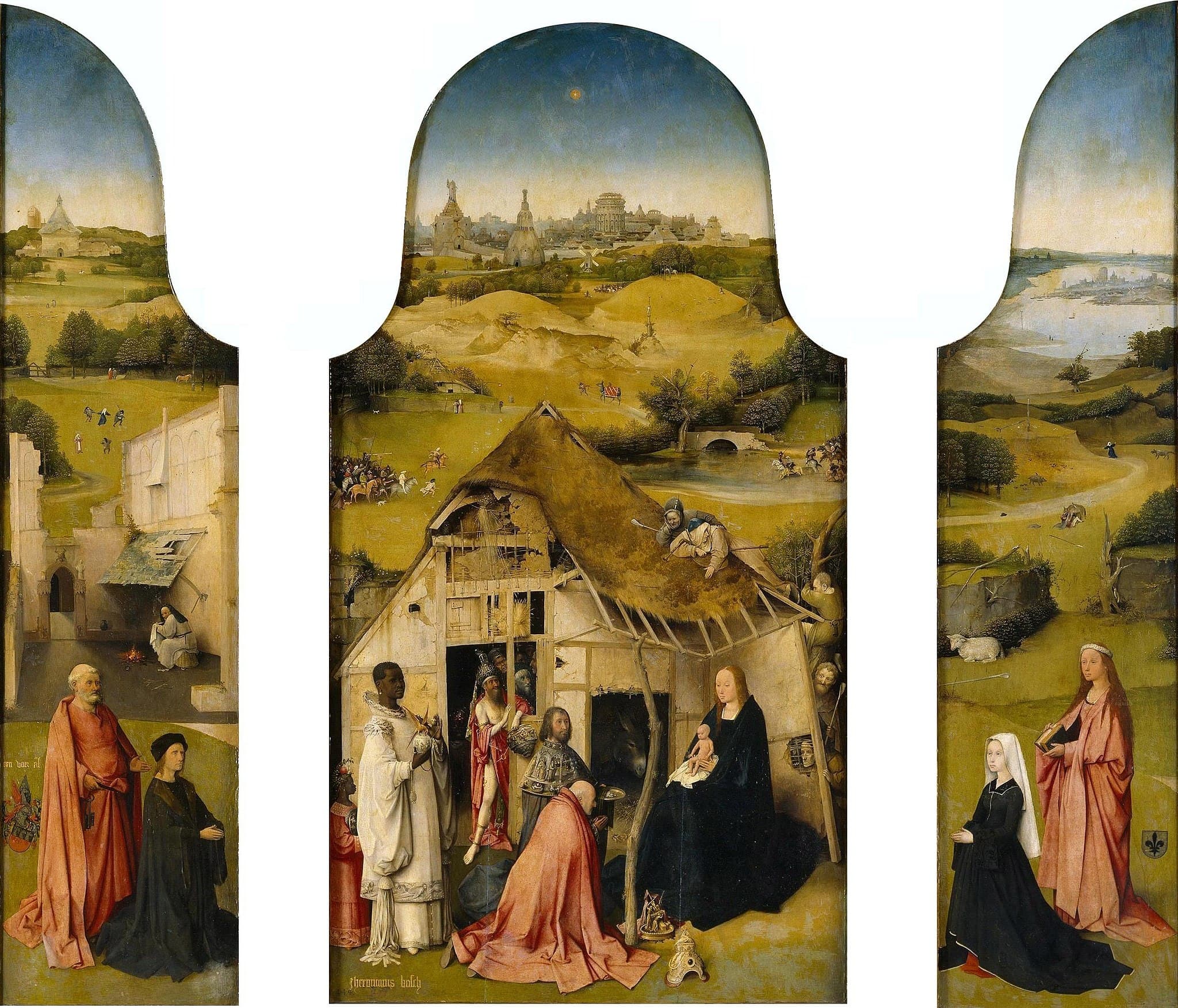
Adoration of the Magi (triptych, Prado)
Hieronymus Bosch, 1495 • Oil on wood
View more by Hieronymus Bosch →Valuation Analysis
Valuation conclusion: On a hypothetical, exportable‑sale basis and assuming a consensus of Bosch scholars that the Prado Triptych of the Adoration of the Magi is an autograph work, I estimate a market range of $120,000,000 to $300,000,000. The Prado triptych is a major Bosch devotional composition with deep provenance in royal collections; its institutional status and art‑historical prominence are the primary drivers of a nine‑figure valuation [1].
Rationale: There is effectively no modern public‑market price discovery for securely attributed autograph Bosch panels because major examples remain in museums; scarcity therefore materially inflates theoretical market value. I derived the upper band by extrapolating top‑end Old Master trophy precedent (notably the modern market ceiling established by the Leonardo Salvator Mundi sale) and then discounting for Bosch’s smaller market of potential trophy buyers relative to a name like Leonardo [2]. The lower band reflects a conservative nine‑figure floor for an undisputed, well‑preserved Bosch triptych offered under ideal sale conditions to multiple international bidders.
Adjustments and conditional scenarios: The single largest price mover is attribution. If subsequent technical study (dendrochronology, IRR, pigment analysis) or conservation history indicates substantial workshop participation or later re‑painting, the market value would likely collapse into the tens of millions (roughly $20–80M). Condition and conservation transparency are next in importance: structural panel issues, heavy overpaint, or unstable paint layers materially reduce both buyer confidence and price. Finally, legal and export constraints (Prado ownership; Spanish cultural‑heritage controls) mean a real‑world sale is highly improbable and any market figure remains hypothetical [1].
Comparables and market context: Public auction comparables are dominated by followers and workshop pieces that realise in the low six‑ to low seven‑figure range; these provide a useful floor but are not informative for autograph masterpieces. The Salvator Mundi sale provides an extreme benchmark for what a unique Old Master can achieve when market psychology, provenance story and bidder competition align, and I used that ceiling as a reference point while calibrating downward to Bosch’s market footprint [2]. Recent follower sales at major European houses (mid‑six figures to low‑seven figures) demonstrate the gulf between museum‑canonical autograph works and on‑market follower material [3].
Practical next steps to refine valuation: Obtain the Prado’s full technical/conservation dossier, confirm attribution consensus among leading Bosch scholars and secure confidential advisory opinions from Old Master departments at major houses. Only with that dossier and clear legal advice on exportability could a tighter, transaction‑level estimate be produced. Until then, the figures above should be read as a reasoned, conditional market‑range estimate for a work that is, for practical purposes, unlikely to enter the open market [1][4].
Key Valuation Factors
Art Historical Significance
High ImpactThe Prado Triptych of the Adoration of the Magi is a canonical, museum‑grade devotional work within Bosch’s small surviving corpus. Its scale, complexity and place in late 15th‑century Netherlandish devotional practice make it central to Bosch scholarship and exhibitions. Canonical status drives institutional demand and attracts the small cohort of private collectors who pursue trophy Old Masters. Because canonical Bosch panels are rare and widely held by public institutions, their theoretical market value is greatly elevated: when an undisputed autograph appears available, competition among deep‑pocketed institutions and private buyers can push prices into the nine‑figure range, provided attribution and condition are unequivocal.
Attribution Certainty
High ImpactAttribution is the decisive value driver. A secure attribution to Hieronymus Bosch — supported by dendrochronology, infrared reflectography, pigment analysis and consensus among leading Bosch scholars — justifies an upper‑band, nine‑figure valuation. Any well‑founded downgrading to workshop, studio or a named follower collapses the market multiple: workshop works trade at mid‑six to low‑seven figures while high‑quality followers might approach low‑seven figures under rare circumstances. Given that modern scholarship (the Bosch Research & Conservation Project and subsequent studies) has tightened attribution standards, technical documentation will determine whether the work sits in the autograph trophy market or the more liquid follower market.
Condition & Conservation
High ImpactPhysical state strongly influences insurability, loanability and buyer confidence. Original paint survival, the extent of historical restorations, panel stability and evidence of overpainting all affect market value materially. A triptych with well‑documented, minimal restorations and stable structural support can justify the top of the range; conversely, heavy overpaint, unresolved structural weakness or invasive past interventions will reduce buyer participation and suppress price. Transparent, current conservation reports are essential to unlock the upper tiers of buyer interest and premium pricing.
Ownership & Legal Constraints
High ImpactThe painting is held by the Museo Nacional del Prado and has a long royal/state provenance. Spanish cultural‑heritage legislation and museum deaccession norms create almost insurmountable barriers to commercial sale or export, which sharply limits practical liquidity. Even if theoretical market value is very high, the effective buyer pool is constrained to domestic institutions or buyers willing to accept in‑country retention conditions. Legal and political impediments therefore discount the practical realisable price and make any valuation largely hypothetical unless extraordinary legal steps are taken.
Market Scarcity & Comparable Sales
High ImpactFew accepted autograph Boschs have ever been on the modern market; most comparables are followers or studio pieces. Consequently, auction comparables only offer a floor (mid‑six to low‑seven figures) and are a poor guide for autograph masterpieces. The scarcity of autograph works creates strong upside potential because rarity concentrates buyer interest, but it also produces a lack of price discovery — valuations must therefore be extrapolated from broader Old Master trophy precedent with careful downward adjustment for Bosch’s narrower commercial market compared with the very top names.
Sale History
Adoration of the Magi (triptych, Prado) has never been sold at public auction.
Hieronymus Bosch's Market
Hieronymus Bosch occupies a uniquely venerated position in Early Netherlandish art: his visionary compositions are globally recognized and heavily studied. On the market, however, autograph Boschs almost never appear; the canon is small and institutional holdings dominate, leaving the open market largely supplied by followers and workshop pieces that typically sell in the low six to low seven figures. This scarcity of market supply combined with high cultural value produces theoretical nine‑figure potential for any genuinely autograph, museum‑quality panel, but the absence of modern autograph sales means price discovery is speculative and attribution‑driven.
Comparable Sales
Follower of Hiëronymus Bosch, Christ Mocked (Crowning with Thorns)
Follower of Hiëronymus Bosch
Recent auction result for a Bosch‑follower panel; illustrates lower‑tier market demand for works in Bosch's style and provides a floor for follower/atelier material.
$83K
2023, Rob Michiels Auctions, Bruges (European & Islamic Arts sale)
~$88K adjusted
Follower of Hieronymus Bosch (Old Master lot)
Follower of Hieronymus Bosch
Mid‑six‑figure realized price at a major European saleroom for a well‑presented follower/workshop attribution; useful as an upper bound for high‑quality follower lots.
$262K
2023, Dorotheum, Vienna — Old Masters sale
~$277K adjusted
Follower of Hieronymus Bosch, Vision of Tondalus (Lempertz offering)
Follower of Hieronymus Bosch
A strong recent follower‑attribution sale (~€906k) at a major Old Masters house; demonstrates that top follower/workshop works can reach low‑seven figures.
$1.1M
2025, Lempertz, Cologne — Old Masters sale
Salvator Mundi
Leonardo da Vinci
Record Old‑Master sale and market ceiling for unique Renaissance masterpieces; used as an upper‑bound benchmark when discussing nine‑figure valuations for exceptionally rare works.
$450.3M
2017, Christie's, New York
~$589.0M adjusted
Current Market Trends
The Old Masters/Northern Renaissance segment is specialist and cautious: buyer pools are narrower than contemporary markets, and institutions and specialized collectors dominate demand. Recent activity has concentrated on followers and workshop attributions (mid‑six to low‑seven figures); no new autograph Bosch has set a market benchmark. Overall, attribution certainty, conservation transparency and legal saleability remain the decisive short‑term determinants of price for works in this category.
Sources
- Museo Nacional del Prado — Triptych of the Adoration of the Magi (Hieronymus Bosch) — collection entry
- Christie's — Salvator Mundi (Leonardo da Vinci) sale press/record (2017) — market ceiling benchmark
- Dorotheum — Follower of Hieronymus Bosch lot listing / realised price (example, Oct 2023)
- Bosch Research & Conservation Project — Hieronymus Bosch: Painter and Draughtsman (catalogue raisonné, 2016)