How Much Is Cutting the Stone (The Extraction of the Stone of Madness / The Cure of Folly) Worth?
Last updated: April 29, 2026
Quick Facts
- Methodology
- extrapolation
If authenticated as an autograph Hieronymus Bosch (early 16th‑century oil on panel), this painting is valued at approximately $100–150 million. This estimate is conditional on definitive technical confirmation (dendrochronology, underdrawing/IRR, pigment analysis), secure provenance, and stable conservation; lacking those, value would fall to workshop/follower bands.
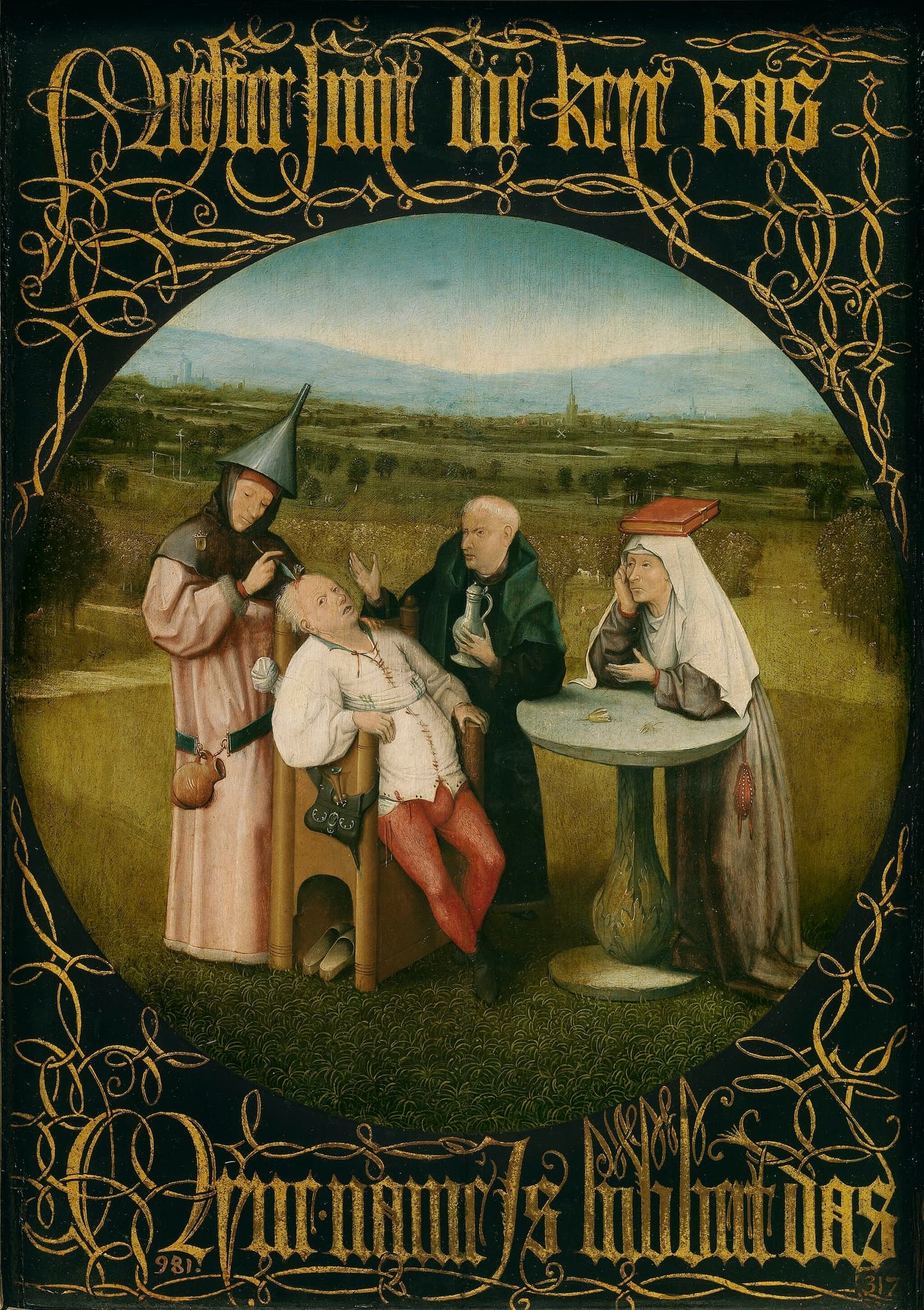
Cutting the Stone (The Extraction of the Stone of Madness / The Cure of Folly)
Hieronymus Bosch, 1505 • Oil on wood
View more by Hieronymus Bosch →Valuation Analysis
Final valuation (autograph scenario): Assuming rigorous confirmation that this panel is an autograph work by Hieronymus Bosch (early 16th century), my reasoned market estimate is $100–150 million. That figure reflects the extreme rarity of undisputed Bosch autographs in private hands, the work’s strong iconographic importance within Bosch’s corpus, and typical buyer behavior for trophy Old Master material among museums and major private collectors.
Method and comparables: There are effectively no direct modern public‑auction comparables for an unquestioned Bosch autograph because the canonical examples (including the Museo del Prado’s Extraction of the Stone of Madness) are museum‑held and off‑market [1]. Consequently the valuation is an extrapolation: I combine (a) the scarcity premium applied to the top echelon of Old Masters, (b) institutional replacement valuations for major Northern Renaissance panels, and (c) market evidence from high‑end follower/workshop sales that show active demand for Bosch subjects at the six‑ and low seven‑figure level [2][3]. The gap between follower results and an authenticated autograph is multiple orders of magnitude because museums compete for the latter.
Market context and buyer universe: Top museums and a handful of ultra‑high‑net‑worth private collectors constitute the realistic buyer pool for an autograph Bosch. Institutional acquisition budgets, export restrictions, and provenance considerations all shape realizable price. When a truly rare Old Master does surface with unambiguous attribution and clean title, competition among institutions (loan/exhibition value plus curatorial urgency) can push prices into the nine‑figure range. However legal/heritage constraints and the preference of museums to retain rather than trade mean public auction exits are uncommon.
Conditions and caveats: This estimate is conditional. It requires: (1) dendrochronology consistent with an early 16th‑century date; (2) infrared reflectography and underdrawing features congruent with Bosch’s hand and practice as described by the Bosch Research and Conservation Project [2]; (3) pigment/binder analysis compatible with period materials; (4) a clear, defensible provenance and no outstanding restitution claims; and (5) conservation that preserves original paint and supports exhibition. Failing any of these elements will materially lower the valuation to the workshop/follower range (typically mid‑five to low‑seven figures in public sales) [3][4].
Recommended next steps: Commission BRCP‑level technical testing, assemble full provenance documentation, and consult leading Bosch scholars and Old Masters specialists at major houses (Sotheby’s/Christie’s) and the BRCP. If confirmation is achieved, negotiate a private treaty sale to a major museum or a high‑profile evening sale with pre‑sale exhibition; either path should be managed to maximize institutional competition and minimize legal/export friction.
Key Valuation Factors
Authenticity / Attribution
High ImpactAuthenticity is the single most decisive factor. An unequivocal attribution to Hieronymus Bosch—supported by consistent dendrochronological dating, infrared reflectography showing underdrawing characteristic of Bosch’s hand, and pigment/binder chemistry matching early 16th‑century Northern European practice—would elevate the work into the trophy category and justify a nine‑figure valuation. Conversely, classification as a high‑quality workshop piece or later follower reduces market value dramatically. Given the scarcity of autograph Bosches on the open market, attribution confirmation typically triggers institutional competition and a substantial premium over workshop/follower comparables. Technical confirmation must be documented to BRCP standards to be persuasive to top buyers.
Provenance & Legal Title
High ImpactA continuous, well‑documented provenance back to the 16th–18th centuries materially increases saleability and price. Evidence of early royal or notable private ownership (as with several canonical Bosch pieces) mitigates doubts about authenticity and reduces restitution risk. Any gaps, potential wartime issues, or unresolved claims will depress value or render the work unsellable to major institutions. National export controls, cultural patrimony laws, and museum acquisition policies can also affect marketability; a work with clear legal title and prior export permissions is far more likely to achieve the top of the estimated range.
Technical Condition & Conservation
High ImpactCondition determines both insurability and market confidence. Original paint retention, minimal intrusive overpainting, stable panel support, and documentation of past conservation interventions are essential. Major restorations, heavy repainting, or structural instability reduce market value and deter institutional buyers. A comprehensive conservation report (including cross‑sections, microscopy, UV and raking light photography) is necessary to quantify required treatment and post‑treatment marketability. Even with confirmed attribution, a compromised condition will lower the achievable price and may shift the likely buyer set from museums to private collectors specializing in restoration projects.
Scarcity & Demand
High ImpactAuthentic Bosch autographs are exceptionally scarce and therefore command outsized premiums relative to workshop/follower works. Demand is concentrated among major museums and a handful of top private collectors; competition is often institutional. Because canonical Bosch panels virtually never trade, any authenticated autograph entering the market would command intense attention. This scarcity effect is the principal rationale for extrapolating to a nine‑figure valuation: the combination of acute rarity and institutional willingness to pay for singular works supports values that are multiples of the best follower sale results.
Exhibition & Scholarly Significance
Medium ImpactPublication, exhibition history and scholarly endorsement increase both price and institutional interest. Inclusion in a major catalogue raisonné, attribution acceptance by the BRCP community, or a feature in a blockbuster exhibition materially raises perceived value and justifies higher purchase bids. Scholarly acceptance reduces buyer risk and broadens the pool of potential institutional purchasers. While this factor is secondary to authenticity, provenance and condition, strong academic backing amplifies market appetite and can be the difference between a high‑eight‑figure and a low‑nine‑figure result.
Sale History
Cutting the Stone (The Extraction of the Stone of Madness / The Cure of Folly) has never been sold at public auction.
Hieronymus Bosch's Market
Hieronymus Bosch is one of the most important and collectible Northern Renaissance masters. Authenticated works by Bosch are rare and overwhelmingly museum‑held, which keeps direct auction comparables limited and elevates the market premium for any confirmed autograph. The BRCP’s recent technical scholarship has raised attribution standards, concentrating premium prices on works with robust scientific and provenance support. Sales that enter the market are usually workshop or follower pieces and trade at much lower levels; truly autograph Bosches, if they appear with clean documentation, draw institutional competition and can command nine‑figure valuations.
Comparable Sales
Follower of Hieronymus Bosch, Saint Christopher Carrying the Christ Child
Hieronymus Bosch (follower/workshop)
Bosch‑circle/follower panel with related Northern Renaissance iconography; a mid six‑figure public auction result that illustrates typical market value for well‑presented follower works on Bosch themes (research source listed this lot as EUR 247,000; USD conversion ≈ $266k).
$266K
2023, Dorotheum (Vienna) — Old Masters sale
~$282K adjusted
Follower of Hieronymus Bosch, The Vision of Tondalus
Hieronymus Bosch (follower)
High‑performing Bosch‑style follower/workshop sale (€907,200 → ≈USD 1,013,000). Although not the identical subject, it is a directly comparable market indicator for top‑end follower/workshop Bosch panels and shows that exceptional follower lots can approach the USD ~1M ceiling.
$1.0M
2025, Lempertz (Cologne) — Auction 1266
Follower of Hieronymus Bosch (Christie's Old Masters example)
Hieronymus Bosch (follower)
Representative lower‑end follower result cited in the research (realized ≈USD 63k). Useful as a lower‑bound comparable for small or poorer‑provenance follower copies of Bosch subjects.
$63K
1970, Christie's — Old Masters (example follower lot cited in research)
~$65K adjusted
Current Market Trends
The Old Masters market remains niche and documentation‑driven: fewer trophy lots trade publicly and buyers demand rigorous provenance and technical backing. Since 2023–24 there has been moderation at the very top end, though well‑provenanced, exhibition‑ready works continue to attract museum interest. Technical transparency (BRCP and similar projects) concentrates value on best‑documented works and reduces speculative buying, reinforcing outcomes that favor thoroughly vetted attributions.
Sources
- Museo Nacional del Prado — The Extraction of the Stone of Madness (canonical example)
- Bosch Research and Conservation Project (BRCP) — technical and attribution standards
- Lempertz press release — high‑performing Bosch‑style follower sale (Auction 1266, 17 May 2025)
- Dorotheum sale page — follower of Bosch realized price (25 Oct 2023)