How Much Is Death and the Miser Worth?
Last updated: April 29, 2026
Quick Facts
- Methodology
- extrapolation
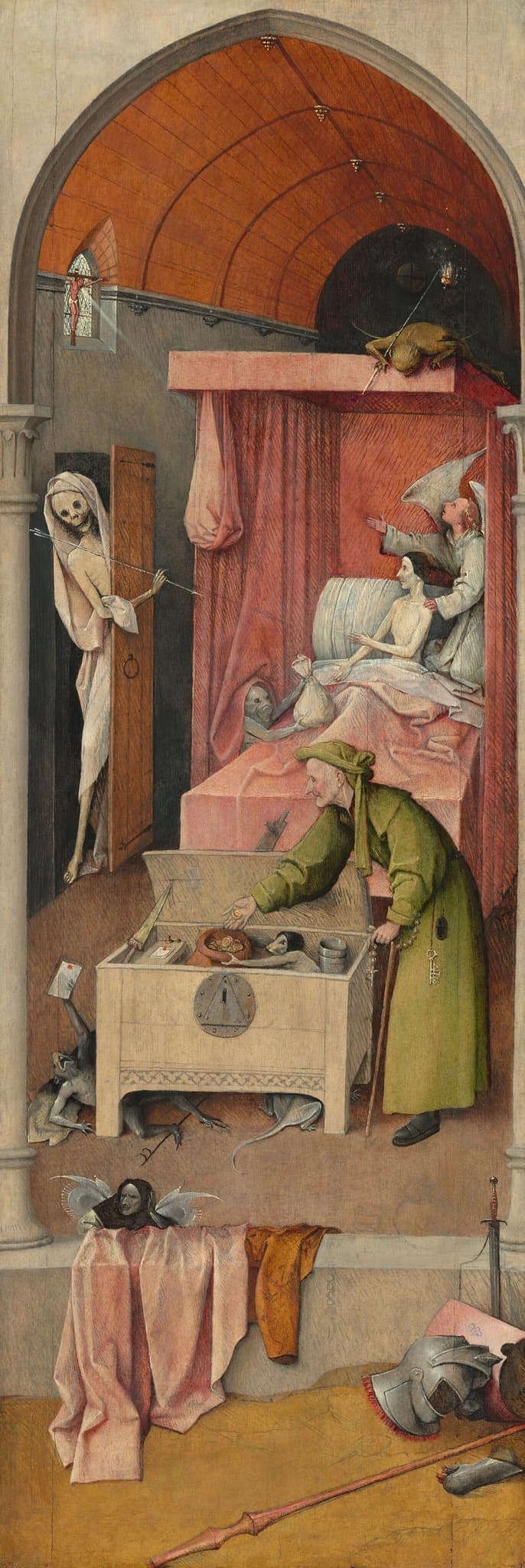
Death and the Miser (c. 1485–1490) is an accepted, autograph Hieronymus Bosch panel in the National Gallery of Art; if ever freely marketable in original condition with museum‑quality provenance, a defensible market valuation is approximately $100–200 million. This range is an extrapolation based on extreme scarcity of autograph Bosch panels, institutional demand for museum‑quality Early Netherlandish masterpieces, and observed pricing gaps between established autograph Old Masters and public sales of high‑quality followers.
Valuation Analysis
Context and provenance: Death and the Miser is an accepted autograph panel by Jheronimus (Hieronymus) Bosch in the National Gallery of Art, Washington, D.C.; it has long museum provenance and was acquired via the Samuel H. Kress Foundation, placing it in the securely documented institutional category [1]. That institutional ownership both elevates scholarly status and places practical constraints on marketability: museum‑held masterpieces are rarely offered, and if offered will attract sovereigns, major museums, and a very small set of ultra‑high‑net‑worth private collectors.
Method and rationale: Because no modern public auction exists for an uncontested autograph Bosch of this calibre, I use an extrapolation methodology that synthesizes (a) rarity and institutional demand for autograph Early Netherlandish masterpieces, (b) recent public sale evidence for Bosch followers/workshop pictures (which trade in low‑to‑mid six figures and, in exceptional follower cases, around US$1M) as a lower bound of market activity [2][3], and (c) market precedent for other top‑tier Old Masters that have moved in private or institutional transactions at high seven to nine‑figure levels. The extrapolation reflects the gap between realized public prices for followers and the prices that autograph, museum‑quality works have historically commanded when they do appear in the market.
Comparables and market signal: Recent public sales of high‑quality Bosch followers (e.g., a Lempertz follower lot that realized c. €907,000) demonstrate active buyer interest for related imagery but also illustrate the multi‑order‑of‑magnitude gap between workshop/follower market realizations and what an authenticated Bosch masterpiece would command [2]. Technical scholarship and the Bosch Research & Conservation Project have tightened attributions and reduced the number of works reliably assigned to Bosch’s autograph hand, increasing scarcity and therefore potential value for confirmed autographs [4].
Valuation range and caveats: Taking these factors together, a reasoned market valuation for Death and the Miser, were it freely sellable in unchanged condition with clear title and no legal export/heritage impediments, is approximately $100–200 million. The lower end reflects a conservative estimate given museum ownership, subject importance, and relative prominence within Bosch’s oeuvre; the upper end recognizes scarcity and competition from institutions/sovereigns but stops short of the very highest theoretical ceiling (which could exceed this band for the rarest single‑work sales). Major caveats include: the painting is essentially off‑market, sales would trigger national patrimony/export issues, and any real sale price would depend heavily on condition, recent conservation history, and the buyer universe at the time of offer.
Practical next steps: For any formal market action—insurance, deaccession consideration, or hypothetical sale—obtain full conservation records, dendrochronology and technical imaging, and a formal written opinion from an Old Masters specialist at a major auction house or a leading museum. These documents materially affect where within (or outside) the above range a final price would fall.
Key Valuation Factors
Art Historical Significance
High ImpactDeath and the Miser is thematically and stylistically central to Bosch’s moralizing oeuvre: its iconography, compositional complexity, and narrative clarity make it a work of major scholarly interest. While not as universally famous as Bosch’s largest triptychs (e.g., The Garden of Earthly Delights), it is nonetheless a securely attributed autograph panel that contributes to major research questions about Bosch’s late 15th‑century workshop practice and iconographic program. This status elevates the painting’s cultural and market value, because collectors and institutions prize works that are both autograph and pivotal to an artist’s production. Academic citation, inclusion in major catalogues, and exhibition history would further increase market desirability.
Provenance & Institutional Ownership
High ImpactThe National Gallery of Art’s documented ownership (acquisition through the Samuel H. Kress Foundation) provides robust provenance and institutional endorsement that reduce title and authenticity risk. Strong, continuous provenance typically enhances market value—but institutional ownership simultaneously makes sale unlikely and introduces legal/ethical complexities (deaccession constraints, national patrimony considerations). If the work were to be placed on the market, its museum provenance would attract institutional bidders and likely national interest, increasing competitive pressure and therefore price, but also adding layers of procedural delay and potential export restrictions.
Attribution / Authenticity Certainty
High ImpactThe valuation presumes broad scholarly acceptance of the panel as autograph Bosch. High attribution certainty (supported by published scholarship, inclusion in authoritative catalogues raisonnés, and concordant technical imaging/dendrochronology) vastly increases market value versus works attributed to workshop or follower hands. Conversely, any substantive attribution dispute would materially reduce the likely price band—moving the piece into the follower/workshop market, where realized auction prices are orders of magnitude lower. Hence, documented technical/scholarly backing is essential to justify the high valuation range.
Condition & Conservation History
Medium ImpactOriginal surface retention, stable panel support, and a documented, minimal‑intervention conservation history support the top end of valuations. Heavy overpainting, extensive losses, or unstable varnish layers reduce collectability and can lower market value substantially. For a hypothetical sale, comprehensive conservation reports, high‑resolution imaging, and records of past interventions will be scrutinized by buyers and insurers; favorable findings will be required to achieve the higher end of the $100–200M band, while serious condition issues could move value downward by tens of millions.
Market Scarcity & Demand
High ImpactThere are very few accepted autograph Bosch paintings in private hands; most canonical works are museum‑held and effectively off‑market. This scarcity concentrates demand among a tiny group of institutions and collectors able to purchase at the highest levels, which increases theoretical value. However, scarcity also limits direct comparables and creates price volatility: when a genuine autograph does appear, prices can far outstrip follower market realizations, but sales may be complicated by export controls, institutional interventions, or limited buyer eligibility.
Sale History
Death and the Miser has never been sold at public auction.
Hieronymus Bosch's Market
Hieronymus Bosch occupies an exceptional position in the Old Master market: autograph works are historically scarce and most recognized masterpieces are museum‑held, which drives a large gap between what collectors pay for Bosch autograph panels versus works by his followers. Post‑BRCP technical scholarship has tightened attributions, reducing the supply of works confidently assigned to Bosch and therefore increasing the theoretical value of confirmed autographs. Public auction activity is dominated by followers/workshop pieces (low‑to‑mid six figures, occasionally around $1M), while autograph examples—if they were to be legitimately offered—would compete at the very top of the Old Masters market.
Comparable Sales
Vision of Tondalus (follower of Jheronimus Bosch)
Follower of Hieronymus Bosch
Recent high-watermark for a follower/workshop Bosch panel; similar panel medium, fantastical/religious subject matter and sold in a major Old Masters sale — useful to gauge the upper range for high-quality follower material.
$1.0M
2025, Lempertz (Cologne) – Old Masters auction
Follower of Hieronymus Bosch (Dorotheum lot)
Follower of Hieronymus Bosch
Representative mid-market result for a follower/workshop Bosch panel at a major continental auction house; similar genre/period and panel support, helpful for mid-tier pricing.
$261K
2023, Dorotheum (Vienna) – Old Masters sale
~$277K adjusted
Follower of Hieronymus Bosch (Dorotheum lot)
Follower of Hieronymus Bosch
Another recent Dorotheum follower sale showing lower six‑figure demand for workshop/after-Bosch panels; useful to define the mid/low side of the follower market band.
$155K
2024, Dorotheum (Vienna) – Old Masters sale
~$160K adjusted
Follower of Hieronymus Bosch (Christie’s day sale panel)
Follower of Hieronymus Bosch
Example of a low-end sale for a Bosch-associated panel at a major house’s day sale; shows the base market for smaller/less-provenanced follower pieces.
$38K
2024, Christie’s (London) – Old Masters/day sale
~$39K adjusted
Current Market Trends
The Old Masters market softened in 2024 with fewer very large public sales, though institutional buying of museum‑quality pieces continues selectively. Bosch‑related public sales remain concentrated in follower/workshop lots with mid/low six‑figure results; institutional demand and scarcity of autograph works are the primary forces that would drive any sale of Death and the Miser well into the nine‑figure territory, subject to legal and conservation constraints.
Sources
- National Gallery of Art — Death and the Miser (object entry and provenance)
- Lempertz — Auction 1266 press report (follower of Bosch sale, 17 May 2025)
- Dorotheum — Follower of Hieronymus Bosch (representative realized lot pages)
- Bosch Research and Conservation Project / MIT Press — catalogue and technical studies