How Much Is The Haywain (The Haywain Triptych) Worth?
Last updated: April 29, 2026
Quick Facts
- Methodology
- comparable analysis
Hypothetically, if Museo Nacional del Prado’s The Haywain were legally available for an unrestricted private sale, a realistic market estimate is USD 150–300 million. The range is driven by the triptych’s canonical status, extreme scarcity of autograph Bosch panels, and benchmarking to trophy Old Master transactions; practical sale remains highly unlikely because of institutional ownership and national patrimony protections.
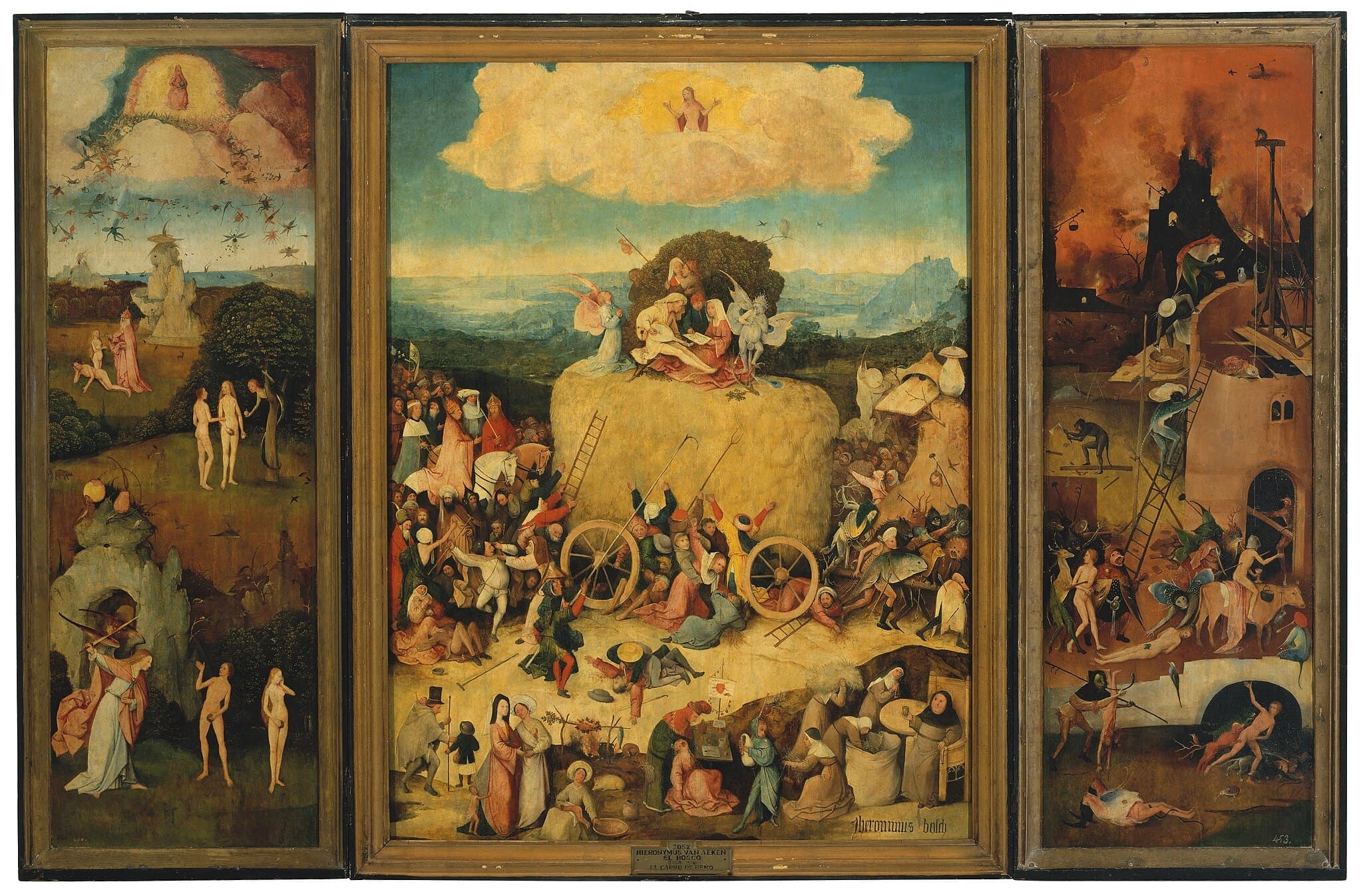
The Haywain (The Haywain Triptych)
Hieronymus Bosch, 1513 • Oil on wood
View more by Hieronymus Bosch →Valuation Analysis
Final estimate and approach: This valuation places the Prado’s Haywain Triptych in a hypothetical open‑market band of USD 150,000,000–300,000,000, derived by mapping the triptych’s cultural and market characteristics onto rare high‑end Old Master comparables and recent institutional buying behavior [1][2]. The figure is not a reflection of an actual or contemplated sale (the work is museum‑held and effectively inalienable under normal circumstances), but rather a market ceiling and floor were unrestricted, competitive bidding to occur.
Comparables and ceiling logic: Unique, securely attributed Renaissance masterpieces that have reached the market (most notably Leonardo’s Salvator Mundi, Christie’s 2017) establish an upper bound for what an exceptional, uncontested work might fetch in an unconstrained auction environment [2]. Large Rubens and other trophy Old Master sales provide additional anchors. Because Bosch autograph panels rarely, if ever, come to market, valuation here is necessarily analogical: scale, autograph certainty, and cultural resonance are up‑weighted against the limited direct-sale precedent.
Scarcity, buyer set and demand: Bosch’s autograph corpus is small and heavily museum‑dominated, so a canonical triptych would attract a tiny but intensely competitive buyer set—national museums, sovereign collections, and ultra‑high‑net‑worth collectors willing to transact at the category peak. Secondary‑market data for Bosch shows most auction activity is in prints, workshop or ‘after’ attributions and sits in the low‑to‑mid six‑figure range; that gap underscores why a canonical panel commands trophy pricing rather than market‑typical figures [3].
Legal and practical modifiers: Spanish cultural‑property protections, Prado stewardship and likely BIC status impose serious legal and political friction on any sale or export, materially lowering the real‑world probability of transfer and complicating price realization. Such constraints justify widening the estimate band: the top of the range reflects theoretical competitive bidding absent restrictions, the bottom reflects a negotiated private treaty sale constrained by export or deaccession hurdles [4].
Condition and attribution sensitivity: Final value would pivot on up‑to‑date technical dossiers—dendrochronology, IR reflectography, pigment analysis, conservation history and panel stability. Any substantive conservation risk or unresolved attribution questions would produce significant downward pressure; conversely, pristine condition and unanimous autograph attribution would support the upper end of the band.
Conclusion and recommended next steps: The USD 150–300M band captures the triptych’s theoretical auction ceiling and a pragmatic floor given legal and institutional realities. To tighten this range, obtain the Prado’s conservation/technical reports, a full provenance dossier, and confidential market appetite memos from major Old Master sales desks.
Key Valuation Factors
Art Historical Significance
High ImpactThe Haywain is among Bosch’s principal triptychs and occupies a central position in his iconography and in public and scholarly perception. Its narrative complexity, scale and the moral‑allegorical program make it a marquee work suitable for major retrospective exhibitions and catalogues raisonnés. Because cultural value and scholarly prominence often translate into a scarcity premium at the top of the market, the triptych’s undisputed place in Bosch’s oeuvre elevates its theoretical market worth above typical Old Master works. Institutional desire to retain or acquire such a canonical piece adds a non‑price dimension of value that supports trophy‑level pricing.
Market Rarity & Supply
High ImpactAuthenticated Bosch autograph paintings are extremely scarce in the market; most are held by national museums with long, public provenances. This supply constraint creates low liquidity and high scarcity premiums: when canonical works of this nature become available they attract concentrated, deep‑pocketed demand. The lack of modern-sale precedent for a Prado‑scale autograph Bosch means valuation must be extrapolated from other trophy Old Master transactions rather than direct Bosch comparables, producing a wide but defensible estimated range conditioned on rarity dynamics.
Legal & Export Restrictions
High ImpactSpanish cultural property legislation, potential BIC (Bien de Interés Cultural) status and the Prado’s stewardship create significant legal, bureaucratic and political hurdles to deaccession and export. Export permits, state pre‑emption rights and reputational considerations for institutions would materially constrain marketability and buyer turnout. Even a private treaty sale would face scrutiny and possible state intervention; these legal frictions depress transactional probability and justify discounting theoretical market ceilings into a broader, more cautious band.
Condition & Attribution Certainty
Medium ImpactHigh‑end buyers and insurers require full technical transparency—dendrochronology, infrared reflectography, X‑ray and conservation histories. Panel stability, prior restorations, varnish condition and results of technical studies can add or subtract tens of percentage points from a trophy valuation. Although Prado catalogue entries support the Haywain’s autograph attribution, any residual scholarly dispute or significant conservation risk would materially reduce price certainty. A purchaser would thus insist on complete, insurance‑grade condition and attribution documentation.
Buyer Pool & Demand
High ImpactThe likely buyer set for a canonical Bosch triptych is narrow but well funded: major museums, wealthy private collectors, foundations and states. Institutional bidders often dominate trophy Old Master acquisitions because of exhibition, scholarship and public‑interest motivations. Competitive bidding among a small group of such buyers can propel prices into the upper Old Master tier, but that outcome depends on unfettered international saleability—if legal or reputational constraints limit bidders, realized prices fall toward the lower end of the estimate band.
Sale History
The Haywain (The Haywain Triptych) has never been sold at public auction.
Hieronymus Bosch's Market
Hieronymus Bosch is a singular figure in Early Netherlandish painting whose autograph corpus is small and predominantly museum‑held. As a market entity, Bosch lacks frequent sale activity; most auction lots are prints, workshop or 'after' attributions that fetch low‑to‑mid six‑figure sums. When high‑quality studio pieces or rediscoveries surface, they can reach low millions and attract institutional interest. True autograph Bosch masterpieces almost never appear on the open market, so price discovery is limited and valuations for canonical panels must be extrapolated from top Old Master comparables and institutional buying behavior.
Comparable Sales
Salvator Mundi
Leonardo da Vinci
Unique, securely attributed Renaissance masterwork that establishes an upper‑market ceiling for a singular, museum‑grade autograph painting.
$450.3M
2017, Christie's, New York
~$598.9M adjusted
The Massacre of the Innocents
Peter Paul Rubens
Major Old Master monumental canvas realized at public auction; useful comparator for large‑scale Old Master demand and what a trophy historic painting may fetch.
$76.7M
2002, Sotheby's, London
~$139.0M adjusted
Madonna of the Cherries
Quentin Metsys
Rediscovered Northern Renaissance work bought by a major museum; illustrates institutional willingness to pay multi‑million prices for high‑quality rediscoveries in this period.
$13.5M
2024, Christie's, London (acquired by J. Paul Getty Museum)
~$13.8M adjusted
Anonymous early 16th‑century Northern Renaissance altarpiece (reported National Gallery purchase)
Anonymous (early 16th‑century Northern Renaissance)
Recent institutional private purchase (~£16.42M) showing museum competition and price levels for high‑quality Northern Renaissance altarpieces in 2024–25.
$20.4M
2025, National Gallery, London (private treaty)
Vision of Tondalus (follower of Hieronymus Bosch)
Follower of Hieronymus Bosch
High‑quality follower/studio piece realizing low‑seven‑figure result; shows the persistent valuation gap between autograph masterpieces and studio/follower works.
$1.0M
2025, Kunsthaus Lempertz
Saint Christopher Carrying the Christ Child (follower of Hieronymus Bosch)
Follower of Hieronymus Bosch
Example of a small‑format follower lot selling in the low six‑figures; underscores typical auction realizations for non‑autograph 'Bosch' works.
$262K
2023, Dorotheum
~$280K adjusted
Current Market Trends
The Old Masters and Northern Renaissance market contracted in 2024 and showed a selective rebound in 2025 driven by museum purchases and rediscoveries. Institutional buyers (museums, foundations) are the principal drivers of high‑end demand; collectors prioritize provenance, scholarship and technical certainty. Supply remains constrained, especially for canonical Bosch works, so when a genuine trophy appears it will be contested but only among a narrow pool. Current conditions favor well‑documented, museum‑grade works while general market liquidity stays limited.