How Much Is The Seven Deadly Sins and the Four Last Things Worth?
Last updated: April 29, 2026
Quick Facts
- Methodology
- comparable analysis
Conditional on a firm, expert attribution as an autograph Hieronymus Bosch, in good condition and legally saleable, the Prado tondo would realistically command approximately $100–150 million on the open market. If the work is deemed a workshop piece, follower or heavily restored, market value would fall into the low single‑ to low double‑digit millions.
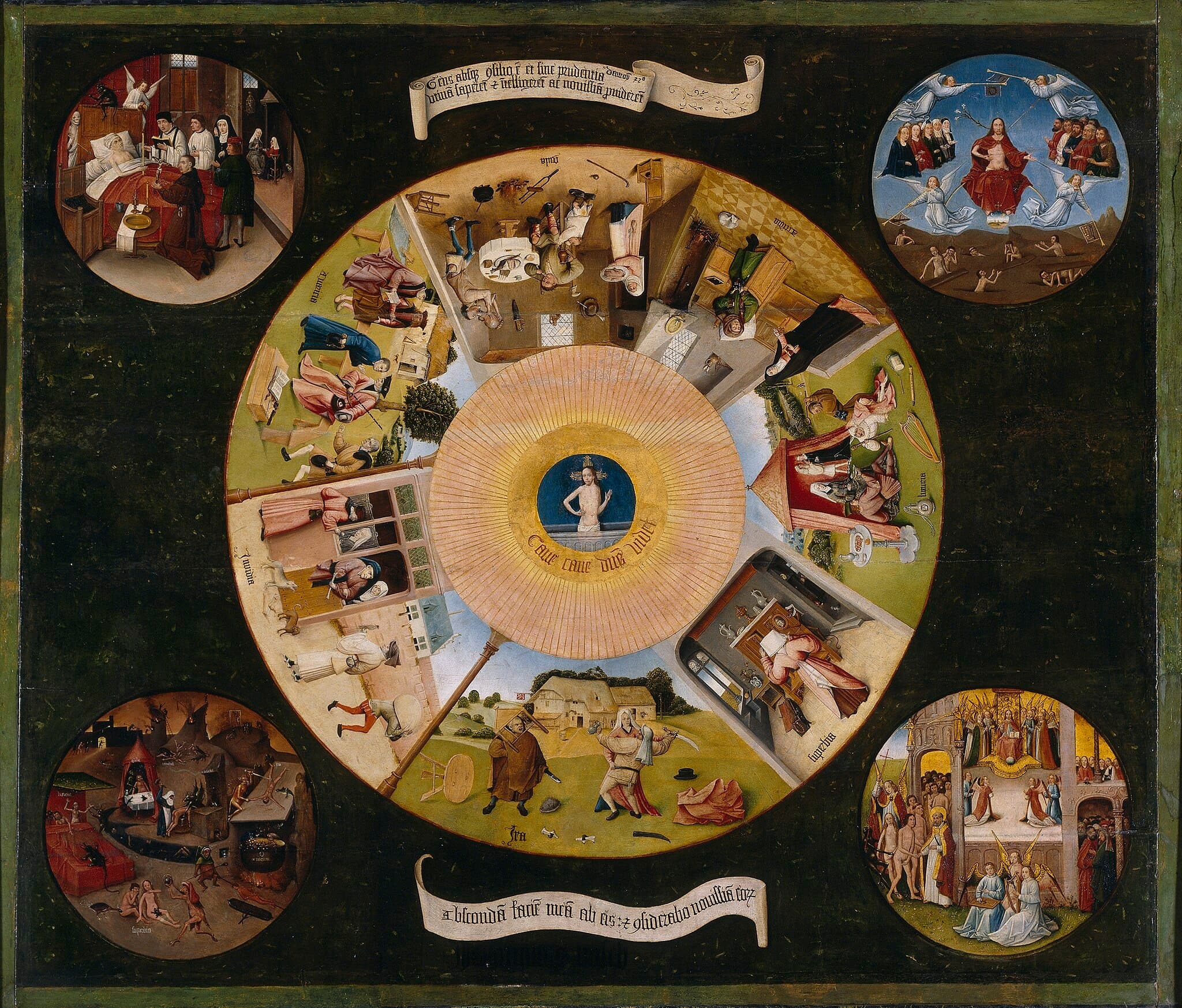
The Seven Deadly Sins and the Four Last Things
Hieronymus Bosch, 1515 • Oil on wood
View more by Hieronymus Bosch →Valuation Analysis
Bottom line. If this tondo is accepted as an autograph Hieronymus Bosch, is in sound condition, and can be offered without legal or export restrictions, a conservative market estimate is $100–150 million. That range reflects the near‑unique scarcity of securely attributed Bosch easel paintings, demonstrable museum and institutional demand, and extrapolation from the highest recent Early Netherlandish/museum‑quality comparables. The object is traditionally catalogued as part of the Museo Nacional del Prado collection and its long royal provenance amplifies its cultural weight while complicating saleability [1].
Why this range. Autograph Bosches almost never appear on the open market; modern public sale data is therefore thin. The market anchor for a universally accepted Renaissance masterpiece is the extraordinary Leonardo Salvator Mundi result, but that is a unique outlier and not a close analogue. More practical anchors are (a) institutional purchases of securely attributed Early Netherlandish panels (mid‑eight‑figure transactions) and (b) major‑house results for high‑quality workshop/follower Bosches (high six‑figures to low millions). A securely authenticated, museum‑quality Bosch would sit well above recent institutional purchases for rediscovered Flemish panels because of Bosch’s singular iconography and collector urgency.
Key risks that widen the band. Attribution uncertainty is paramount: the Bosch Research & Conservation Project and subsequent scholarship have reassessed, and in some cases reclassified, several paintings once accepted as autograph — a shift that can reduce value from nine‑figure to single‑figure millions or less [2]. Condition, conservation history, dendrochronology, infrared reflectography and pigment/binder analysis will materially affect market confidence and value. Finally, provenance and national patrimony law (museum ownership, export controls) may make the work effectively unsaleable in practice even if a notional market price can be stated.
How the sale would likely occur. Were the panel saleable, the transaction would almost certainly take place by private treaty to a major museum or a blue‑chip private buyer after an extensive technical and provenance dossier is compiled and vetted. Public auction is unlikely to realize top value for such a high‑profile, sensitive object because institutions typically compete privately to avoid political backlash and to control exhibition/loan terms.
Conclusion. The $100–150 million range is a reasoned, conditional valuation based on comparable institutional purchases, the premium for extreme rarity and the known market behavior for top Old Masters; it assumes autograph attribution, robust technical backing, and legal saleability. If any of those conditions fail, the price falls sharply and predictably.
Key Valuation Factors
Art Historical Significance
High ImpactThe Seven Deadly Sins and the Four Last Things is a canonical Bosch composition that encapsulates his moralizing iconography and didactic program. It is widely reproduced in Bosch scholarship and sits among the artist’s recognized important panels, though it is not as universally iconic as The Garden of Earthly Delights. That stature translates into outsized institutional interest: museums and top collectors prize works that are both didactically complete and representative of an artist’s defining themes. Because authenticity would confer not just aesthetic but scholarly importance, the market attaches a significant premium to securely attributed, well‑provenanced examples; this premium is the primary reason a confirmed autograph Bosch would command a nine‑figure price.
Attribution Certainty
High ImpactAttribution is the single most decisive factor. The Bosch Research and Conservation Project and subsequent scholarship have revised attributions and clarified workshop involvement for a number of panels, demonstrating how technical findings can overturn long‑standing cataloguing [2]. A unanimous, contemporary scholarly consensus supported by dendrochronology, infrared reflectography and pigment/binder analysis is required to justify a nine‑figure valuation. If these studies indicate significant workshop or later studio intervention, the object’s market classification would shift to follower/workshop, with commensurate value reduction into the millions rather than the tens or hundreds of millions.
Condition & Technical Findings
Medium ImpactPanel condition, extent of original paint, conservation history and structural stability materially affect marketability and price. Losses, heavy overpainting, or unresolved restoration issues reduce competitive bidding among institutional buyers and lower insurance appetite. Conversely, a clean technical report — stable original paint layer, consistent dendrochronology and diagnostic underdrawing — increases buyer confidence and supports the upper end of the estimate. Detailed technical documentation is therefore a gating requirement before any high‑value negotiation or public offering can proceed.
Provenance & Legal Status
High ImpactLong royal/museum provenance increases cultural value but may simultaneously make the work effectively unsaleable. If the panel is held by a national museum (as public records indicate for the Prado), export controls, national patrimony laws and political resistance to deaccession make market transactions unlikely. Even where sale is legally possible, works with state or crown provenance attract intense public scrutiny, which suppresses liquidity and channels any transfer toward negotiated inter‑institutional transactions rather than open auction — a dynamic that tends to preserve cultural ownership but complicates market realization.
Market Demand & Comparables
High ImpactDemand for securely attributed Early Netherlandish masterpieces remains strong among museums and a narrow set of private collectors. Recent institutional purchases of rediscovered period panels (mid‑eight‑figure acquisitions) and high‑end follower sales (high six‑figures to low millions) define the market context. A confirmed autograph Bosch would attract top institutional attention and private buyers able to transact at the highest levels; absent that confirmation, comparables show a steep drop to the hundreds of thousands or low millions. Supply scarcity is a major driver of the premium assigned to securely attributed works.
Sale History
The Seven Deadly Sins and the Four Last Things has never been sold at public auction.
Hieronymus Bosch's Market
Hieronymus Bosch occupies a singular place in the Early Netherlandish market: canonical and culturally prominent, yet with very few securely attributed easel paintings in private hands. That scarcity elevates demand from museums and elite collectors when a panel is convincingly attributed. The 2016 Bosch Research and Conservation Project reshaped attribution standards and increased due diligence; since then, autograph works rarely, if ever, trade publicly. Consequently, Bosch’s market is characterized by high premiums for unquestioned works, a narrow buyer pool, and frequent reliance on private treaty or institutional transfers rather than auctions.
Comparable Sales
Salvator Mundi
Leonardo da Vinci
Market-ceiling anchor: record public-auction price for a rediscovered Renaissance masterpiece; useful only as an upper-bound for what a universally accepted autograph masterpiece could fetch.
$450.3M
2017, Christie's New York
~$540.4M adjusted
The Temptation of Saint Anthony (follower)
Follower of Hieronymus Bosch
Top-end follower/workshop sale at a major house; shows the high-six-figure range buyers will pay for quality Bosch-like workshop pieces.
$850K
2016, Sotheby's (Master Paintings sale, Jan 2016)
~$1.0M adjusted
Follower of Bosch (lot sold at Sotheby's London, lot 6)
Follower of Hieronymus Bosch
Major-house sale (July 2014) of a Bosch-attributed/follower work that realized roughly US$0.7M — another benchmark for high-quality follower material.
$723K
2014, Sotheby's London
~$925K adjusted
The Harrowing of Hell (Circle of Hieronymus Bosch)
Circle of Hieronymus Bosch
Recent 2025 major-house sale of a 'circle of' Bosch work (mid-six-figure); demonstrates where circle-level works trade in the current market.
$225K
2025, Christie's Old Masters Evening Sale (July 2025)
Christ in Limbo (attributed / Bosch-related, Koller sale cited by MutualArt)
Attributed to Bosch / Bosch school
Historical public-auction example often cited as a relatively high figure for problematically attributed Bosch panels (illustrates modest public-market results where attribution is uncertain).
$213K
2013, Koller (auction cited 2013)
~$277K adjusted
Madonna of the Cherries
Quentin Metsys (Flemish / Early Netherlandish)
Institutional acquisition of a rediscovered Early Netherlandish panel for mid-eight-figures — useful as a museum-level anchor showing institutions will pay multiples of millions for securely-attributed period panels.
$13.5M
2024, Christie's London / acquired by The J. Paul Getty Museum (July 2024)
~$13.9M adjusted
Current Market Trends
The Old Masters segment is supply‑constrained and specialist‑driven. After a weak 2024, selective recovery in 2025 saw museums and institutions reengaging for high‑quality, well‑documented works. Collectors now demand rigorous technical dossiers and secure provenance; top‑tier transactions increasingly occur privately. For Bosch and his circle, attribution clarity and institutional interest remain the dominant determinants of price.
Sources
- Museo Nacional del Prado — Collection entry, "Table of the Seven Deadly Sins"
- Hieronymus Bosch: Painter and Draughtsman — Yale University Press / Bosch Research & Conservation Project (catalogue raisonné and technical studies)
- Christie's — Discussion of Salvator Mundi sale (market ceiling context)
- The J. Paul Getty Museum — Press release on acquisition of rediscovered Quentin Metsys (institutional comparables)
- Observer — Market analysis and Old Masters trend commentary (2024–2025)