How Much Is Fine Wind, Clear Morning (South Wind, Clear Sky) — 'Red Fuji' Worth?
Last updated: May 1, 2026
Quick Facts
- Last Sale
- $479K (2024, Christie's Online — 'Landscapes of Japan: Woodblock Prints from Edo to Post‑War')
- Methodology
- comparable analysis
For a genuine early (c.1830–31) Nishiki-e first impression of Hokusai’s Fine Wind, Clear Morning ('Red Fuji') in excellent condition (wide margins, vivid original beni red, publisher/censor seals, strong provenance), the market value is estimated at $300,000–$600,000. The range is derived from recent Christie’s auction realizations and institutional comparables; final placement depends critically on impression/state, pigment originality and condition.
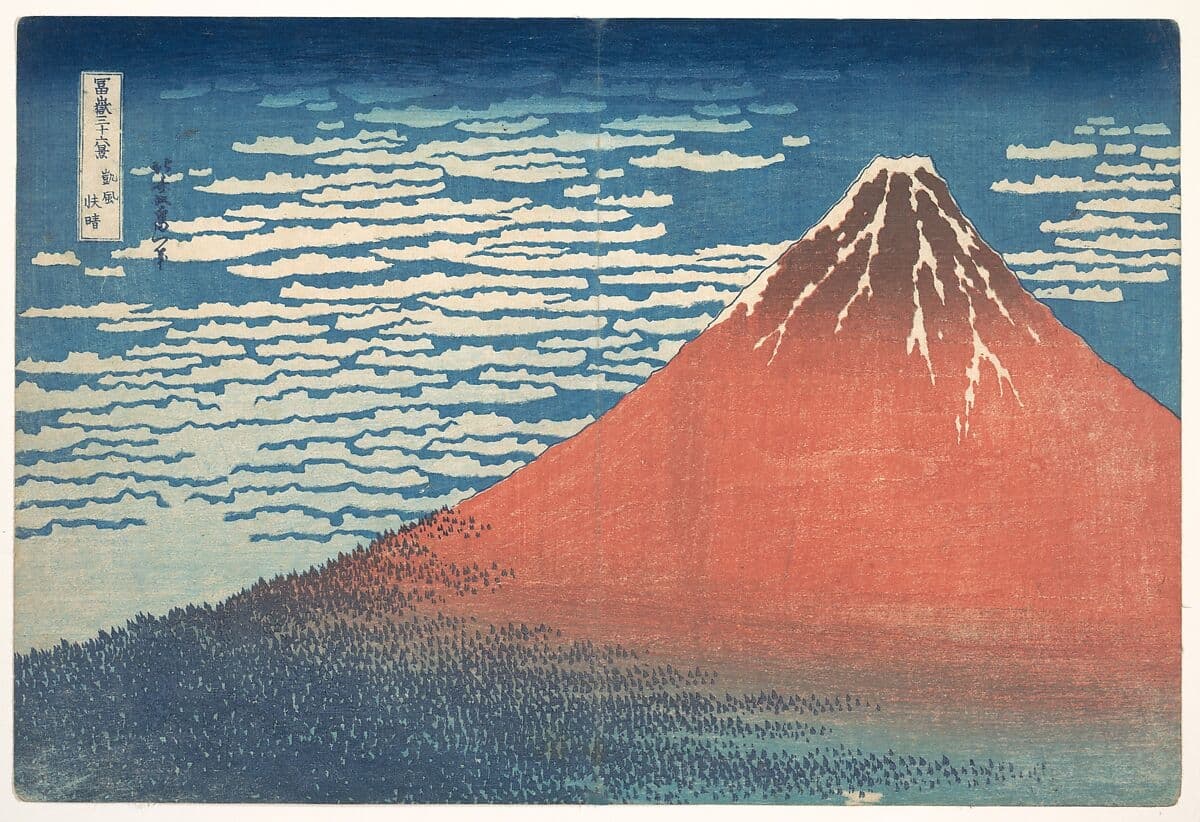
Fine Wind, Clear Morning (South Wind, Clear Sky) — 'Red Fuji'
Hokusai • Nishiki-e woodblock print
View more by Hokusai →Valuation Analysis
Valuation conclusion: For a genuine early (c.1830–31) Nishiki-e first impression of Katsushika Hokusai’s Fine Wind, Clear Morning (commonly called 'Red Fuji') in excellent condition — intact wide margins, original vivid beni (red) on the slope, visible publisher and censor seals, and solid provenance — I place the likely market range at $300,000–$600,000. This estimate assumes the sheet is an early impression printed close to publication and has not been heavily restored.
The methodology used is a comparative analysis of recent, realized auction results for this design and closely related Hokusai iconic prints, adjusted for the single-sheet’s specific attributes: impression/state, pigment fidelity, margins, condition and provenance. Major recent Christie’s results for Gaifū kaisei form the primary anchors for the range; the cluster of mid-five-figure to low-six-figure realizations demonstrates a stable market band for sale-ready impressions and a clear premium for exceptional examples[1].
Impression/state and pigment are the dominant value drivers. First and very early impressions — printed when the series was first issued — show crisper carving, better registration and a more saturated, even beni red on Fuji’s flank. Later reprints, recuts or Meiji‑era impressions often show weaker keying and diluted color; such sheets generally trade at a substantial discount. Authentication that the red pigment is original (not later inpainting) is essential to supporting placement at the top of the estimate range.
Condition considerations follow closely. Full, untrimmed margins, absence of stains, no significant foxing, minimal repairs and an unwashed paper tone are necessary for upper‑range value. Trimming to the printed border, significant inpainting on the red slope, heavy foxing, paper losses or visible repairs can reduce the value dramatically — often by multiples depending on severity. A short conservator condition report (verso imaging, fiber analysis if necessary) should be obtained before offering.
Provenance, exhibition and publication history also materially affect price. Gaifū kaisei is widely held in major public collections (British Museum, The Met, MFA Boston and others), which both underscores the work’s importance and limits the frequency of top-quality sheets appearing on the market — driving competitive bidding when a museum-quality impression is offered[2].
Recommended next steps: supply high‑resolution recto/verso images showing margins, publisher/censor/collector seals, and details of the red slope; commission a brief conservator condition report; and consult a major auction house’s Japanese prints specialist for pre‑sale guidance or private‑sale options. With that documentation the estimate can be tightened and a sale strategy determined (public auction vs. private placement).
Key Valuation Factors
Art Historical Significance
High ImpactHokusai's Gaifū kaisei (Fine Wind, Clear Morning, 'Red Fuji') is a signature image from the landmark Thirty-Six Views of Mount Fuji series and ranks among the artist's most culturally resonant and publicly recognized prints. Its prominence ensures perennial institutional interest and scholarly attention; holdings in major museums worldwide affirm its status in the canon of Edo-period ukiyo-e. Because the design is both iconic and widely published, a superior single-sheet impression that combines rarity of condition with documented provenance gains additional prestige and demand from collectors and institutions seeking representative examples for exhibition or research.
Impression/Edition & Pigment
High ImpactThe single most important technical factor is whether the sheet is a first/early impression versus a later reprint or recut. Early impressions display crisp carving, precise registration and a characteristic, saturated beni red on the Fuji slope; these qualities are both visually and materially verifiable and command substantial premiums. Later impressions typically show weaker keying and less vibrant pigment. Authentication of pigment originality (absence of later inpainting or retouch) and identification of publisher and censor seals to confirm print date are essential to justifying upper-range market values.
Condition & Conservation
High ImpactCondition drives price after impression/state. Full, untrimmed margins, even paper tone with minimal foxing, absence of tears or major repairs, and no conspicuous inpainting are prerequisites for top-level value. Trimming to the plate edge, widespread foxing, paper losses or invasive restoration can reduce market price by large percentages; some restorations (invisible mends, discreet backing) may be acceptable but still lower value. A concise conservator report and verso imaging will materially reduce buyer uncertainty and can preserve value at sale.
Provenance & Documentation
High ImpactClear, documented provenance (especially museum or respected private collections) and evidence of publication or exhibition history meaningfully increase buyer confidence and can push a sale toward the upper estimate. Sheets with documented descent, catalogue citations, or inclusion in scholarly literature are more attractive to institutions and blue‑chip private collectors. Conversely, lack of provenance or gaps that raise questions about past restorations or authenticity will suppress competitive bidding and reduce realized prices.
Sale History
Christie's New York
Christie's New York
Christie's Online — Landscapes of Japan: Woodblock Prints from Edo to Post‑War
Hokusai's Market
Katsushika Hokusai is the most marketable of Edo-period ukiyo-e masters; his iconic plates (notably The Great Wave and Red Fuji) are continuously sought by institutions and collectors. While woodblock prints do not reach the absolute price levels of top-tier Western paintings, Hokusai’s best early impressions trade strongly — mid-five to low-six figures at major houses is a well‑established band for high-quality, early impressions. The highest auction records for Hokusai are set by exceptional Great Wave examples, and those results have reinforced demand and price expectations for other benchmark plates from the Thirty-Six Views series.
Comparable Sales
Gaifū kaisei (Fine Wind, Clear Morning) — 'Red Fuji'
Katsushika Hokusai
Identical work ('Red Fuji') sold at a major house; represents an upper-market result for a market-ready, desirable impression.
$507K
2019, Christie's New York
~$636K adjusted
Gaifū kaisei (Fine Wind, Clear Morning) — 'Red Fuji'
Katsushika Hokusai
Same title sold later for substantially less — useful as a mid-market comparable that likely reflects differences in impression/state, color intensity or provenance.
$338K
2020, Christie's New York
~$418K adjusted
Gaifū kaisei (Fine Wind, Clear Morning) — 'Red Fuji'
Katsushika Hokusai
Recent online Christie's sale showing sustained demand and pricing in the mid-to-upper five-figure / low six-figure band for sale-ready impressions.
$479K
2024, Christie's Online — 'Landscapes of Japan: Woodblock Prints from Edo to Post‑War'
~$491K adjusted
Current Market Trends
Current market activity for top-class Japanese prints remains robust: selective online and live auctions by major houses have produced consistent mid-five to low-six-figure results for Hokusai’s best impressions. Collectors and institutions remain active, but realized prices vary with impression/state, condition and provenance; primary-market scarcity of museum‑quality single sheets keeps competition high when strong examples surface.
Sources
- Christie's — Asian Art Week / notable sale results including Gaifū kaisei
- The British Museum collection entry for Gaifū kaisei (Fine Wind, Clear Morning / 'Red Fuji')
- Christie's — Results: Asia Week September 2020 (sale PDF summary)
- Coverage of Christie's Online 'Landscapes of Japan' sale (March 2024) including Hokusai results