How Much Is Fine Wind, Clear Weather (Red Fuji) Worth?
Last updated: July 5, 2026
Quick Facts
- Last Sale
- $733K (2025, Sotheby's Hong Kong)
- Insurance Value
- $800K (Replacement value based on top-tier recent auction results (Sotheby’s HK 2025) and current dealer asking levels)
- Methodology
- comparable analysis
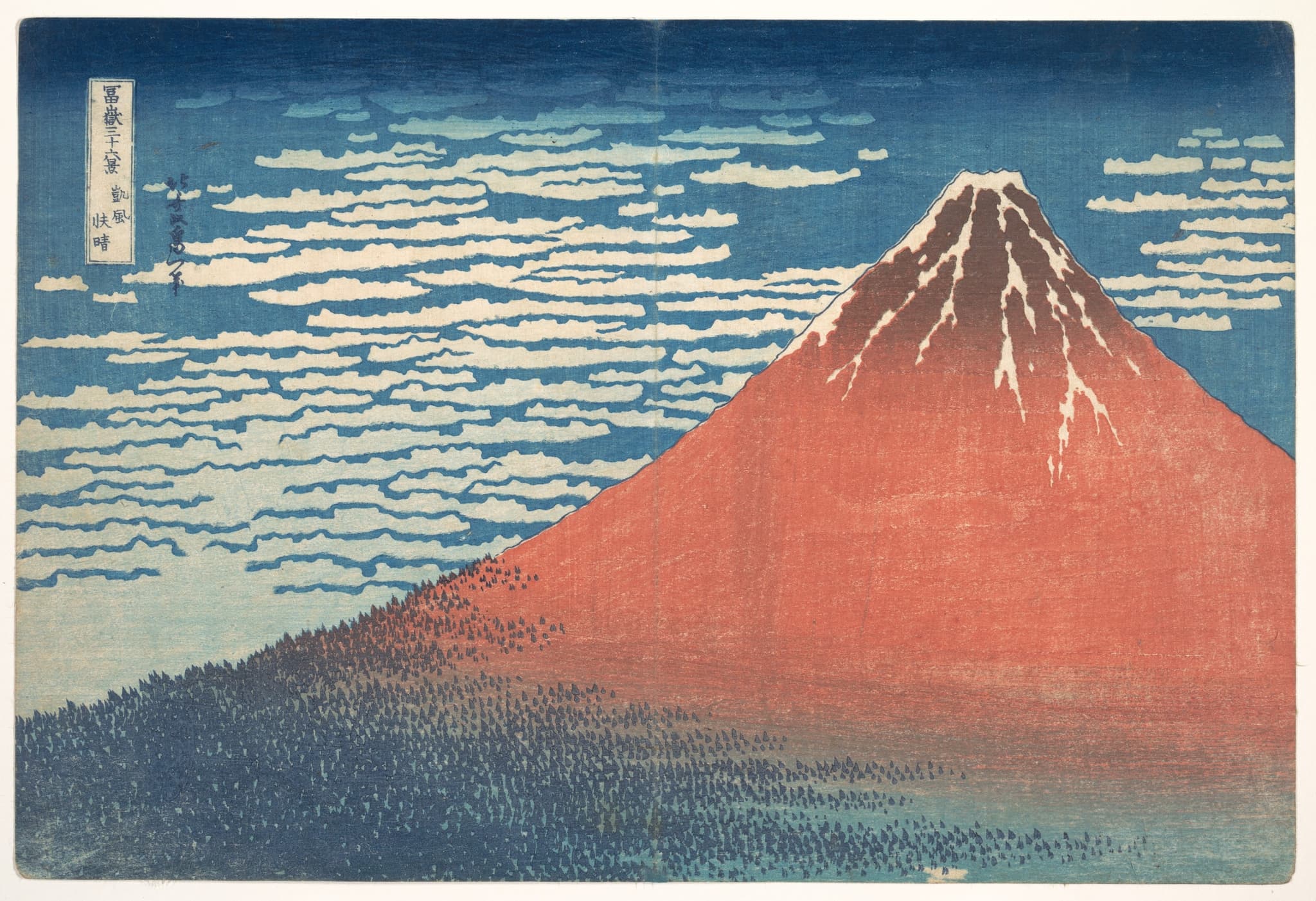
For an authentic Edo-period impression of Hokusai’s Fine Wind, Clear Weather (Red Fuji) in good-to-very-good color and condition, the current market supports $300,000–$650,000. Exceptional early-state, vividly colored impressions with ample margins and strong provenance can command $600,000–$900,000 and, in prime circumstances, stretch toward $1,000,000.
Valuation Analysis
Estimate: $300,000–$650,000 for an authentic Edo-period impression in good-to-very-good color and condition. This conclusion is anchored in recent, directly comparable public sales of the same design and reflects today’s depth of demand for high-quality Hokusai impressions.
Comparable sales. A top-tier early impression from the Okada Museum realized HK$5,715,000 (≈$733,000 with premium) at Sotheby’s Hong Kong on November 22, 2025, setting a strong recent benchmark for best-in-class sheets [1]. Mid–upper six-figure outcomes for solid early impressions are well established, including $507,000 at Christie’s New York (Mar 19, 2019) and $478,800 via Christie’s Online (Mar 26, 2024) [3][4]. These results bracket the prevailing range for attractive, original Edo impressions and inform the center of our estimate.
Key drivers of value. Price dispersion is primarily explained by impression quality, state, and condition. Early states (including so-called “Pink Fuji” variants) with fresh pigments, crisp keyblock lines, and delicate bokashi gradations in the sky carry meaningful premiums; later pulls with block wear, fading (especially reds and Prussian blue), trimming, or repairs trade materially lower. Technical scholarship and museum guidance emphasize how differences in printing sequence and pigment application affect both aesthetics and market value [5]. Where present, full or ample margins and blue-chip provenance (e.g., museum deaccessions, published/exhibited examples) further enhance liquidity and price realization.
Market positioning. Hokusai remains a blue‑chip name with robust global demand. Recent headline results—the $3.559 million record for a complete Thirty‑six Views set (Christie’s, Mar 19, 2024) and repeated multi‑million outcomes for The Great Wave, including a record-setting sale in Hong Kong in 2025—underscore the artist’s depth and international reach [2][1]. Within this context, Red Fuji sits just below The Great Wave in price potential yet consistently attracts competitive bidding. Taken together, these comparables and category dynamics support a confident $300,000–$650,000 estimate for a market-ready Edo impression, with museum-grade early states realistically commanding $600,000–$900,000 and stretch potential toward $1,000,000 in a prime venue.
Key Valuation Factors
Art Historical Significance
High ImpactFine Wind, Clear Weather (Red Fuji) is one of Hokusai’s two most iconic designs, a pillar of the Thirty-six Views of Mount Fuji and a touchstone of global printmaking. Its synthesis of radical composition, atmospheric color transitions, and Mount Fuji’s cultural symbolism has secured enduring museum and collector demand. The image’s ubiquity in scholarly literature and exhibitions ensures a wide buyer base well beyond specialist ukiyo‑e circles. This stature provides price resilience across cycles and supports a premium relative to most other Japanese prints. Among single-sheet Hokusai works, only The Great Wave consistently outperforms it, placing Red Fuji squarely in the top echelon of the artist’s market.
Impression Quality and State
High ImpactEarly-state impressions with crisp keyblock lines, strong bokashi in the sky, and fresh pigments (notably the red slopes and Prussian blue) command substantial premiums. Variants often termed “Pink Fuji,” with subtler gradations and more delicate color transitions, signal earlier and more desirable printings. Later pulls may show block wear, weaker cloud/sky gradation, and slightly coarser outlines. These technical differences are visible even to non-specialists and directly correlate with pricing tiers: the best early Edo impressions achieve the high six to low seven figures, while later or dull-color examples sell markedly lower. Accurate state identification is thus essential to valuation.
Condition and Margins
High ImpactColor freshness and structural integrity are critical for Edo prints. Fading of reds and blues, surface soiling, foxing, paper thinning, wormholes, restoration overpaint, and trimming into the image or narrow margins can each reduce value materially. For Red Fuji, strong, even red across the slope, intact sky gradation, and ample margins materially enhance desirability. Conversely, compromised sheets—especially those with significant trimming or disfiguring repairs—can fall multiple pricing tiers. Collectors also prize clean versos and minimal backing. Condition is often decisive when two impressions are otherwise comparable in state, and it explains much of the observed price dispersion at auction.
Provenance, Publication, and Marketability
Medium ImpactPrestigious provenance and a documented exhibition or publication history add liquidity and pricing power. The 2025 Sotheby’s Hong Kong example linked to the Okada Museum achieved a market-leading outcome, reflecting buyer confidence in a vetted, blue-chip source. Catalog citations, inclusion in notable shows, and appearance in authoritative literature all broaden the buyer pool, especially among institutions and top private collectors. By contrast, works with uncertain histories or extensive later interventions can experience buyer resistance, slower absorption, and softer pricing. In a globally competitive category with many surviving impressions, the right provenance can be the tiebreaker that lifts a good sheet into a superior result.
Sale History
Sotheby's Hong Kong
Price with premium; very fine early impression; Okada Museum provenance
Christie's Online (New York)
Price with premium; strong color for Edo impression
Christie's New York
Price with premium; top lot of the sale
Sotheby's London
Price with premium; catalogued as an early impression
Christie's New York
Price with premium; representative mid-tier outcome
Christie's Hong Kong
Price with premium; likely later/average impression or with condition issues
Hokusai's Market
Hokusai is a blue‑chip cornerstone of Japanese art with sustained global demand. His auction record currently stands at $3.559 million for a complete Thirty‑six Views of Mount Fuji set (Christie’s New York, March 19, 2024), underscoring institutional and top‑tier private appetite for museum-caliber ensembles [2]. Single‑sheet records are dominated by Under the Wave off Kanagawa (The Great Wave), which has achieved multiple seven‑figure prices, including a record in Hong Kong in 2025 [1]. Depth of bidding spans regions and age groups, and recent sales demonstrate healthy participation online as well as in live rooms. Within this landscape, Red Fuji consistently ranks just below The Great Wave, benefiting from the artist’s strong brand, cross‑category appeal, and robust repatriation-driven interest in Asia.
Comparable Sales
Fine Wind, Clear Weather (Red Fuji)
Katsushika Hokusai
Exact work, Edo-period woodblock from Thirty-six Views; very fine impression with blue-chip Okada Museum provenance—an ideal top-tier benchmark.
$733K
2025, Sotheby's Hong Kong
Fine Wind, Clear Weather (Red Fuji)
Katsushika Hokusai
Exact work; strong online result indicating depth of demand for good Edo impressions even outside a live saleroom.
$479K
2024, Christie's Online (New York)
~$493K adjusted
Fine Wind, Clear Weather (Red Fuji)
Katsushika Hokusai
Exact work; major U.S. live-auction benchmark and top lot of the sale, reflecting strong competition for quality impressions.
$507K
2019, Christie's New York
~$644K adjusted
Fine Wind, Clear Weather (Red Fuji)
Katsushika Hokusai
Exact work; cited by Sotheby’s as an early impression—useful mid–upper benchmark for better-than-typical state/colour.
$425K
2022, Sotheby's London
~$468K adjusted
Fine Wind, Clear Weather (Red Fuji)
Katsushika Hokusai
Exact work; representative mid-tier outcome for solid Edo impression with typical condition/colour variance.
$250K
2021, Christie's New York
~$293K adjusted
Fine Wind, Clear Weather (Red Fuji)
Katsushika Hokusai
Exact work; Asia sale showing market support for later/compromised or average impressions at the lower end of the original Edo range.
$224K
2018, Christie's Hong Kong
~$290K adjusted
Current Market Trends
The ukiyo‑e market remains bifurcated: masterpieces and early, high‑quality impressions command strong competition and often outperform estimates, while mid‑tier material is steadier. For Hokusai specifically, momentum from headline sales and exhibitions has reinforced demand at the top end. Online channels now reliably deliver mid‑six‑figure outcomes for important prints, expanding access and bidder depth. Across 2024–2026, broader auction conditions favored prints and multiples due to accessible entry points and global participation, while Asia’s strength—evident in record Japanese art sales—has added a powerful demand node. Against this backdrop, well‑preserved Red Fuji impressions are liquid and price‑stable, with exceptional examples capable of achieving step‑change premiums.
Sources
- Sotheby’s 2025 Asian Art Year in Review (includes Red Fuji HK$5.715m and Great Wave record)
- Christie’s Press Release: Complete Thirty‑six Views of Mount Fuji sets artist record ($3,559,000), Mar 19, 2024
- Christie’s Press (post‑sale coverage citing Red Fuji $507,000, Mar 19, 2019)
- The Art Newspaper: Asia Week New York 2024 sales recap (includes Red Fuji $478,800 online result)
- Heritage Science (Nature): Technical study on Hokusai print states/colourants and impression differences