How Much Is Kajikazawa in Kai Province (The Fisherman at Kajikazawa) Worth?
Last updated: May 1, 2026
Quick Facts
- Last Sale
- $3K (2022, Heritage Auctions (Fine & Decorative Asian Art))
- Methodology
- comparable analysis
I estimate an original Edo‑period woodblock impression of Hokusai’s Kajikazawa in Kai Province (The Fisherman at Kajikazawa) to be worth approximately $3,000–$75,000. This range is derived from auction comparables, museum reference impressions, and observed market behavior; the final price hinges on impression/state, condition, seals/margins, and provenance.
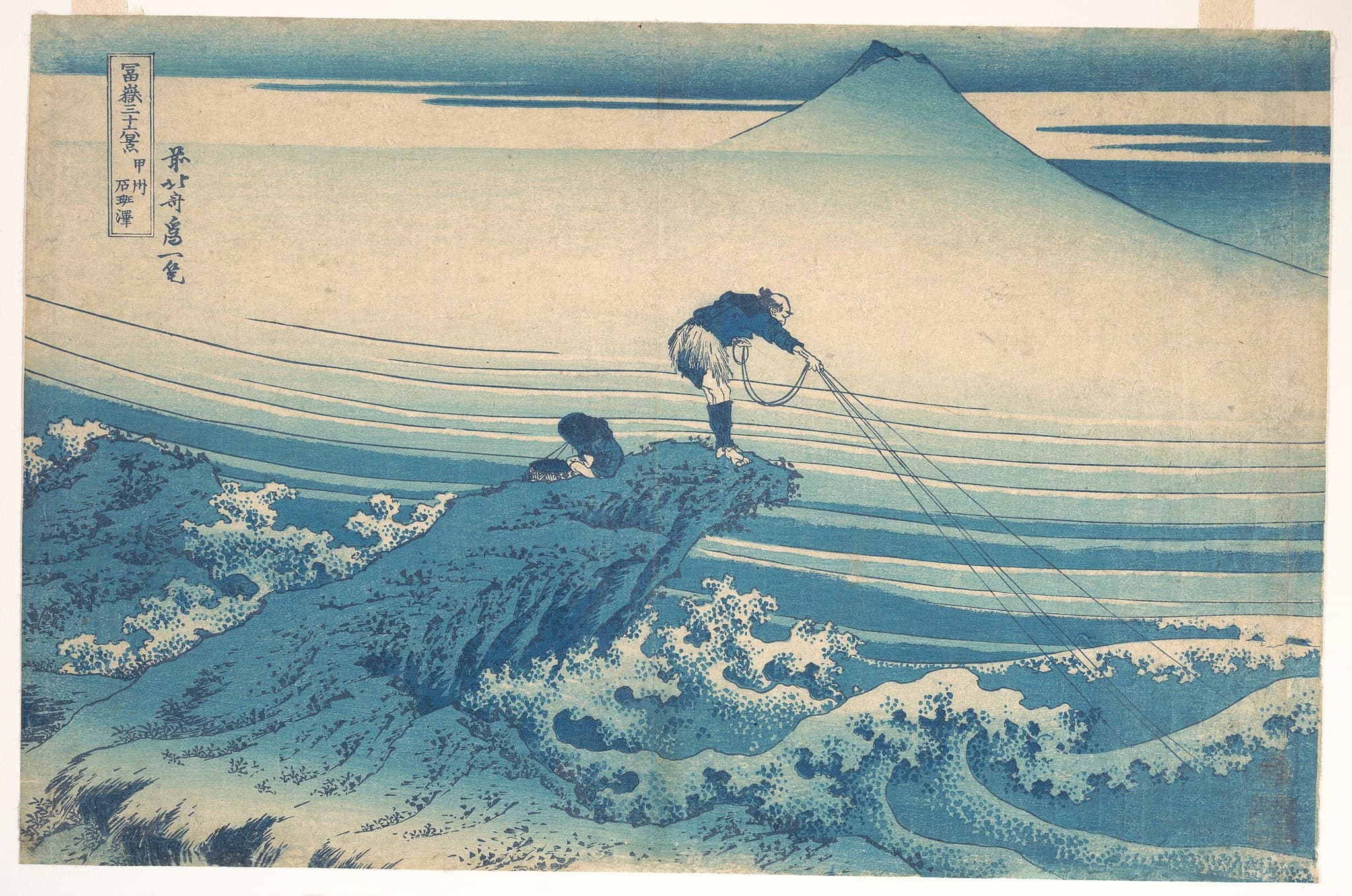
Kajikazawa in Kai Province (The Fisherman at Kajikazawa)
Hokusai • Nishiki-e woodblock print
View more by Hokusai →Valuation Analysis
Valuation conclusion: Based on comparative auction results, museum reference impressions, and market patterns for Hokusai’s Thirty‑Six Views, a fair market range for a single original Edo‑period woodblock impression of Kajikazawa is approximately $3,000–$75,000. The low end reflects common later reprints or examples in compromised condition; the high end reflects scarce early/aizuri or first‑state impressions in very fine condition with clear publisher/censor seals and good provenance [1][2][6].
Why the wide range: The decisive variable is the impression/state. Early aizuri (predominantly blue) or first printing impressions with strong color saturation, intact margins, and publisher/censor seals are scarce and attract collectors and institutions; these command multiples of what a later 19th‑century reprint would fetch. Major public collections hold reference impressions that illustrate visible differences between early and later states, and curatorial records show why museums prefer early prints for acquisition [3][4].
Condition and technical issues: Condition drives realized price. Bright Prussian blue, minimal rubbing, original untrimmed margins, and the absence of foxing, tapes, or repairs materially increase buyer confidence. Conversely, staining, mounted backs with adhesive removal, edge tears or extensive inpainting reduce auction interest and price—often moving a lot from the mid‑four figures to the lower end of the market. Auction evidence demonstrates this dispersion: Christie’s realized a stronger example in the mid five‑figures range in past sales while regional results (and later states) have realized in the low thousands or under [1][2]. Reproductions and modern giclées sell for negligible amounts and should be excluded from market comparisons [5].
Market context and upside: Hokusai is a blue‑chip ukiyo‑e name—top examples (notably The Great Wave or museum‑quality sets) reach trophy prices and drive attention back to the series, which helps demand for good Kajikazawa impressions. That said, Kajikazawa has not historically operated at the same trophy level as Hokusai’s very top plates; its upside is therefore real but bounded by rarity of exceptional impressions and collector willingness to pay a premium [6].
Practical next steps to refine value: provide high‑resolution recto/verso photographs (full sheet + closeups of seals/signature), a short conservator condition report, and any provenance/exhibition labels on the verso. With those I can identify likely state (first/early vs later) and narrow the estimate to a single‑band expectation and advise on the optimal sale venue (specialist Asian art sale vs regional sale) and reserve strategy.
Key Valuation Factors
Art Historical Significance
High ImpactKajikazawa is part of Hokusai’s seminal Thirty‑Six Views of Mount Fuji, one of the most important series in the Edo ukiyo‑e canon. While not as culturally iconic as The Great Wave or Red Fuji, Kajikazawa is a recognized composition within the cycle and has steady collector interest. Its inclusion in the series gives it enduring scholarly and market relevance: museums and specialist collectors seek representative, high‑quality impressions to illustrate the series’ range and Hokusai’s technique. That provenance of importance underpins intrinsic demand and provides a platform for higher valuations when other technical and provenance conditions are met.
Impression / State (aizuri / first vs later)
High ImpactImpression state is the single most significant price driver. Early aizuri or first‑state impressions (with original strong Prussian/indigo printing and characteristic gradations) are comparatively scarce and command substantial premiums. Later 19th‑century reprints or post‑Edo editions are more common and typically sell for a fraction of early impressions. Presence or absence of publisher/censor seals and the crispness of carving/printing identify state; collectors and institutions prize impressions with intact seals and clear technical evidence of early printing, making state the principal determinant of marketplace tiering.
Condition & Restoration
High ImpactCondition—color freshness, paper integrity, presence of foxing, stains, repairs, and the degree of margin trimming—is decisive. Even a correct early state will be discounted heavily if there is extensive foxing, adhesive damage, or inpainting. Conversely, a later‑state print in exceptionally good, unrestored condition with generous margins can outperform a trimmed early impression. Because condition is relatively straightforward to document for bidders, it has immediate pricing impact and influences whether an item is offered in a specialist sale or a general/regional sale.
Provenance & Exhibition History
Medium ImpactClear provenance—especially museum, institutional, or notable private ownership—and documented exhibition history materially improve buyer confidence and price. A well‑documented history can elevate a strong impression into the upper bands of the estimate by reducing perceived risk and making the piece more attractive to institutions. Absence of provenance does not preclude a good sale but increases reliance on technical and condition evidence. Labels, prior cataloguing entries, and conservation records are all additive value factors.
Market Demand & Rarity
Medium ImpactDemand for Hokusai is robust, but it bifurcates strongly by quality: trophy examples (e.g., The Great Wave early impressions or complete sets) achieve outsized results, while more common plates trade at lower, steady levels. Kajikazawa is not ultra‑rare, but high‑quality early impressions are uncommon in the market, creating occasional competitive bidding and price jumps. Regional buyer pools (Asia, Europe, North America) and the timing of institutional sales/dispersals can temporarily lift realized prices.
Sale History
Christie's, New York
Heritage Auctions (Fine & Decorative Asian Art)
LiveAuctionWorld / Seized Assets Auctioneers
Hokusai's Market
Katsushika Hokusai is among the most sought‑after ukiyo‑e artists in the global market. His best single prints and paintings can reach six or seven figures when early‑state, museum‑quality impressions are offered; more typical single‑print results range widely depending on state and condition. Institutional interest, large dispersals, and high‑profile exhibitions sustain top‑end demand, while the broader market supports steady secondary‑market activity for later impressions and reproductions. Overall, Hokusai is a blue‑chip name with strong stratification between trophy and common works.
Comparable Sales
Koshu (Kōshū) Kajikazawa (Kajikazawa in Kai Province)
Katsushika Hokusai
Direct match — same plate (Kajikazawa). Higher realized price indicates premium for a stronger impression/provenance in market.
$16K
2015, Christie's, New York
~$21K adjusted
Kajikazawa in Kai Province
Katsushika Hokusai
Direct match — same plate sold at a low–mid market level, illustrating prices for average/lower-condition single impressions.
$3K
2022, Heritage Auctions (Fine & Decorative Asian Art)
~$3K adjusted
Kajikazawa in Kai Province (giclée reproduction)
Katsushika Hokusai (reproduction)
Modern reproduction/giclée — shows the low-end market for non-originals and why careful identification of original state is critical.
$150
2021, LiveAuctionWorld / Seized Assets Auctioneers
~$165 adjusted
The Thirty-Six Views of Mount Fuji (complete set of prints)
Katsushika Hokusai
Same series, complete/rare offering — demonstrates trophy demand for museum-quality/early impressions and sets (upper-market benchmark).
$3.6M
2024, Christie's, New York
~$3.6M adjusted
Under the Wave off Kanagawa (The Great Wave off Kanagawa)
Katsushika Hokusai
High-profile single-plate comparable from the same series; early/exceptional impressions command very large premiums and set the upper bound.
$857K
2024, Christie's, New York
~$874K adjusted
Current Market Trends
Current market dynamics show strengthened top‑end demand for museum‑quality early impressions and for curated group offerings; Asia‑based buyers exert strong influence at the high end. Condition and state remain decisive, producing wide price dispersion. Short‑term supply events (institutional dispersals) and exhibition programming can spike interest, but the underlying bifurcation between trophy and common impressions persists.
Sources
- Christie's — Koshu (Kōshū) Kajikazawa lot (2015)
- Heritage Auctions — Kajikazawa in Kai Province (sold 2022)
- The Metropolitan Museum of Art — Object record for Kajikazawa (reference impression)
- The British Museum — Kajikazawa object record and notes on impressions
- LiveAuctionWorld — Example modern giclée listing (reproduction)
- Christie's press release — Sale of the complete Thirty‑Six Views (context for top‑end demand, 2024)