How Much Is The Dream of the Fisherman's Wife (Tako to ama) Worth?
Last updated: May 1, 2026
Quick Facts
- Last Sale
- $57K (2025, Christie's New York)
- Methodology
- comparable analysis
Final market valuation for Hokusai’s The Dream of the Fisherman’s Wife (Tako to ama) is highly state- and condition-dependent: estimated range $500–$300,000. Typical later impressions and poor-condition leaves sit at the low end; well-preserved early 19th‑century impressions sit mid-range; original 1814, museum-quality sheets with documented provenance can reach the top end of this band.
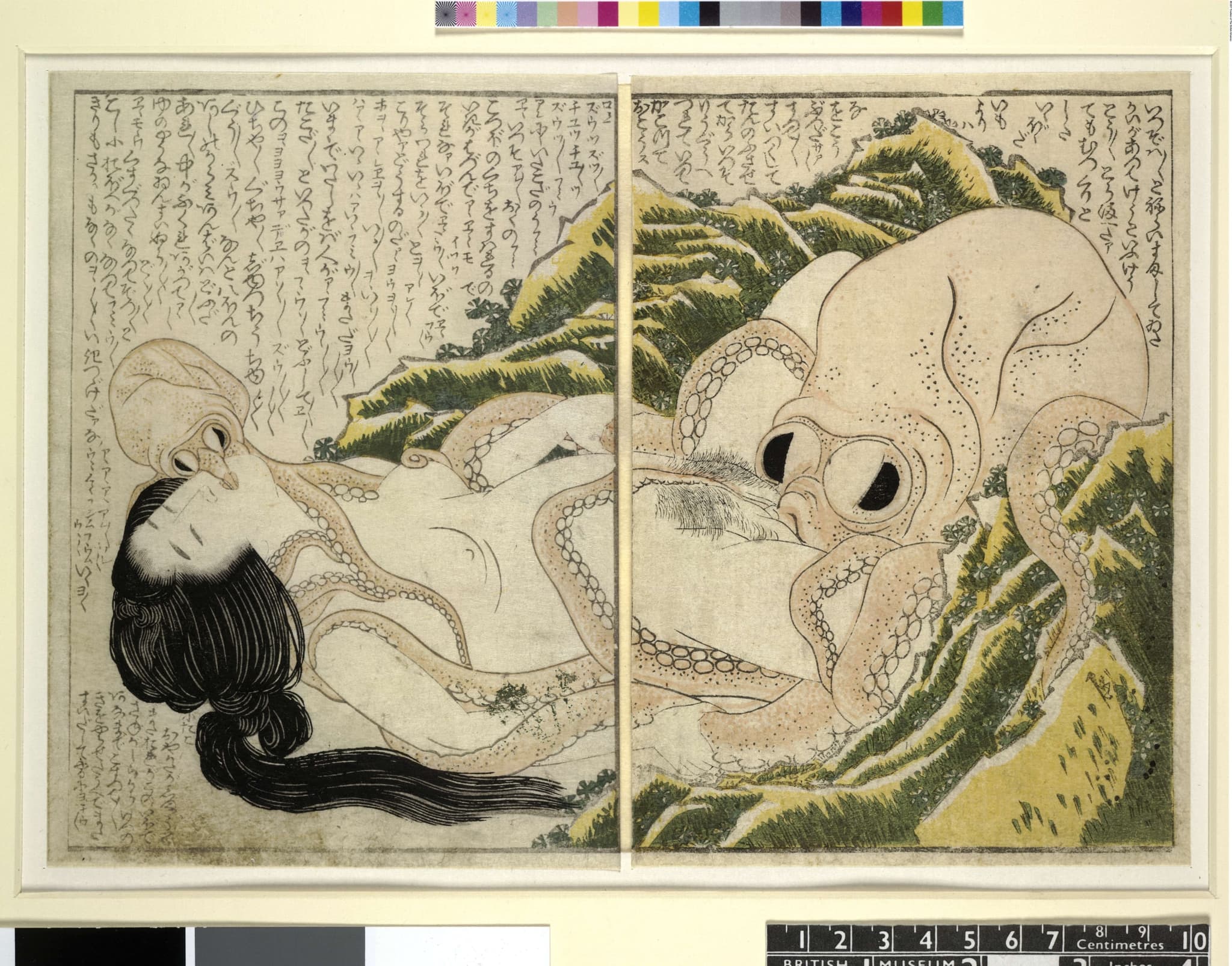
The Dream of the Fisherman's Wife (Tako to ama)
Hokusai, 1814 • Woodblock print (shunga)
View more by Hokusai →Valuation Analysis
Overview and headline conclusion: Based on public auction results, specialist sales, and institutional-holding frequency, a market valuation for Hokusai’s The Dream of the Fisherman’s Wife (Tako to ama) falls broadly between $500 and $300,000 depending squarely on impression/state, condition, and provenance. The most directly relevant recent public benchmark is a Christie's sale of a complete Kinoe no Komatsu set that realized $56,700 in March 2025, which illustrates demand for well-preserved sets and early impressions rather than later reprints [1].
Why the broad range: This image was issued as a woodblock plate within the three-volume Kinoe no Komatsu rather than as a single unique painting, so multiple impressions—across different printings and states—survive. Later reprints, hand-colored or trimmed single leaves and heavily restored sheets are relatively common in the market and typically realize low prices (hundreds to a few thousand dollars). By contrast, true early 1814 impressions printed from original blocks with strong key-block strikes, original pigments (notably clear beni reds), wide margins and no backing or repairs are substantially rarer and attract institutional bidders and specialist collectors.
Comparable bands and rationale: On the lower end, single leaves sold in specialist online sales or mixed lots have realized hundreds to low thousands (evidence: specialist sales and auction-archive results). Mid-range examples—good early 19th‑century impressions in sound condition—typically trade in the mid five‑figure band (roughly $15,000–$75,000). At the top end, genuinely original-state 1814 sheets with pristine condition and strong provenance/exhibition history can command $75,000–$300,000 in specialist or private markets; public six‑figure auction realizations for this specific plate are rare, but top Hokusai landscape impressions show the market ceiling for the artist more generally [2].
Practical selling/valuation advice: The single largest determinants are (1) verified printing state (original 1814 versus later impression), (2) condition (foxing, backing, trimming, repairs), and (3) provenance/publication/exhibition history. For sale or insurance, obtain high-resolution imaging, a conservator’s condition report, and research provenance/catalogue citations. For top examples, target specialist Japanese-print auctions or direct museum/private-sale channels: institutions often avoid erotic subject lots in general auctions, so sale route and buyer outreach materially affect realizable price.
Closing note: This valuation is conservative relative to trophy Hokusai landscape records because Tako to ama is a widely held book plate with many surviving impressions; however, documented, early-state, museum-quality impressions remain highly collectible and can command substantial premiums within the specialist market. For a sheet-specific valuation I recommend submitting high-res images, full measurements, and provenance documentation so I can refine the estimate to a narrower band.
Key Valuation Factors
Art Historical Significance
High ImpactKatsushika Hokusai’s Dream of the Fisherman’s Wife is one of the most culturally resonant Edo-period shunga images and a frequently cited work in scholarship on Japanese erotic prints. Its visual inventiveness and strong public recognition enhance institutional interest: museums and specialist collectors prize early, well-documented impressions for their art-historical value. Although the market treats it as a specialist shunga object rather than a canonical landscape trophy, its iconic status supports consistent demand among the relatively small but committed cohort of ukiyo-e and shunga buyers, which in turn sustains meaningful premiums for the best examples.
Rarity & State
High ImpactThe principal scarcity variable is printing state: true c.1814 impressions from the original blocks with original pigments and wide margins are uncommon compared with later reprints or hand-colored copies. Plates issued within books (Kinoe no Komatsu) survive in multiple states and formats; intact, unrestored single sheets that demonstrably derive from the earliest block impressions are much rarer. Consequently, identification and documentation of state (block wear patterns, pigment types, censor/publisher marks) are the most decisive categorical value determinants.
Condition & Conservation
High ImpactCondition is the dominant determinant of market value for Japanese woodblocks. Attractive market-grade sheets exhibit minimal foxing, no invasive backing or heavy restoration, original pigments with good saturation, and full margins. Many surviving Kinoe no Komatsu leaves are trimmed, backed, or show worming and foxing—each condition issue can reduce value substantially. Professional, reversible conservation can improve marketability, but heavy restoration or loss of original surface and margins materially depresses auction and private-sale expectations.
Provenance & Exhibition/Publication History
High ImpactDocumented provenance and inclusion in major exhibitions or catalogues raisonnés materially increase buyer confidence and price realization. Sheets with museum or notable private-collection provenance and with publication/exhibition citations attract institutional interest and competitive private bidding. In contrast, undocumented or poorly documented examples face higher buyer risk and typically sell in the lower bands of the market. Provenance can be the difference between a plate selling as a modest specialist lot and one entered as a museum-quality example.
Sale History
Christie's New York
Bonhams New York
Bonhams London
Artelino (specialist online sale)
Sotheby's Hong Kong
Hokusai's Market
Katsushika Hokusai occupies a top-tier place within ukiyo-e markets: early, museum-quality impressions, especially of the Thirty-Six Views and certain Great Wave impressions, have set headline records. The market is bifurcated—while top landscape and drawing holdings fetch six- to seven-figure sums, single-sheet shunga and book plates form a specialist submarket with generally lower realized prices. Nevertheless, Hokusai’s strong scholarly profile and frequent institutional interest underpin robust demand for the best-preserved, well-documented impressions.
Comparable Sales
Kinoe no Komatsu (three-volume set; includes Tako to ama plate)
Katsushika Hokusai
Complete Kinoe no Komatsu set that contains the Tako to ama plate — same publication/artist and the best public-market comparable for this plate when offered as part of a well-preserved book.
$57K
2025, Christie's New York
Kinoe no Komatsu (three-volume set)
Katsushika Hokusai
Earlier/comparatively low-result complete set of the same three-volume work — useful to show the lower end for sets (likely later impression or lesser condition) and price dispersion over venues/condition.
$6K
2010, Bonhams New York
~$9K adjusted
Plate from Kinoe no Komatsu (mixed lot)
Katsushika Hokusai
Individual plate from the same book sold in a mixed lot — directly comparable to single-sheet market for Tako to ama, especially later impressions or leaves sold outside top-tier events.
$2K
2017, Bonhams London
~$3K adjusted
Single plate (reported as from Kinoe no Komatsu)
Katsushika Hokusai
Small specialist/online sale of a single leaf — illustrates the low end for later impressions or poor-condition single sheets.
$700
2013, Artelino (specialist/online sale)
~$950 adjusted
Under the Wave off Kanagawa (The Great Wave) — early impression
Katsushika Hokusai
High‑profile, museum‑grade Hokusai impression that set a top‑end market benchmark for the artist; not the same subject (landscape vs. shunga) but important for showing the ceiling for exceptional early Hokusai impressions.
$2.8M
2025, Sotheby's Hong Kong
Current Market Trends
Recent market dynamics (2023–2025) show stronger top-end demand for exemplary ukiyo-e impressions, driven by major institutional purchases, high-profile dispersals, and resurgent Asian collector participation. Competition for museum-quality, early-state Hokusai sheets has lifted headline prices, but pricing remains highly selective: marginal differences in printing state, pigments, margins and provenance cause wide dispersion. For Tako to ama, steady specialist demand exists but public auction realizations are usually modest compared with landmark landscapes; truly exceptional shunga impressions with documented provenance and pristine condition are rare and fetch the highest premiums, often in private sales.