Mount Fuji in the Distance in The Great Wave off Kanagawa
A closer look at this element in Hokusai's ca. 1830–32 masterpiece
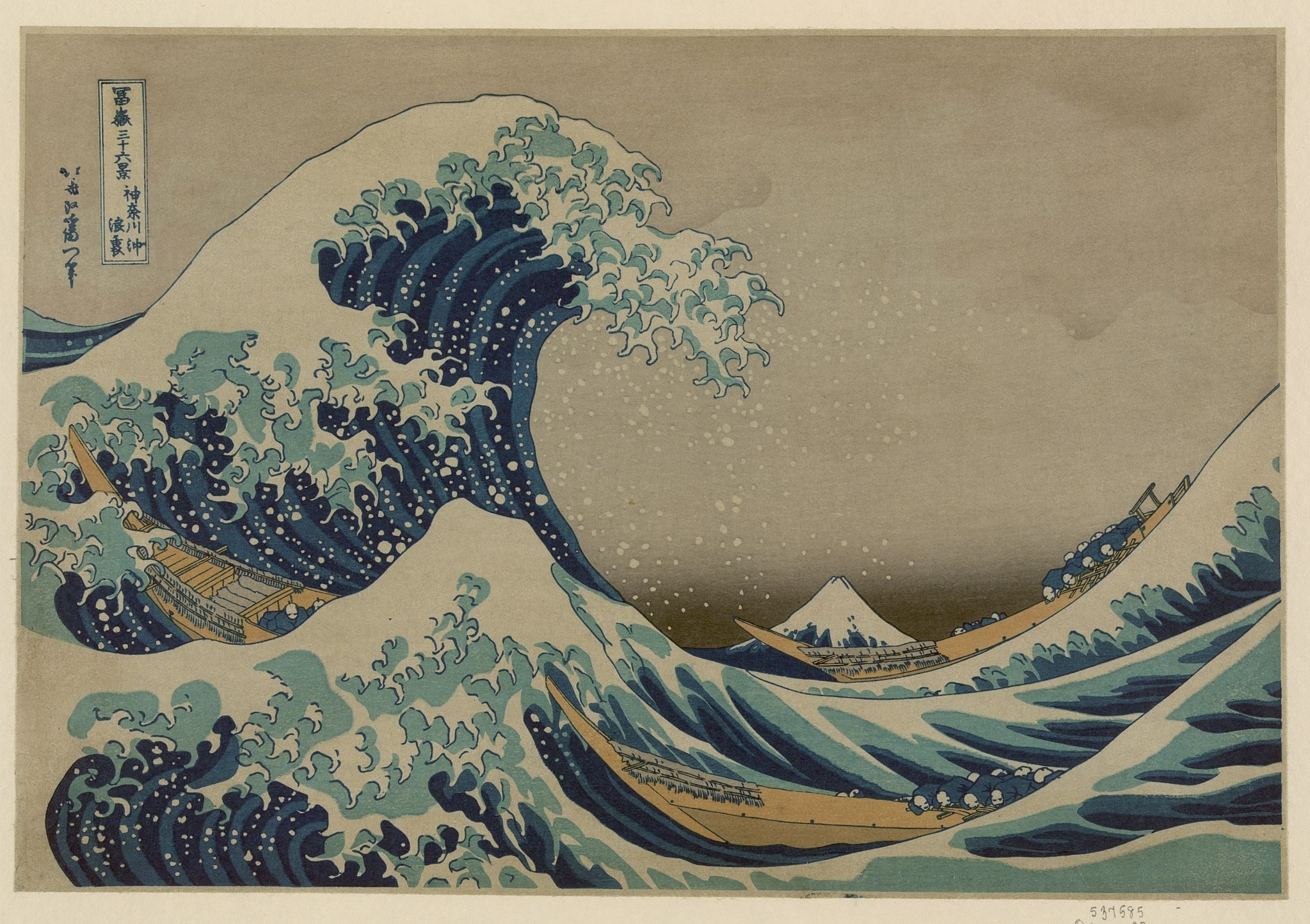
In The Great Wave off Kanagawa, Hokusai tucks a tiny, snow-capped Mount Fuji into the hollow of the wave’s crest. This distant triangle is the still, sacred anchor of a series devoted to the mountain, a calm counterpoint to the sea’s violence and the fishermen’s peril.
Historical Context
Under the Wave off Kanagawa was published around 1830–32 as part of Hokusai’s Thirty-six Views of Mount Fuji, a project that promised to show Japan’s revered peak from many places and conditions. In this offshore view, Fuji necessarily appears, even if reduced to a distant cone at the horizon. Hokusai places it minutely yet deliberately within the curling maw of the great breaker, a compositional conceit noted in museum records that emphasizes both presence and vulnerability 1.
Across the series Fuji acts as the constant protagonist—sometimes monumental, sometimes glimpsed—so that each sheet is ultimately a “view” of the mountain first and of its setting second. The Art Institute underscores this premise, describing Fuji as the work’s continuing subject even when scaled down and far away, as here from Kanagawa’s coastal waters 2. The timing aligns with late Edo-period fascination with Fuji, when urban audiences avidly bought color woodblock prints and Fuji-themed imagery, ensuring that the mountain’s inclusion satisfied both the series’ concept and the public’s devotional and pictorial appetite 12.
Symbolic Meaning
Mount Fuji carries layered significance that Hokusai activates with its small, crystalline presence. In Shintō-Buddhist practice, Fuji is a sacred dwelling of kami and a site of pilgrimage and purification. Edo-period confraternities (Fuji-kō) popularized its veneration, so the mountain readily signified purity, endurance, and auspiciousness to contemporary viewers 3. By rendering Fuji steady and snow-bright behind the tumult, Hokusai stages a visual dialectic: the wave embodies transience and human risk, while Fuji suggests constancy and spiritual refuge. Museums often read the mountain as an emblem of longevity and stability; even when it looks momentarily fragile in the wave’s “hollow,” that frailty heightens the image’s tension between permanence and impermanence 4.
Fuji’s meaning, however, is not fixed. As Christine Guth argues, The Great Wave has accrued mobile, transcultural associations—from national icon to the sublime energies of nature and modernity’s circulation of images. Within this shifting field, Fuji operates both as a local sacred sign and as a globally legible landmark anchoring the composition’s drama 5. The tiny triangle thus becomes more than background: it is the picture’s spiritual axis, a talismanic point around which the boats, breakers, and our readings of danger and endurance revolve 145.
Artistic Technique
Hokusai reduces Fuji to a small, crisp isosceles silhouette, centered and exactly framed by the curling, clawed crest. This precise placement creates a near/far snap that locks the viewer’s eye on the mountain amid turmoil 17. The print’s celebrated Prussian blue palette—often layered through double printing—deepens the sea’s tonal range, while Fuji’s snowcap catches pale light, separating it from the darker, misted surround 6. British Museum research notes that greenish passages result from adding yellow orpiment to Prussian blue, tying Fuji’s cool whites and blues into the work’s innovative color chemistry 8. Hokusai also blends European linear perspective with ukiyo-e conventions, so the distant peak reads as sharply small and far away, intensifying the clash between monumental wave and miniature mountain 67.
Connection to the Whole
Although visually dwarfed, Fuji is the print’s conceptual subject: the series promises a “view” of the mountain, and the composition obliges by cradling it at the exact center-back, the still point around which everything surges 12. The fishermen’s skiffs and the clawing breaker gain scale and urgency only because Fuji fixes the horizon and time of day, likely early morning, when its snowcap catches first light 6. By tucking the sacred peak within the wave’s hollow, Hokusai sharpens a core theme of the series—humans and nature measured against a durable, spiritual landscape—leaving viewers to weigh whether permanence holds or teeters on the brink. The print’s enduring power hinges on that tiny triangle: a quiet anchor inside a global icon of motion 126.
Explore More from This Painting
This detail is one part of The Great Wave off Kanagawa. Use the links below to return to the full interpretation, browse the full set of details, or view the painting's valuation if available.
Sources
- The Metropolitan Museum of Art, object record: Under the Wave off Kanagawa
- Art Institute of Chicago, object record: The Great Wave (AIC 77333)
- UNESCO World Heritage Centre: Fujisan, sacred place and source of artistic inspiration
- Museum of Fine Arts, Boston: Under the Wave off Kanagawa (The Great Wave) essay
- Christine Guth, The Multi-centered Modernities of Hokusai’s 'Under the Wave off Kanagawa', Transcultural Studies (2012)
- The Met, Conservation: The Great Wave—Anatomy of an Icon
- British Museum, object record: Kanagawa-oki nami-ura
- British Museum blog: Not fade away—preventive conservation on Hokusai prints