The Fishing Boats in The Great Wave off Kanagawa
A closer look at this element in Hokusai's ca. 1830–32 masterpiece
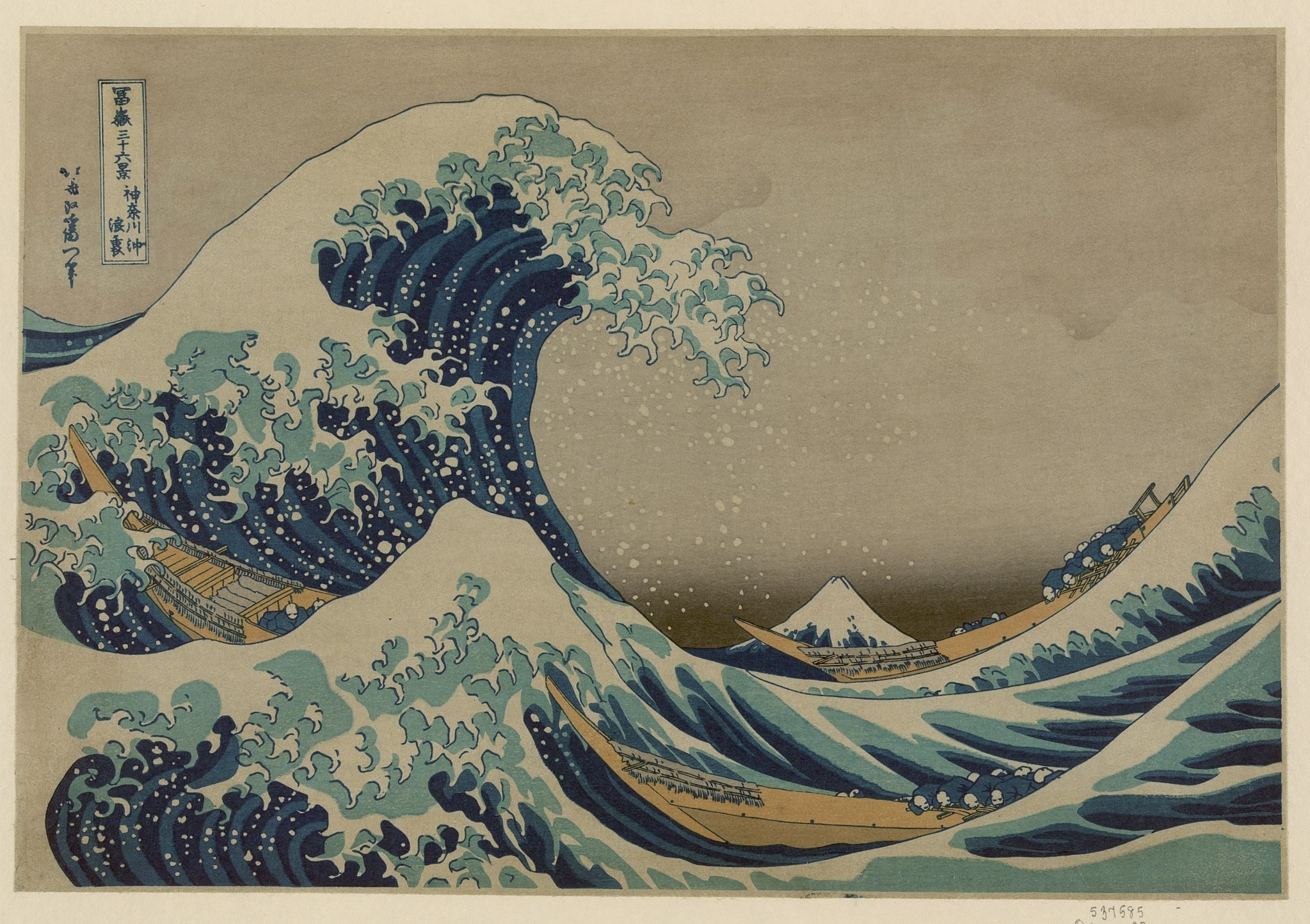
Hokusai’s three oshiokuri‑bune slice across the swells like tan needles stitching commerce through a storm. These fast fish‑carriers—crewed by crouching scullers—turn the Great Wave into a scene of urgent work, setting human resolve against the sea and Fuji’s calm distance.
Historical Context
Created around 1830–32 for Thirty‑Six Views of Mount Fuji, Hokusai’s Under the Wave off Kanagawa anchors the sacred peak within the lived world of Edo. The Metropolitan Museum describes the vessels in the foreground as “three fishing boats,” a working flotilla rather than pleasure craft 1. Curators at the British Museum identify them more precisely as oshiokuri‑bune—long, narrow runners licensed to rush fresh catches such as bonito and tuna from coastal waters to the city’s markets. Their crews hunch forward in tight ranks as the wave rears, a description that matches the print’s visible posture of concentrated labor 2.
In the early nineteenth century, Edo depended on rapid maritime supply lines; oshiokuri‑bune were the fleet‑footed links binding offshore fishing grounds to urban distribution. By threading three of these carriers through successive troughs, Hokusai situates Fuji within contemporary coastal industry and the bustling circulation of goods. The resulting image is not a fantasy seascape but a time‑stamped glimpse of everyday transport under duress—fleets sprinting toward or away from the markets even as weather turns volatile 12.
Symbolic Meaning
The oshiokuri‑bune crystallize a central theme of the series: human industry set against nature’s vastness. Museum texts repeatedly read the print as a drama of “man versus nature,” with laborers compacted into fragile hulls while the ocean towers above them 5. The boats embody collective effort—synchronized bodies powering a civic lifeline—yet they are also precarious, swept into the same rhythm as the storm. That tension sharpens the contrast with Fuji’s stillness beyond, a mountain that functions as an axis of permanence in the composition 15.
British Museum commentary observes how the spray falls like snow on Fuji’s cone, a delicate echo that turns violent motion into momentary ornament—an eloquent image of transience against endurance often linked to Buddhist impermanence and Shinto reverence for natural forms 2. At the same time, the craft signify Edo’s economic metabolism: swift carriers driving perishables to Nihonbashi and other urban markets, an interpretation reinforced by Japanese museum entries that broaden their cargo to perishable goods beyond fish 6. Within the wider tradition of ukiyo‑e landscapes, these boats assert a worldly, contemporary register, fusing sacred landscape with the pulse of daily commerce 8.
Artistic Technique
Hokusai chains three low‑freeboard hulls diagonally across successive swells, a compositional “metronome” that times the sea and guides the eye from foreground peril to distant Fuji 3. Their warm tan blocks and crisp keylines cut sharply against the print’s animated blues, a deliberate chromatic counterpoint.
Early impressions layer imported Prussian blue with indigo; British Museum technical notes describe the blue palette and careful overprinting that gives depth and motion to the water 7. Maritime specifics—closely spaced thwarts and the crouched sculling teams—reflect contemporary oshiokuri practice; scholars identify crews of eight active scullers with two relief men per boat, details that lend documentary bite to the scene 4.
Connection to the Whole
The boats supply the print’s human scale and stakes. Their narrow beams and packed crews let viewers gauge the wave’s magnitude, dramatizing the moment when working lives and cargo are nearly swallowed—a tension the Met calls out in its description of the “helpless boats” before the crest 1.
By stretching three craft across three troughs, Hokusai converts the ocean from empty sublime to a trafficked surface that carries labor, goods, and risk—perfectly aligning with the series’ fusion of sacred Fuji and everyday activity 38. Pressed between water’s volatility and the mountain’s permanence, the oshiokuri‑bune become the hinge of meaning: they render the scene both documentary and philosophical, a record of Edo’s commerce and a meditation on endurance under pressure 21.
Explore More from This Painting
This detail is one part of The Great Wave off Kanagawa. Use the links below to return to the full interpretation, browse the full set of details, or view the painting's valuation if available.
Sources
- The Metropolitan Museum of Art, object entry for Under the Wave off Kanagawa (JP2972)
- British Museum, object entries and curatorial notes on oshiokuri‑bune and crews
- National Gallery of Victoria, collection entry noting boat action and composition
- Cartwright & Nakamura, “What kind of a wave is Hokusai’s Great wave off Kanagawa?” Notes and Records of the Royal Society (2009)
- Chazen Museum of Art, interpretive text on man versus nature in The Great Wave
- Tokyo Fuji Art Museum, collection entry linking boats to Edo market logistics
- British Museum blog, conservation and pigment notes on Hokusai prints (Prussian blue, printing)
- Thirty‑Six Views of Mount Fuji overview