The Wave's Claws in The Great Wave off Kanagawa
A closer look at this element in Hokusai's ca. 1830–32 masterpiece
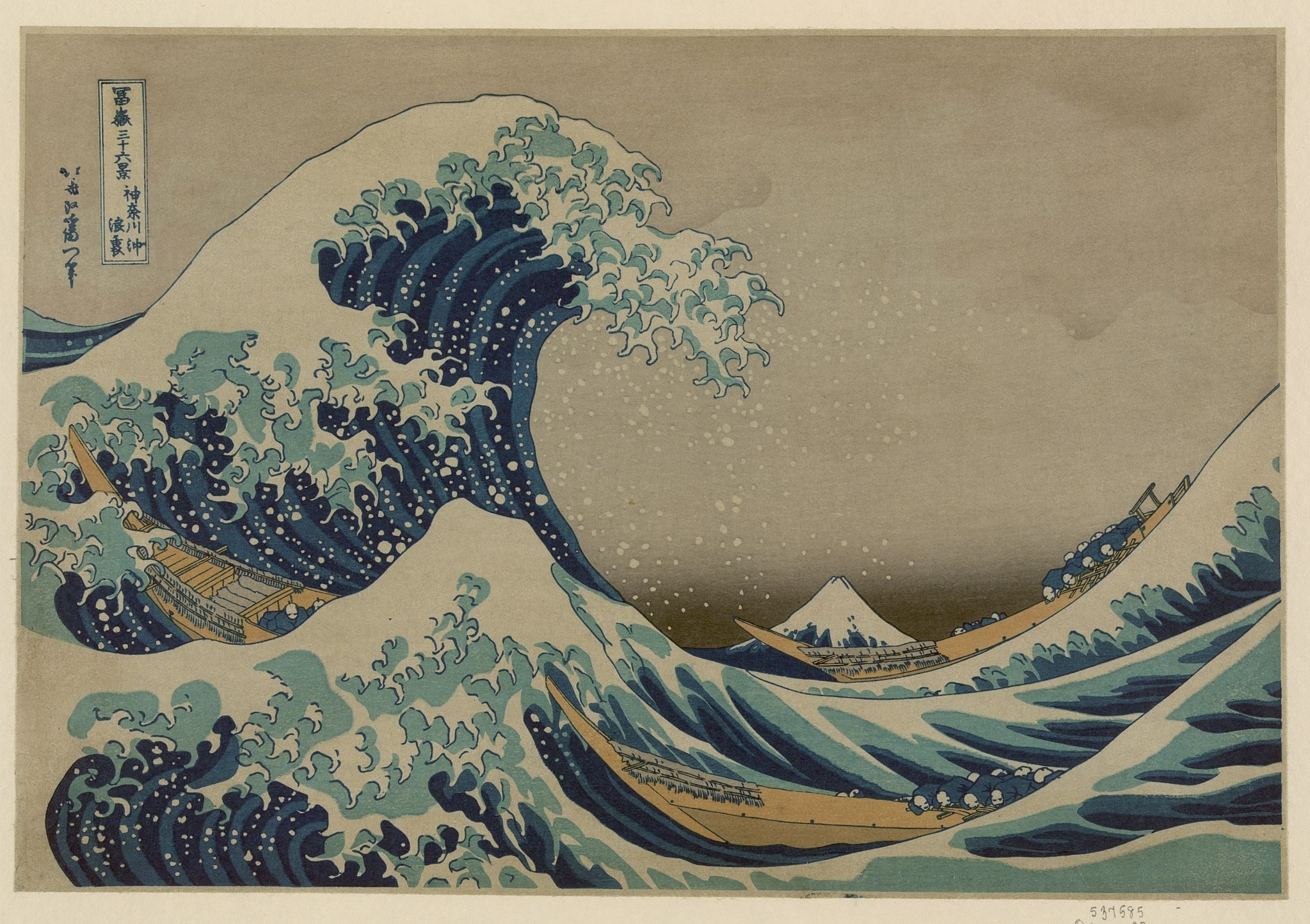
Hokusai’s “claws” — the finger‑like foam at the crest — turn the Great Wave into a living predator, curling over boats and even Mount Fuji. This sharpened silhouette fuses drama, myth, and cutting‑edge print craft, making the moment before impact both terrifying and mesmerizing.
Historical Context
Under the Wave off Kanagawa inaugurates Hokusai’s celebrated Thirty‑six Views of Mount Fuji (ca. 1830–32), a series that views Japan’s sacred peak from varied vantage points. Here, fishermen in fast oshiokuri‑bune confront a towering breaker while Fuji sits small yet unwavering on the horizon — a framing that made the mountain’s constancy legible to Edo viewers amid daily labor and risk 2.
The crest’s talon‑like foam is no incidental flourish. Curators at The Met explicitly describe the wave’s “clawlike” structure and note how Hokusai positions Fuji within the hollow directly beneath the angry crest, intensifying the sense that the sea reaches out to seize both men and mountain 1. In this first design of the Fuji series, the ferocity of the crest announces the project’s ambitions: to pair contemporary subjects and viewpoints with a psychologically charged nature that seems to act upon human lives. The result is a gripping, immediately readable scene that set the tone for the entire series 12.
Symbolic Meaning
The crest reads as a personification of the sea: a sentient, predatory force whose foam‑tendrils act like grasping talons. The Met ties these “clawlike” forms to dragons and other dangerous beasts, aligning the wave with supernatural potency familiar in East Asian visual culture 1. Contemporary viewers sensed this immediacy; Vincent van Gogh famously wrote that “these waves are claws” clutching the boats, confirming a visceral nineteenth‑century reception of the crest as grasping fingers 5.
At a broader level, the “claws” stage a meditation on impermanence. The split‑second reach of the foam — just before collapse — embodies the Buddhist sense of ceaseless arising and passing, a theme museums emphasize in readings of the print 7. The personified sea also echoes labels that call the wave a “living creature with its own agency,” foregrounding nature’s power over human endeavor 6. Hokusai’s forms build on Japanese precedents in stylized wave crests, especially Rinpa “rough waves,” which already sharpened tips into claw‑like hooks; here, he intensifies that idiom for narrative shock 9. Finally, scientific analyses identifying the crest as a steep plunging breaker support why the lip fractures into finger‑like jets, a physical behavior Hokusai stylizes into talons 8.
Artistic Technique
Hokusai and his printers achieve the “claws” through a dialogue of reserved paper and layered blues. The foam tips are unprinted paper bounded by the key block; within the white foam, printers added a light‑blue pattern. Technical study shows later printings used a different block for this light‑blue, yielding more angular foam shapes — so the claws vary by impression and state 4.
Met conservation analysis details how the wave’s body was double‑printed with indigo mixed with Prussian blue, then over‑printed with pure Prussian blue, creating a dark‑to‑bright gradient that makes the white talons snap forward against the hollow’s depth 3. Together with the curling silhouette, this chromatic modeling turns the crest into a crisp, grasping edge that commands the eye 31.
Connection to the Whole
Compositionally, the clawed crest arcs across the sheet like a closing hand: it encloses the three boats and curls over Mount Fuji, which Hokusai has placed neatly inside the wave’s hollow. This arrangement makes the sea’s agency feel literal — the ocean appears to seize both men and mountain — while Fuji’s tiny, triangular steadiness measures human fragility against larger forces 1.
Because the crest marks the instant before a plunging breaker falls, it freezes the print at maximum suspense. That suspended violence clarifies the series’ central dialectic: transient, animated water versus enduring, sacred mountain — a contrast that anchors the Thirty‑six Views and explains the image’s universal charge 12.
Explore More from This Painting
This detail is one part of The Great Wave off Kanagawa. Use the links below to return to the full interpretation, browse the full set of details, or view the painting's valuation if available.
Sources
- The Met, object page (JP2972): crest described as "clawlike"; Fuji framed in the hollow
- The Met, object page (JP1847): Thirty‑six Views of Mount Fuji, dating and series context
- The Met conservation/science essay: Prussian blue, double printing, tonal modeling
- British Museum technical paper (Korenberg): light‑blue pattern in foam; re‑carved blocks changing foam shapes
- Van Gogh, Letter 676 (8 Sept 1888): “these waves are claws ... the boat is caught in them”
- Hood Museum label: wave as a living creature with its own agency
- MFA Boston essay: Buddhist/impermanence readings of The Great Wave
- Cartwright & Nakamura, Notes & Records (Royal Society): the wave as a steep plunging breaker
- Smithsonian, Legacy of Waves: Rinpa "rough waves" precedents with claw‑like crests